Content Strategy
Lead Generation Content for Loan Officers: Earn Visibility So Borrowers Reach Out First
Loan officer lead generation content works when it builds the reputation that makes borrowers choose you before the first call. A 30-day scan of mortgage social content found the dominant theme among high-performing loan officers is trust-building and education — not promotional offers. When someone searches your name and finds helpful, specific content, they already trust you before the conversation starts.
Why "more leads" is the wrong goal for content
The mortgage industry has a complicated relationship with the word "leads." Loan officers who approach social media as a lead funnel — posting rate teasers, hard CTAs, and promotional offers — typically see the weakest results. The successful pattern, validated across a 30-day scan of loan-officer social content, is using content to build reputation infrastructure: showing up consistently with education and context so that when a prospective borrower finally decides to move forward, your name is already at the top of their mental list. Content doesn't generate leads in the transactional sense — it generates relationships that convert at a far higher rate than cold-generated names on a list.
The content formats that attract serious borrowers
Borrowers who are actively thinking about buying or refinancing respond to content that treats them as capable adults navigating a complex process. First-time-buyer explainers earn saves and shares from people in active research mode. Market-context posts attract people who want to make an informed decision. Lead-magnet content — a downloadable first-time-buyer guide, a closing-cost worksheet, a rent-vs-own calculator — is the highest-converting format because it asks for a name and email in exchange for something genuinely useful. The comment-trigger format produces the same exchange inside a platform's native flow. All of these earn attention because they are useful first and promotional second.
- First-time-buyer explainers: answer the questions borrowers are already searching
- Market-context posts: frame rate and market news without making predictions
- Lead-magnet downloads: guides, worksheets, and checklists that justify a name and email
- Comment-trigger posts: platform-native lead capture that feels like a conversation
- FAQ content: answer the question borrowers are afraid to ask their agent
The realtor-referral alternative: owning your own channel
Industry reporting shows the average real estate agent now works with more than 17 different loan officers. The realtor-referral channel is structurally crowded — and most loan officers who rely on it exclusively describe the dependence as a private frustration. Content-based visibility is the honest alternative: building an audience of prospective borrowers directly, so your pipeline doesn't depend entirely on who an agent happened to recommend this week. A loan officer who posts consistently to a few hundred engaged followers has a secondary channel that compounds over time. The emotional appeal is autonomy: if you could generate your own visibility, you wouldn't need to wait in anyone else's pipeline.
Compliance lines that protect lead-generation content
Lead-generation content carries specific compliance risks because it is often written with urgency and persuasion. The most common violations are phrases that sound helpful but imply a personal recommendation: "it's a great time to buy," "you'd be wise to refinance now," "rates are only going up." These have created real enforcement actions. The safer pattern: instead of "now is a great time to act," write "here's how to think about timing for your specific situation." Lead magnets should include appropriate NMLS disclosures; CompliPost's federal-baseline review aid flags missing disclosure patterns before export.
- Avoid: "it's a great time to buy / refinance" — this is unauthorized advice
- Avoid: "rates are going up, act now" — urgency framing is a UDAAP risk
- Avoid: "delete after reading" or "don't quote me on this" — documented violations
- Use: context, not prediction ("here's what I watch before advising anyone")
- Use: NMLS disclosure on lead magnets and any rate-adjacent content
Building a lead-generation content system with CompliPost
The blank-calendar problem is the most-named content pain among loan officers. CompliPost addresses it directly — generating branded social copy, educational carousels, lead-magnet outlines, and caption packs that a loan officer can review, adjust, export, and post from their own platforms. Every piece of generated content goes through a federal-baseline compliance review aid that surfaces unauthorized-advice language, NMLS disclosure gaps, and Fair Housing signals before export. That review is a starting check, not a legal guarantee; your compliance team owns the final call.
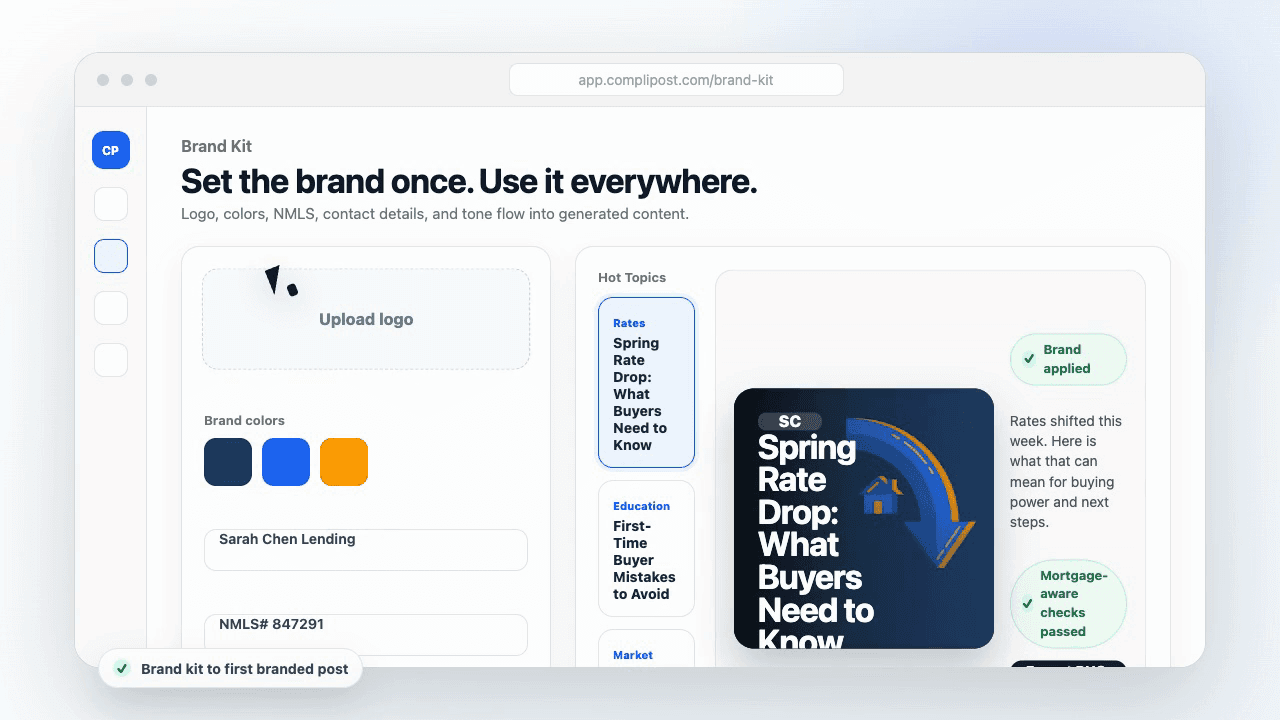
Product workflow
From blank page to export-ready mortgage content
- Start with a borrower topic
- Generate copy and a visual direction
- Review, save, and export the finished asset
These previews reflect the core CompliPost workflow: create, review, save, and export assets for use in your own channels.
Workflow comparison
| Content approach | What happens | Why it matters |
|---|---|---|
| Random posting | One-off ideas created when there is spare time | Inconsistent visibility and weak reuse |
| Template-only posting | Faster design but still requires rewriting and review | Helpful starting point, but not a full system |
| CompliPost workflow | Plan, generate, review, save, and export from one place | Better consistency with mortgage-aware review context |
| Done-for-you service | Someone else creates much of the content | Useful for some teams, but less control and less immediate reuse |
Who this guide helps
This guide is for loan officers working on solo loan officers who need a repeatable mortgage content workflow. The goal is to turn a broad mortgage topic into one borrower question, one useful takeaway, and one asset that can be reviewed before it is shared.
- You need content that sounds like a loan officer, not a generic brand account
- You want examples that can become captions, graphics, GIFs, or PDFs
- You need a clear place to review claims before export
- You want finished work saved for reuse, not lost in a chat thread
A practical workflow for this use case
Start with a narrow scenario, then move through planning, drafting, visual creation, review, and export. For loan officer lead generation content, that means the topic should be specific enough that a borrower or referral partner can immediately understand what decision the content helps with.
- Choose the borrower type, loan topic, or platform before generating copy
- Draft the caption and visual together so the asset feels cohesive
- Use the federal baseline review aid to flag claims and disclosure gaps
- Export the finished asset and save the post as a reusable starting point
What makes the content stronger
Strong mortgage content is usually specific, plain-spoken, and calm. It explains tradeoffs without pretending one answer fits every borrower. That is especially important on public social channels, where a short post can be interpreted without the full context of a loan conversation.
- Name the borrower question in the first line
- Explain one decision or tradeoff instead of covering everything
- Use examples without implying approval, savings, or rate outcomes
- End with a soft next step, checklist, or guide rather than pressure
Compliance-aware review notes
CompliPost should be treated as a review aid, not a compliance approval system. The public page, generated draft, graphic, and exported asset should all stay honest about that boundary.
- Review specific payment, APR, rate, savings, and qualification language
- Avoid “best,” “lowest,” “guaranteed,” “free,” and urgency claims unless approved
- Check NMLS, Equal Housing, company, and state-specific requirements
- Use company or legal review for anything outside the federal baseline
How this connects to the rest of CompliPost
A focused guide should leave you with a usable next step. After you understand the topic, you can turn it into a calendar slot, a reviewed social post, a downloadable guide, or a platform-specific version for the channel where your audience already spends time.
- Use the content calendar to turn the idea into a weekly plan
- Use the compliance page when claims or disclosures need a slower pass
- Use lead magnets when the topic deserves a deeper PDF guide
- Use platform pages to adapt the same idea for LinkedIn, Facebook, or Instagram
Recommended next steps
Mortgage social media content
See the cross-platform content workflow for loan officers.
Loan officer social proof content
Build the credibility layer that makes lead-generation content land.
Loan officer niche marketing
Why content targeting a specific borrower type outperforms generalist marketing for lead generation.
Homebuyer education content strategy
Build a library of borrower-education content that attracts qualified first-time buyers.
Examples
FAQ
Does social media actually generate leads for loan officers?+
Not in the transactional sense — content-based visibility builds reputation, not a lead list. But borrowers who find you through consistent, helpful content convert at far higher rates than cold leads because they already trust you before the first call. The correct frame is reputation infrastructure, not lead funnel.
What type of content works best for loan officer lead generation?+
First-time-buyer explainers, market-context posts that frame rather than predict, downloadable lead magnets (guides, worksheets, checklists), and comment-trigger posts that invite a DM or email. All share one trait: they are genuinely useful to the borrower before they ask for anything in return.
What compliance risks apply to lead-generation content?+
Urgency-framing phrases like "it's a great time to buy," "rates are going up, act now," and "you'd be wise to refinance" are the most common violations — they can be read as unauthorized financial advice. Lead magnets and rate-adjacent content should carry NMLS disclosures. CompliPost's federal-baseline review aid flags this class of phrase before export.
How do I build a content system that generates leads consistently?+
Consistency is the compounding mechanism — posting once a week every week for a year outperforms bursting for two weeks and stopping. A structured 5-day posting schedule gives you a repeatable framework. Tools like CompliPost handle generation and compliance review so the bottleneck is publishing, not creation.
Should I focus on social media or SEO for loan officer lead generation?+
Both compound in different time frames. Social media builds visible reputation quickly and generates direct conversations. SEO builds durable search visibility over 6–18 months. The strongest content strategies produce social posts that also live as searchable web content — which is how a single piece of education reaches borrowers across channels.
Create mortgage content with a calmer workflow
CompliPost helps you plan, generate, review, save, and export useful mortgage content without pretending compliance or social distribution is automatic.
Start free