Content strategy
Build Trust with Homebuyer Education Before the First Call
Loan officers can significantly enhance their client engagement strategy by effectively using homebuyer education content. This type of content involves crafting posts that educate potential buyers on specific aspects of the homebuying process. By doing so, loan officers can establish themselves as valuable resources, building trust with potential clients even before the first conversation takes place. The primary goal is to provide meaningful information that resonates with potential homebuyers, encouraging shares and saves which ultimately increase reach. By focusing on educational content, loan officers position themselves as industry experts, which can lead to higher conversion rates when these informed prospects are ready to engage in a sales conversation.
Applying the 80/20 Content Rule
For loan officers, a successful social media strategy involves a balance of educational content and soft offers. The 80/20 rule suggests that 80% of posts should provide useful information—such as educational pieces, context, or detailed explainers—while the remaining 20% can include subtle calls to action. This approach is not merely a preference but a data-backed strategy that retains audiences. Followers who find value in educational posts are more likely to stay engaged, whereas those who encounter frequent pitches may lose interest. A well-curated audience built on this principle is more likely to convert into clients.
Effective Homebuyer Education Topics
To maximize engagement, loan officers should focus on content that homebuyers find valuable enough to save and share. Topics that perform well include myth corrections, process explainers, decision frameworks, and readiness checklists. These types of posts provide concrete information that potential buyers can act upon or think critically about. For instance, correcting common misconceptions or offering a step-by-step guide to the homebuying process can clarify complex topics, making them more approachable. Decision frameworks help clients weigh their options, while readiness checklists offer practical steps to prepare for homeownership.
- Myth corrections: "Debunking the a defined down-payment option payment myth for first-time buyers"
- Process explainers: "Breaking down the steps from preapproval to closing"
- Decision frameworks: "FHA vs. conventional loans: deciding what's strong for you"
- Readiness checklists: "10 essential steps to take before house hunting"
Addressing the Buyer Journey with Content
An effective content strategy addresses every stage of the homebuying journey, from initial curiosity to the final decision-making process. Content should cater to audiences at each phase: those wondering if buying is feasible, those educating themselves on the process, those making decisions, and those ready to act. By creating a library of content that covers these stages, loan officers can maintain a fresh and relevant presence, attracting potential buyers at various points in their journey. This comprehensive approach ensures that loan officers remain top-of-mind as buyers progress through their decision-making process.
Ensuring Compliance in Educational Content
Educational content, while informative, still requires careful compliance considerations. Loan officers must ensure that posts do not make specific suggestions or imply possible outcomes. For example, when discussing FHA loans, avoid stating specific credit score requirements that could be misconstrued as guarantees. Instead, encourage potential clients to reach out for personalized advice. This approach not only aligns with compliance standards like TILA but also fosters direct engagement. It's essential to provide information that guides without overpromising, maintaining transparency and trust. homebuyer education content loan officer reuse plan: make one caption, one carousel point, one email follow-up, and one saved template. homebuyer education content loan officer then supports social, partner, and nurture workflows.
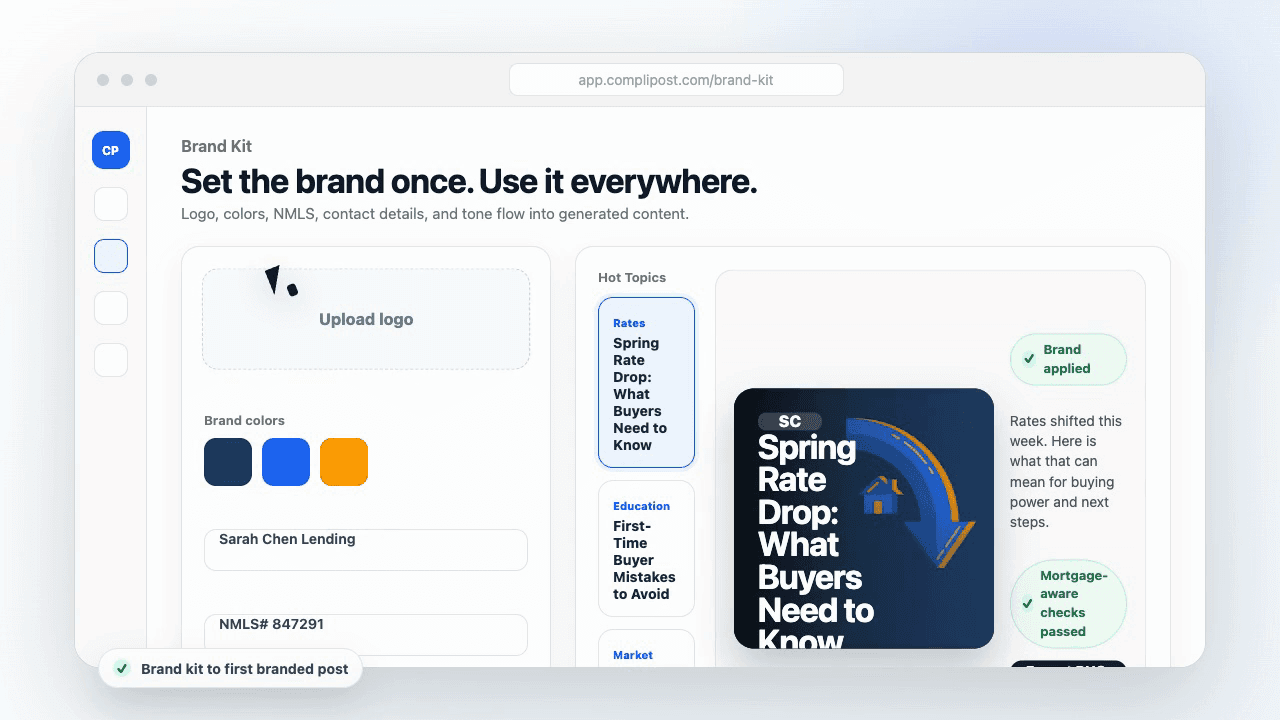
Product workflow
From blank page to export-ready mortgage content
- Start with a borrower topic
- Generate copy and a visual direction
- Review, save, and export the finished asset
These previews reflect the core CompliPost workflow: create, review, save, and export assets for use in your own channels.
Workflow comparison
| Content approach | What happens | Why it matters |
|---|---|---|
| Random posting | One-off ideas created when there is spare time | Inconsistent visibility and weak reuse |
| Template-only posting | Faster design but still requires rewriting and review | Helpful starting point, but not a full system |
| CompliPost workflow | Plan, generate, review, save, and export from one place | Better consistency with mortgage-aware review context |
| Done-for-you service | Someone else creates much of the content | Useful for some teams, but less control and less immediate reuse |
Who this guide helps
This guide is for loan officers working on solo loan officers who need a repeatable mortgage content workflow. The goal is to turn a broad mortgage topic into one borrower question, one useful takeaway, and one asset that can be reviewed before it is shared.
- You need content that sounds like a loan officer, not a generic brand account
- You want examples that can become captions, graphics, GIFs, or PDFs
- You need a clear place to review claims before export
- You want finished work saved for reuse, not lost in a chat thread
A practical workflow for this use case
Start with a narrow scenario, then move through planning, drafting, visual creation, review, and export. For homebuyer education content loan officer, that means the topic should be specific enough that a borrower or referral partner can immediately understand what decision the content helps with.
- Choose the borrower type, loan topic, or platform before generating copy
- Draft the caption and visual together so the asset feels cohesive
- Use the federal baseline review aid to flag claims and disclosure gaps
- Export the finished asset and save the post as a reusable starting point
What makes the content stronger
Strong mortgage content is usually specific, plain-spoken, and calm. It explains tradeoffs without pretending one answer fits every borrower. That is especially important on public social channels, where a short post can be interpreted without the full context of a loan conversation.
- Name the borrower question in the first line
- Explain one decision or tradeoff instead of covering everything
- Use examples without implying approval, savings, or rate outcomes
- End with a soft next step, checklist, or guide rather than pressure
Compliance-aware review notes
CompliPost should be treated as a review aid, not a compliance approval system. The public page, generated draft, graphic, and exported asset should all stay honest about that boundary.
- Review specific payment, APR, rate, savings, and qualification language
- Avoid “best,” “lowest,” “guaranteed,” “free,” and urgency claims unless approved
- Check NMLS, Equal Housing, company, and state-specific requirements
- Use company or legal review for anything outside the federal baseline
How this connects to the rest of CompliPost
A focused guide should leave you with a usable next step. After you understand the topic, you can turn it into a calendar slot, a reviewed social post, a downloadable guide, or a platform-specific version for the channel where your audience already spends time.
- Use the content calendar to turn the idea into a weekly plan
- Use the compliance page when claims or disclosures need a slower pass
- Use lead magnets when the topic deserves a deeper PDF guide
- Use platform pages to adapt the same idea for LinkedIn, Facebook, or Instagram
Recommended next steps
Mortgage social media content
See the cross-platform content workflow for loan officers.
Mortgage content calendar
Plan a weekly rhythm of useful borrower and referral-partner posts.
Client education mortgage posts
Specific education post formats for existing and prospective clients.
Post idea generator
Generate borrower-friendly social post angles from one topic.
Examples
FAQ
What homebuyer education topics perform strong on social media?+
Topics like myth corrections, process explainers, decision frameworks, and readiness checklists are highly effective. They provide concrete insights and actionable advice, which homebuyers find valuable enough to share and save. The practical move is to keep the answer educational, mention that details vary by borrower profile and lender guidelines, and invite the reader to ask for a personal review instead of implying a certain result.
How much homebuyer education content should loan officers post?+
A balanced strategy involves posting 80% educational content and 20% soft calls to action. This mix builds trust and engagement without overwhelming followers with promotional material. The practical move is to keep the answer educational, mention that details vary by borrower profile and lender guidelines, and invite the reader to ask for a personal review instead of implying a certain result.
Can CompliPost assist in creating homebuyer education content?+
Yes, CompliPost can generate tailored homebuyer education content, ensuring it meets compliance standards. It offers branded assets ready for posting, simplifying the content creation process. The practical move is to keep the answer educational, mention that details vary by borrower profile and lender guidelines, and invite the reader to ask for a personal review instead of implying a certain result.
What compliance considerations should be kept in mind?+
Ensure content does not imply guarantees or specific outcomes. For instance, when discussing loan types, avoid stating specific qualification criteria. Encourage direct engagement for personalized advice to remain compliant with TILA and other regulations. The practical move is to keep the answer educational, mention that details vary by borrower profile and lender guidelines, and invite the reader to ask for a personal review instead of implying a certain result.
Create mortgage content with a calmer workflow
CompliPost helps you plan, generate, review, save, and export useful mortgage content without pretending compliance or social distribution is automatic.
Start free