Global Borrower Series
Help Work Visa Holders Understand Home Purchase Timelines and Loan Programs
Visa holders often delay buying homes thinking they can't qualify or shouldn't invest in U.S. real estate. In reality, many lenders now offer specialized programs for H-1B, L-1, and other work visa categories. Your role is to educate borrowers on program options, visa-related timelines, and documentation requirements. Help them understand that homeownership is achievable even with work visa status.
Visa Categories and Mortgage Qualification Paths
H-1B (specialty occupation), L-1 (intra-company transfer), E-2 (treaty investor), and O-1 (extraordinary ability) visa holders each have slightly different qualification paths. H-1B is most common and easiest to document. Lenders understand visa categories and have programs tailored to each. Teach borrowers which program fits their visa type and what documentation is required.
- H-1B visa holders are most accommodated; many lenders have dedicated H-1B programs
- L-1 visa holders use intra-company transfer documentation and employer verification
- E-2 visa holders may use business investment documentation and asset statements
- O-1 visa holders use visa status and work authorization documents
- F-1 students on Optional Practical Training (OPT) can qualify if OPT is valid through closing
Visa Validity and Timeline Coordination
Lenders require that your visa be valid through closing. If visa expires before closing, extend before applying. If visa expires after closing, lenders are generally fine—your visa just needs to be active at signing. This timing coordination is critical; explain it upfront to prevent last-minute crises.
- Visa must be valid at closing; if expiring soon, renew before mortgage application
- Approved I-797 (extension notice) can substitute for unexpired visa if in process
- Employment offer letter for visa renewal can support qualification if renewal is likely
- Plan visa renewal timing around mortgage closing; underwriting timeline is 30–45 days
- Communicating visa expiration date upfront prevents delays during underwriting
Employment Verification and Employer Documentation
Lenders require employment verification letter from the sponsoring employer (for H-1B and L-1) or from the visa petitioner. Letter should confirm job title, salary, visa type sponsorship, expected visa duration, and likelihood of renewal. Many employers hesitate to provide letters; normalize this conversation by explaining it's standard for mortgages and protects both employer and employee.
- Employment verification letter on company letterhead from HR or hiring manager
- Letter must confirm job title, annual salary, visa sponsorship, and visa type
- Expected visa renewal date or likelihood of extension matters to lenders
- Some lenders accept I-797 approval notice (visa petition) in place of letter
- Keep letter professional; explain to employer that it's standard mortgage documentation
Home Purchase Considerations for Visa Holders
Visa holders often ask: Should I buy if I might not stay? Should I rent out the property if I return home? What if my visa isn't renewed? Address these openly. Buying a home is still a sound financial decision—property typically appreciates, and borrowers can rent or sell if they move. Many international homeowners own U.S. property remotely.
- Home equity builds over time; even if you move, the property remains an asset
- Many visa holders rent out property if they move abroad; property management services exist
- Selling is always an option; no commitment to stay forever
- Consider location carefully—emerging markets may appreciate faster but carry more risk
- Some visa holders buy investment property intentionally, planning to relocate
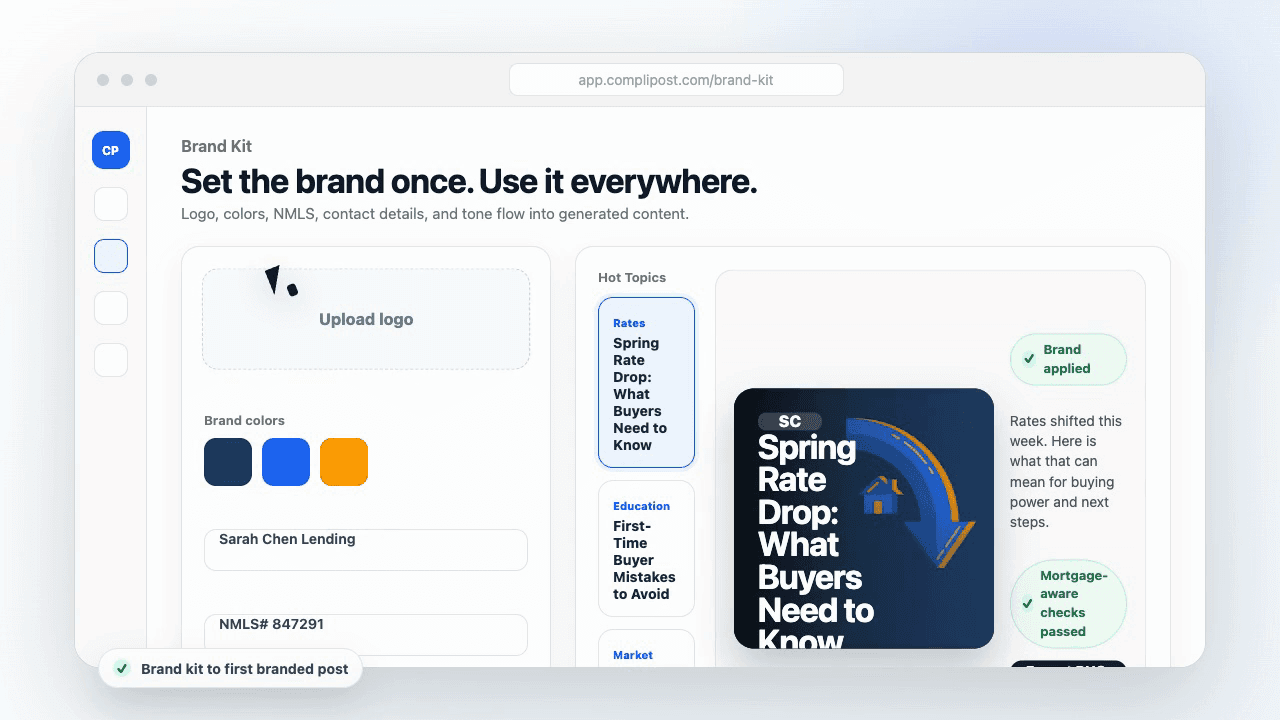
Product workflow
From blank page to export-ready mortgage content
- Start with a borrower topic
- Generate copy and a visual direction
- Review, save, and export the finished asset
These previews reflect the core CompliPost workflow: create, review, save, and export assets for use in your own channels.
Workflow comparison
| Content approach | What happens | Why it matters |
|---|---|---|
| Random posting | One-off ideas created when there is spare time | Inconsistent visibility and weak reuse |
| Template-only posting | Faster design but still requires rewriting and review | Helpful starting point, but not a full system |
| CompliPost workflow | Plan, generate, review, save, and export from one place | Better consistency with mortgage-aware review context |
| Done-for-you service | Someone else creates much of the content | Useful for some teams, but less control and less immediate reuse |
Who this guide helps
This guide is for loan officers working on solo loan officers who need a repeatable mortgage content workflow. The goal is to turn a broad mortgage topic into one borrower question, one useful takeaway, and one asset that can be reviewed before it is shared.
- You need content that sounds like a loan officer, not a generic brand account
- You want examples that can become captions, graphics, GIFs, or PDFs
- You need a clear place to review claims before export
- You want finished work saved for reuse, not lost in a chat thread
A practical workflow for this use case
Start with a narrow scenario, then move through planning, drafting, visual creation, review, and export. For visa holder home purchase mortgage, that means the topic should be specific enough that a borrower or referral partner can immediately understand what decision the content helps with.
- Choose the borrower type, loan topic, or platform before generating copy
- Draft the caption and visual together so the asset feels cohesive
- Use the federal baseline review aid to flag claims and disclosure gaps
- Export the finished asset and save the post as a reusable starting point
What makes the content stronger
Strong mortgage content is usually specific, plain-spoken, and calm. It explains tradeoffs without pretending one answer fits every borrower. That is especially important on public social channels, where a short post can be interpreted without the full context of a loan conversation.
- Name the borrower question in the first line
- Explain one decision or tradeoff instead of covering everything
- Use examples without implying approval, savings, or rate outcomes
- End with a soft next step, checklist, or guide rather than pressure
Compliance-aware review notes
CompliPost should be treated as a review aid, not a compliance approval system. The public page, generated draft, graphic, and exported asset should all stay honest about that boundary.
- Review specific payment, APR, rate, savings, and qualification language
- Avoid “best,” “lowest,” “guaranteed,” “free,” and urgency claims unless approved
- Check NMLS, Equal Housing, company, and state-specific requirements
- Use company or legal review for anything outside the federal baseline
How this connects to the rest of CompliPost
A focused guide should leave you with a usable next step. After you understand the topic, you can turn it into a calendar slot, a reviewed social post, a downloadable guide, or a platform-specific version for the channel where your audience already spends time.
- Use the content calendar to turn the idea into a weekly plan
- Use the compliance page when claims or disclosures need a slower pass
- Use lead magnets when the topic deserves a deeper PDF guide
- Use platform pages to adapt the same idea for LinkedIn, Facebook, or Instagram
Recommended next steps
Mortgage social media content
See the cross-platform content workflow for loan officers.
Foreign National Mortgage Programs
Comprehensive guide to visa categories and program-specific qualification paths.
Employment Verification and Work Authorization
General guide to income documentation; applicable to visa holders.
Investment Property Mortgages
For visa holders planning to rent out property if they relocate.
Examples
FAQ
Can I get a mortgage if my H-1B visa is expiring soon?+
Yes, if your visa is valid at closing. Underwriting takes 30–45 days, so apply only if your visa is valid through closing. If expiration is tight, renew your visa before applying. An approved I-797 (extension notice) counts as proof of valid visa status. Plan timeline carefully; communicate visa dates to your lender upfront.
Will my employer find out if I apply for a mortgage?+
Your employer finds out only if you tell them or if you provide an employment verification letter. Many lenders accept I-797 (visa petition approval) or pay stubs instead of an employer letter. If you must provide a letter, frame it as routine: 'My mortgage lender requires employer verification.' Most employers provide them routinely—it's not a signal of visa problems.
What if I move back to my home country after buying a house?+
You remain the property owner and are responsible for the mortgage. You can rent out the property, hire a property manager, or sell it. Many international homeowners own U.S. property remotely. Consider this scenario when choosing location—growing markets may appreciate even if you're not living there. Consult a tax professional about foreign tax implications.
Do lenders treat H-1B borrowers differently from SSN borrowers?+
Some lenders do, but the best ones treat qualification by income, credit, and assets—not visa type. Shopping multiple lenders is important. Some offer dedicated H-1B programs with competitive rates; others may charge slightly higher rates due to perceived visa risk. Work with lenders comfortable with your visa category.
Can I refinance if my visa status changes after I buy?+
Refinancing after your visa expires is difficult because lenders require valid visa status at time of refi. If you plan to stay long-term, buy within the visa's valid period and refinance before visa expires. If you become a permanent resident or citizen before refinancing, that's ideal. Plan ahead if refi is in your long-term strategy.
Create mortgage content with a calmer workflow
CompliPost helps you plan, generate, review, save, and export useful mortgage content without pretending compliance or social distribution is automatic.
Start free