Global Borrower Series
Help Relocating Professionals Buy Homes in New Cities with Confidence
Relocating professionals—new hires, expat transfers, international physicians—often face unique mortgage challenges: new employer, new city, potential visa changes, and timing pressures. Your role is to educate them on pre-approval strategies, employment letter requirements, and timing coordination. Help them understand that being new to a job doesn't disqualify them; strong income and documentation do.
Pre-Approval Before or After Relocation
Encourage pre-approval before moving—it's faster and shows commitment to employers/realtors. Lenders can pre-approve based on offer letters and old employment documentation. If relocating without pre-approval, have offer letter, employment contract, and salary information ready immediately. New employment doesn't disqualify borrowers; it requires supporting documentation.
- Pre-approval before relocation shows commitment and accelerates home search
- Offer letter on new employer letterhead satisfies income documentation at start
- Previous employer W-2s and tax returns show income history (12+ months typically required)
- Employment letter from new employer confirming job, title, salary, and visa sponsorship (if applicable)
- Start clock: timing from offer letter to closing is typically 30–45 days
Employment Documentation and Offer Letter Strategy
The employment offer letter is critical. It should confirm: job title, salary, start date, expected duration (if contract), visa sponsorship if applicable, and permanence (permanent hire vs. contract). Vague letters create underwriting questions. Work with HR to get specific language. Lenders understand relocation; strong documentation moves things forward.
- Offer letter details: job title, annual salary, start date, expected duration, permanence
- Visa sponsorship statement (if applicable): 'We sponsor [visa type] and intend to support renewal'
- Previous employment: W-2s and offer letter from prior employer show income history
- Gap between jobs: brief gaps (1–2 months) acceptable if strong offer letter is in place
- Self-employed relocating: 2 years of business tax returns + new client contracts required
Visa Sponsorship Coordination During Relocation
If relocating internationally (visa holder transferring, new H-1B hire), visa sponsorship timing is critical. New employer may sponsor visa; process takes 1–3 months (H-1B lottery, L-1 case processing). Coordinate mortgage timing with visa process. Pre-approval on offer letter is often smarter than waiting for visa approval.
- H-1B visa sponsorship takes 3–4 months (lottery in March, approval in May–July)
- L-1 visa sponsorship typically takes 1–2 months
- Some lenders pre-approve on approved I-797 (visa petition approval notice)
- Other lenders accept offer letter + employer sponsorship commitment letter
- Timing coordination: apply for mortgage while visa process is underway, don't wait
Credit and Asset Documentation for Quick Qualification
Relocating professionals with good credit, strong income, and substantial assets qualify faster. If credit is thin, focus on alternative documentation: current rent history, utility bills, international credit reports (translated). Strong savings/investment accounts compensate for minimal credit history. Help borrowers understand their strongest qualification angles.
- Strong credit (700+) accelerates qualification for employed professionals
- Alternative credit: rent history, utility payments, international credit reports
- Large down payment (15–20%+) reduces lender risk and speeds approval
- Substantial liquid assets (savings, investments) shown via statements
- Debt-to-income ratio: keep under 45% for strongest qualification
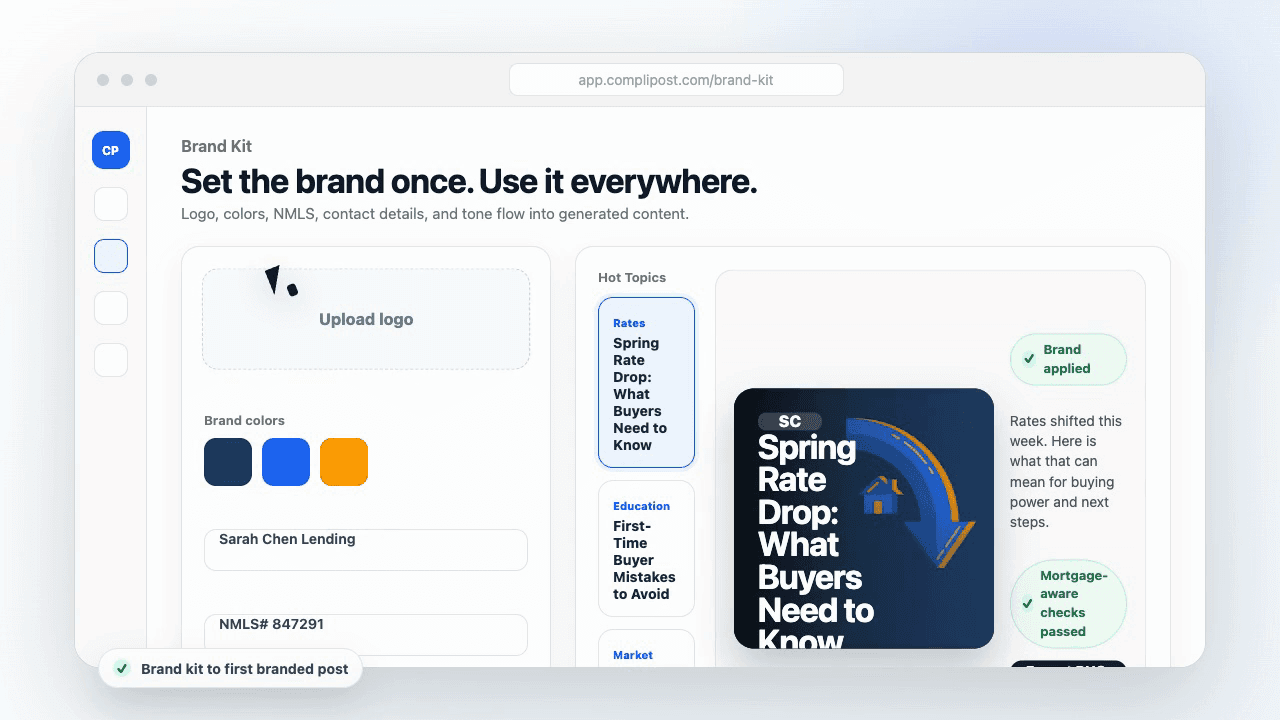
Product workflow
From blank page to export-ready mortgage content
- Start with a borrower topic
- Generate copy and a visual direction
- Review, save, and export the finished asset
These previews reflect the core CompliPost workflow: create, review, save, and export assets for use in your own channels.
Workflow comparison
| Content approach | What happens | Why it matters |
|---|---|---|
| Random posting | One-off ideas created when there is spare time | Inconsistent visibility and weak reuse |
| Template-only posting | Faster design but still requires rewriting and review | Helpful starting point, but not a full system |
| CompliPost workflow | Plan, generate, review, save, and export from one place | Better consistency with mortgage-aware review context |
| Done-for-you service | Someone else creates much of the content | Useful for some teams, but less control and less immediate reuse |
Who this guide helps
This guide is for loan officers working on solo loan officers who need a repeatable mortgage content workflow. The goal is to turn a broad mortgage topic into one borrower question, one useful takeaway, and one asset that can be reviewed before it is shared.
- You need content that sounds like a loan officer, not a generic brand account
- You want examples that can become captions, graphics, GIFs, or PDFs
- You need a clear place to review claims before export
- You want finished work saved for reuse, not lost in a chat thread
A practical workflow for this use case
Start with a narrow scenario, then move through planning, drafting, visual creation, review, and export. For relocating professionals home purchase, that means the topic should be specific enough that a borrower or referral partner can immediately understand what decision the content helps with.
- Choose the borrower type, loan topic, or platform before generating copy
- Draft the caption and visual together so the asset feels cohesive
- Use the federal baseline review aid to flag claims and disclosure gaps
- Export the finished asset and save the post as a reusable starting point
What makes the content stronger
Strong mortgage content is usually specific, plain-spoken, and calm. It explains tradeoffs without pretending one answer fits every borrower. That is especially important on public social channels, where a short post can be interpreted without the full context of a loan conversation.
- Name the borrower question in the first line
- Explain one decision or tradeoff instead of covering everything
- Use examples without implying approval, savings, or rate outcomes
- End with a soft next step, checklist, or guide rather than pressure
Compliance-aware review notes
CompliPost should be treated as a review aid, not a compliance approval system. The public page, generated draft, graphic, and exported asset should all stay honest about that boundary.
- Review specific payment, APR, rate, savings, and qualification language
- Avoid “best,” “lowest,” “guaranteed,” “free,” and urgency claims unless approved
- Check NMLS, Equal Housing, company, and state-specific requirements
- Use company or legal review for anything outside the federal baseline
How this connects to the rest of CompliPost
A focused guide should leave you with a usable next step. After you understand the topic, you can turn it into a calendar slot, a reviewed social post, a downloadable guide, or a platform-specific version for the channel where your audience already spends time.
- Use the content calendar to turn the idea into a weekly plan
- Use the compliance page when claims or disclosures need a slower pass
- Use lead magnets when the topic deserves a deeper PDF guide
- Use platform pages to adapt the same idea for LinkedIn, Facebook, or Instagram
Recommended next steps
Mortgage social media content
See the cross-platform content workflow for loan officers.
Income Documentation and Qualification Requirements
General guide to income documentation; applicable to relocating professionals.
Foreign National Mortgage Programs
For relocating professionals on work visas.
Preapproval vs. Prequalification
Understand difference and why pre-approval matters for relocating job changers.
Examples
FAQ
Can I get pre-approved before my new job starts?+
Yes. Lenders pre-approve based on offer letters and previous employment documentation. You'll need: offer letter on new employer letterhead (confirming salary and start date), W-2s and tax returns from previous employer (12+ months history), and current employment status documentation. Pre-approval before moving shows strong qualification and helps in home search.
Will a job change hurt my credit or mortgage qualification?+
No. Job changes don't hurt credit scores (credit reports don't track employment). Lenders care about income stability and documentation. A strong offer letter satisfies income documentation. If there's a gap between jobs (1–2 months), it's usually acceptable if new employment is solid. Avoid gaps longer than 2–3 months if possible.
How do I time visa sponsorship and mortgage closing?+
Don't wait for visa approval. Apply for mortgage pre-approval on offer letter while visa is in process. H-1B sponsorship takes 3–4 months; L-1 takes 1–2 months. Lenders accept offer letters + employer visa sponsorship commitment. Coordinate closing date to be after visa approval if possible, but don't delay home search waiting for visa.
What if I'm relocating and have no credit history in my new city?+
Credit score is national (your score is the same in every state). If you have established U.S. credit, it travels with you. If not, alternative credit (rent history, utility bills, international credit reports) works nationwide. Your income and assets matter more than local history.
Can I buy before my new job officially starts?+
Technically yes if offer letter is strong, but risky. Lenders may require that employment is active at closing. If new job starts before closing (typical 30–45 day timeline), you're safe. If your closing is after start date, you can show recent pay stubs from new employer—even stronger. Plan for start date before closing if possible.
Create mortgage content with a calmer workflow
CompliPost helps you plan, generate, review, save, and export useful mortgage content without pretending compliance or social distribution is automatic.
Start free