Condo Financing
Buying a Condo with FHA vs. Conventional: Know the Approval Rules
Condo financing is one of the biggest differences between FHA and conventional loans. FHA requires the condo project to be on an approved list and have specific reserve requirements, while conventional loans offer much more flexibility. Many desirable condos fail FHA approval because the building doesn't meet program requirements. Understanding these rules upfront saves you and your borrowers from wasted application effort and disappointment.
FHA condo project approval: the gating requirement
FHA maintains a list of approved condo projects, and the property MUST be on that list for an FHA loan to be considered. Even if the individual unit qualifies perfectly, if the building is not FHA-approved, the loan will be denied. Approval is project-wide and can take months to obtain. Condos may be removed from the approved list if the project doesn't maintain financial or management standards. Builders and condo associations can apply for approval, but lenders cannot guarantee speed or approval odds. Conventional loans have no such restriction—any condo building can be financed as long as the unit itself meets basic standards.
- FHA requires condo project approval before any loans can close in that building
- Approval is list-based and maintained by FHA; not all condos qualify
- Buildings can be removed from approval if reserves or management decline
- Approval process can take 2-4 months and requires builder or association application
- Conventional loans work on any condo building regardless of project status
Reserve requirement differences: FHA vs. conventional
FHA requires condo buildings to maintain cash reserves equal to 10-20% of the annual operating budget (the exact percentage depends on the project). These reserves are meant to cover common area repairs and unexpected major expenses. Conventional loans typically require 6-10% reserves. Buildings with inadequate reserves often fail FHA approval or can lose approval if reserves drop below threshold. New or very small condo buildings often struggle to meet FHA reserve requirements. Check the building's reserve study and current reserve balance before offering on an FHA-financed purchase—this single requirement blocks many loans.
- FHA requires 10-20% of annual operating budget in cash reserves
- Conventional typically requires 6-10%, offering more flexibility
- Reserve percentage varies based on condo project size and loan percentage
- New buildings and small condo projects often can't meet FHA reserve standards
- Check reserve study before submitting FHA application; insufficient reserves = automatic denial
Other FHA condo requirements: owner occupancy and rental limits
FHA requires at least 50% of condo units to be owner-occupied (not rented out). If a project falls below 50% owner occupancy, it loses FHA approval. Additionally, FHA limits the number of units a single owner can hold in the same project (typically limits apply to prevent investor concentration). Conventional loans have no owner-occupancy requirement or ownership concentration limits. This matters greatly for investor-friendly condos or buildings in high-turnover rental markets. Buildings that are investor-dominated or condo-to-apartment conversions often fail FHA approval.
- FHA requires 50%+ owner-occupancy; investor-heavy condos don't qualify
- FHA limits single-owner unit concentration to prevent investor dominance
- Conventional allows investor-heavy condos and has no occupancy limits
- Buildings trending toward rentals may lose FHA approval over time
- Verify owner-occupancy percentage before submitting FHA application
Strategic advice: when to recommend FHA vs. conventional for condos
Recommend FHA for condos only after confirming the building is on the FHA-approved list and has solid reserves. FHA works well for stable, owner-occupied buildings with strong management and financial health. Recommend conventional for newer buildings, investor-friendly condos, urban high-rises, or buildings that fall short of FHA reserves or occupancy requirements. If a borrower wants FHA but the condo doesn't qualify, discuss either finding a different property or using conventional. Never submit an FHA application for a non-approved condo building—it will be denied and waste time. Transparency about the condo approval requirement builds trust.
- Always verify FHA approval status before advising FHA as an option
- Check reserve study and owner-occupancy percentage upfront
- FHA: best for established, owner-occupied buildings with strong financials
- Conventional: better for newer condos, investor buildings, high-rise units
- If condo doesn't qualify for FHA, explain clearly and pivot to conventional
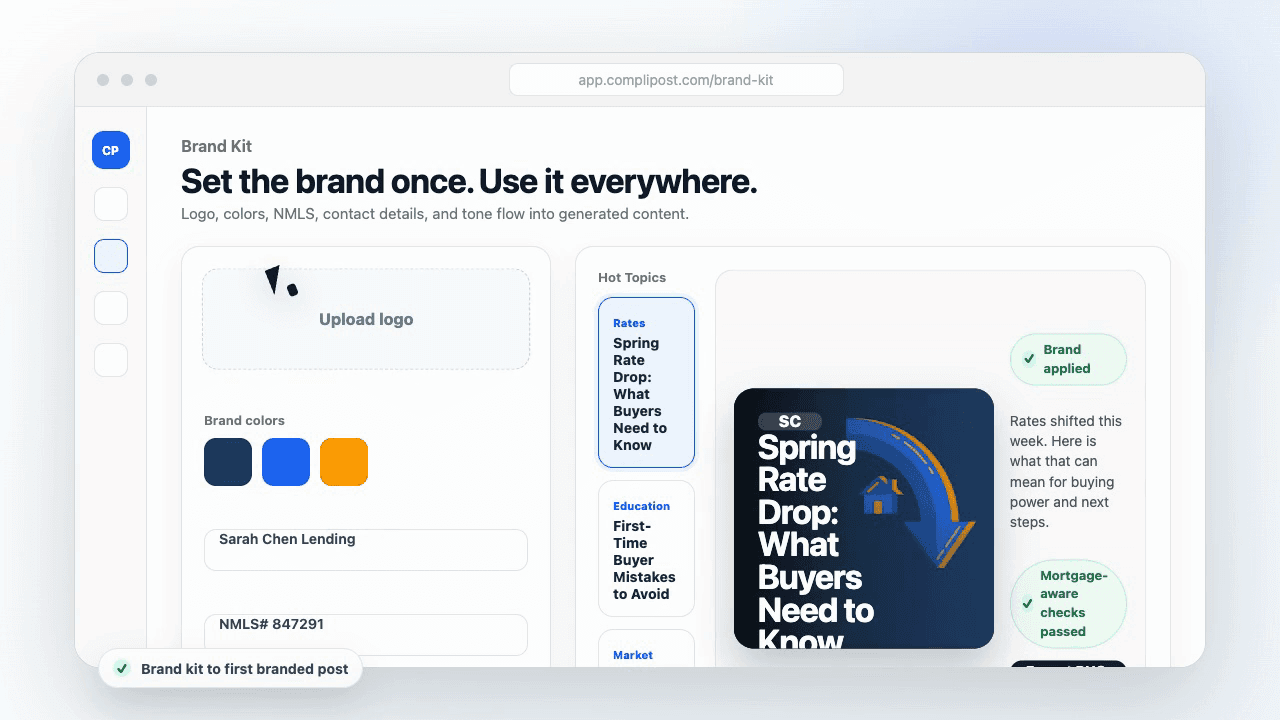
Product workflow
From blank page to export-ready mortgage content
- Start with a borrower topic
- Generate copy and a visual direction
- Review, save, and export the finished asset
These previews reflect the core CompliPost workflow: create, review, save, and export assets for use in your own channels.
Workflow comparison
| Content approach | What happens | Why it matters |
|---|---|---|
| Random posting | One-off ideas created when there is spare time | Inconsistent visibility and weak reuse |
| Template-only posting | Faster design but still requires rewriting and review | Helpful starting point, but not a full system |
| CompliPost workflow | Plan, generate, review, save, and export from one place | Better consistency with mortgage-aware review context |
| Done-for-you service | Someone else creates much of the content | Useful for some teams, but less control and less immediate reuse |
Who this guide helps
This guide is for loan officers working on solo loan officers who need a repeatable mortgage content workflow. The goal is to turn a broad mortgage topic into one borrower question, one useful takeaway, and one asset that can be reviewed before it is shared.
- You need content that sounds like a loan officer, not a generic brand account
- You want examples that can become captions, graphics, GIFs, or PDFs
- You need a clear place to review claims before export
- You want finished work saved for reuse, not lost in a chat thread
A practical workflow for this use case
Start with a narrow scenario, then move through planning, drafting, visual creation, review, and export. For FHA condo financing approval, that means the topic should be specific enough that a borrower or referral partner can immediately understand what decision the content helps with.
- Choose the borrower type, loan topic, or platform before generating copy
- Draft the caption and visual together so the asset feels cohesive
- Use the federal baseline review aid to flag claims and disclosure gaps
- Export the finished asset and save the post as a reusable starting point
What makes the content stronger
Strong mortgage content is usually specific, plain-spoken, and calm. It explains tradeoffs without pretending one answer fits every borrower. That is especially important on public social channels, where a short post can be interpreted without the full context of a loan conversation.
- Name the borrower question in the first line
- Explain one decision or tradeoff instead of covering everything
- Use examples without implying approval, savings, or rate outcomes
- End with a soft next step, checklist, or guide rather than pressure
Compliance-aware review notes
CompliPost should be treated as a review aid, not a compliance approval system. The public page, generated draft, graphic, and exported asset should all stay honest about that boundary.
- Review specific payment, APR, rate, savings, and qualification language
- Avoid “best,” “lowest,” “guaranteed,” “free,” and urgency claims unless approved
- Check NMLS, Equal Housing, company, and state-specific requirements
- Use company or legal review for anything outside the federal baseline
How this connects to the rest of CompliPost
A focused guide should leave you with a usable next step. After you understand the topic, you can turn it into a calendar slot, a reviewed social post, a downloadable guide, or a platform-specific version for the channel where your audience already spends time.
- Use the content calendar to turn the idea into a weekly plan
- Use the compliance page when claims or disclosures need a slower pass
- Use lead magnets when the topic deserves a deeper PDF guide
- Use platform pages to adapt the same idea for LinkedIn, Facebook, or Instagram
Recommended next steps
FHA loan content hub
Create FHA loan explainers and buyer guidance.
FHA vs. Conventional Explained Simply
Core program differences and where condos fit into the broader landscape.
FHA vs. Conventional: Loan Limits, DTI & Occupancy Rules
FHA project requirements and occupancy rules for all property types.
FHA vs. Conventional: Appraisal Standards & Property Eligibility
How appraisals differ and what properties each program accepts.
Examples
FAQ
How do I know if my condo building is FHA-approved?+
Ask your lender or real estate agent to check the FHA-approved condo list using the building address or project name. You can also request the condo's certificate of occupancy and reserve study from the building management or seller—these documents often indicate FHA approval status. FHA maintains an online database, but it's cumbersome to search. Your lender is your fastest resource. Checking this before making an offer saves months of heartbreak if the building isn't approved.
Can a condo building get FHA-approved if it isn't currently on the list?+
Yes, but it's a slow process. The condo association or builder can apply for FHA approval, which involves providing financial documents, reserve studies, management agreements, and proof of owner-occupancy compliance. The approval process typically takes 2-4 months and isn't guaranteed—FHA can deny applications if reserves, occupancy, or management standards aren't met. Once approved, the building gets ongoing FHA monitoring. If you're buying in a non-approved building, ask the seller or association if they've applied or would apply, but don't count on fast approval for your specific deal.
What percentage of reserves do FHA condos actually have?+
It varies widely. Healthy, mature condo buildings often maintain 15-20% reserves. Newer buildings or those with financial challenges may have 5-10%. FHA's minimum is typically 10-20% depending on the project profile. Buildings with less than 10% often fail FHA approval or are at risk of losing approval. You can request the condo's reserve study from the seller or listing agent—this document details the reserve percentage, upcoming major expenses, and the association's financial health. If reserves are below 10%, assume FHA approval is unlikely.
Does an investor condo (a unit rented to tenants) require different financing than an owner-occupied condo?+
FHA loans are only for owner-occupied primary residences, so investor-owned condos in owner-occupied buildings don't qualify for FHA financing. Conventional loans work for investor condos as long as the overall building has minimum 25% owner-occupancy and adequate reserves. However, condo buildings where most units are investor-owned (less than 50% owner-occupancy) often fail FHA approval for new FHA borrowers entirely. If you're buying a condo unit to rent out, conventional is your only option, and you'll need to verify the building's owner-occupancy percentage first.
If my condo building loses FHA approval, do I have to refinance into a conventional loan?+
Not immediately. If you already have an FHA loan and the building loses FHA approval, you can keep your loan—the approval status doesn't retroactively affect existing loans. However, you won't be able to refinance using FHA if the building has been removed from the approved list. The building's approval status only affects new FHA loan applications. If you're planning a refinance in the future, you may want to lock in an FHA rate while the building is still approved, or plan to refinance into conventional.
Create mortgage content with a calmer workflow
CompliPost helps you plan, generate, review, save, and export useful mortgage content without pretending compliance or social distribution is automatic.
Start free