Credit Repair Strategy
Credit Setbacks and Home Buying: FHA vs. Conventional Recovery Paths
Credit setbacks—late payments, collections, bankruptcy, foreclosure—feel permanent, but they don't bar you from homeownership. FHA and conventional both accept borrowers with credit challenges, but they weigh old issues vs. recent ones very differently. Understanding these distinctions helps you rebuild confidence and position the strongest possible application after credit damage.
How age of credit issues matters on FHA vs. conventional
FHA is more flexible on older credit issues. A late payment from 3+ years ago is less concerning if recent history is clean. A foreclosure from 5+ years ago, with clean credit since, is approvable on FHA. Conventional lenders want to see squeaky-clean recent credit (24+ months clean typically) but may forgive older issues more quickly if the borrower shows long-term recovery. Conventional is stricter on recent damage: a late payment within the last 12 months is a major barrier; FHA is more forgiving. The equation: FHA is better immediately after credit recovery (clean for 1-2 years); conventional requires longer clean history (3+ years) but may forgive older damage faster. For borrowers in the '1-2 year clean after damage' window, FHA is often the only option.
- FHA: more forgiving on older credit issues (3+ years old)
- FHA: requires only 1-2 years clean history after recent damage
- Conventional: stricter on recent damage; typically wants 24+ months clean minimum
- Conventional: may forgive older issues faster if all recent credit is clean
- Window of opportunity: 1-3 years after damage, FHA is more accessible
Specific credit situations: bankruptcy, foreclosure, late payments, collections
Chapter 7 Bankruptcy: FHA typically allows 2+ years after discharge; conventional wants 4+ years and very strong recent credit. Chapter 13 Bankruptcy: both allow you to apply while still in the repayment plan if payments are current; FHA more flexible. Foreclosure: FHA typically 3+ years; conventional 5-7 years. Short Sale: FHA 3+ years; conventional 3-5 years (treated less harshly than foreclosure). Collections: both consider age and amount; older accounts (3+ years) less damaging than recent ones. Late Payments: FHA treats as less severe; conventional scrutinizes heavily. Repossession: most damaging; requires 2-3+ years clean history on FHA, 5+ on conventional. For any of these, the key factor is: time + demonstrable clean history. Show on-time payments, no new collections, and financial stability for the clean period.
- Chapter 7: FHA 2+ yrs after discharge, conventional 4+ yrs
- Chapter 13: can apply while still in plan if current; FHA more flexible
- Foreclosure: FHA 3+ yrs, conventional 5-7 yrs
- Short sale: FHA 3+ yrs, conventional 3-5 yrs (less severe than foreclosure)
- Collections: age matters; recent collections (under 2 yrs) are hard on both
Building your application after credit damage: what matters most
Time is the healer, but action accelerates healing. Focus on: (1) Payment history going forward—make every payment on time for 1-2+ years. This demonstrates you've changed financial behavior. (2) Credit score recovery—if you have collections, pay them off (even settled); if you have old delinquencies, stop adding new debt. (3) Down payment savings—the larger your down payment, the more you offset credit concerns. FHA at 10% down is viewed better than FHA at 3.5% down after credit damage because you have 'skin in the game.' (4) Income stability—change jobs or income fluctuation looks bad after credit damage. Stay in same job for 2+ years if possible. (5) Explanation letters—write a short, honest explanation of what caused the damage (job loss, medical emergency, divorce) and what you've done to prevent it happening again. Lenders want to see you understand what went wrong.
- Payment history: 1-2+ years of on-time payments is your biggest asset
- Credit score recovery: settle collections if possible; avoid new debt
- Down payment: larger down payment (10% vs. 3.5%) offsets credit concerns
- Income stability: stay in same job for 2+ years; job changes look risky
- Explanation letter: honest, brief explanation of cause and what changed
Which program after credit damage: FHA or conventional?
Use FHA if: credit damage is recent (1-3 years ago) or you have older damage but current credit is strong. FHA is your faster path to approval. Use conventional if: damage is aged (5+ years) and you have 24+ months of perfect recent credit. Conventional might offer better long-term rates once you're approved. However, for most borrowers with recent credit setbacks, FHA is the realistic option. You can always refinance to conventional later once you reach 20% equity and have 3+ years of on-time FHA payments proving you've changed. This is not a permanent choice; FHA is a bridge to conventional homeownership.
- Recent damage (1-3 yrs): FHA is your better option
- Older damage (5+ yrs) + clean recent credit: conventional possible
- Most cases: FHA is the faster, more accessible path
- Plan to refinance to conventional later (2-5 yrs) once equity and payment history build
- See FHA as a bridge to conventional homeownership, not a permanent choice
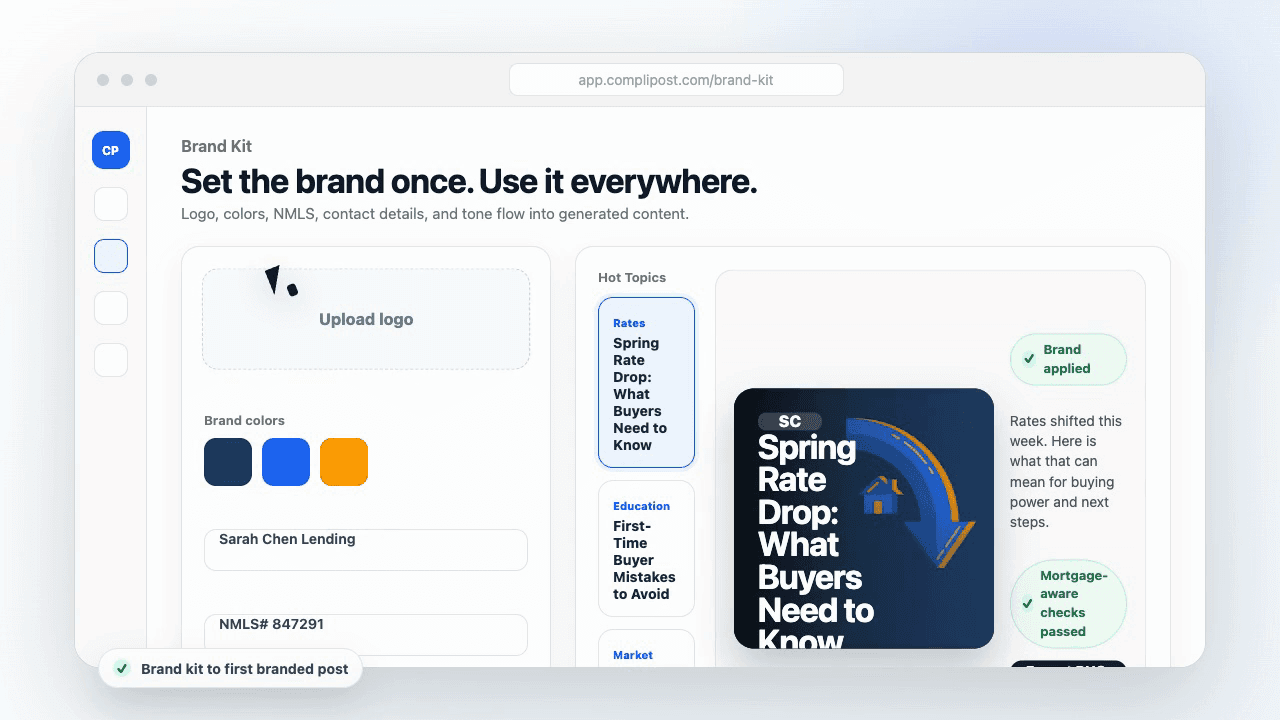
Product workflow
From blank page to export-ready mortgage content
- Start with a borrower topic
- Generate copy and a visual direction
- Review, save, and export the finished asset
These previews reflect the core CompliPost workflow: create, review, save, and export assets for use in your own channels.
Workflow comparison
| Content approach | What happens | Why it matters |
|---|---|---|
| Random posting | One-off ideas created when there is spare time | Inconsistent visibility and weak reuse |
| Template-only posting | Faster design but still requires rewriting and review | Helpful starting point, but not a full system |
| CompliPost workflow | Plan, generate, review, save, and export from one place | Better consistency with mortgage-aware review context |
| Done-for-you service | Someone else creates much of the content | Useful for some teams, but less control and less immediate reuse |
Who this guide helps
This guide is for loan officers working on solo loan officers who need a repeatable mortgage content workflow. The goal is to turn a broad mortgage topic into one borrower question, one useful takeaway, and one asset that can be reviewed before it is shared.
- You need content that sounds like a loan officer, not a generic brand account
- You want examples that can become captions, graphics, GIFs, or PDFs
- You need a clear place to review claims before export
- You want finished work saved for reuse, not lost in a chat thread
A practical workflow for this use case
Start with a narrow scenario, then move through planning, drafting, visual creation, review, and export. For FHA conventional credit setbacks bankruptcy foreclosure, that means the topic should be specific enough that a borrower or referral partner can immediately understand what decision the content helps with.
- Choose the borrower type, loan topic, or platform before generating copy
- Draft the caption and visual together so the asset feels cohesive
- Use the federal baseline review aid to flag claims and disclosure gaps
- Export the finished asset and save the post as a reusable starting point
What makes the content stronger
Strong mortgage content is usually specific, plain-spoken, and calm. It explains tradeoffs without pretending one answer fits every borrower. That is especially important on public social channels, where a short post can be interpreted without the full context of a loan conversation.
- Name the borrower question in the first line
- Explain one decision or tradeoff instead of covering everything
- Use examples without implying approval, savings, or rate outcomes
- End with a soft next step, checklist, or guide rather than pressure
Compliance-aware review notes
CompliPost should be treated as a review aid, not a compliance approval system. The public page, generated draft, graphic, and exported asset should all stay honest about that boundary.
- Review specific payment, APR, rate, savings, and qualification language
- Avoid “best,” “lowest,” “guaranteed,” “free,” and urgency claims unless approved
- Check NMLS, Equal Housing, company, and state-specific requirements
- Use company or legal review for anything outside the federal baseline
How this connects to the rest of CompliPost
A focused guide should leave you with a usable next step. After you understand the topic, you can turn it into a calendar slot, a reviewed social post, a downloadable guide, or a platform-specific version for the channel where your audience already spends time.
- Use the content calendar to turn the idea into a weekly plan
- Use the compliance page when claims or disclosures need a slower pass
- Use lead magnets when the topic deserves a deeper PDF guide
- Use platform pages to adapt the same idea for LinkedIn, Facebook, or Instagram
Recommended next steps
FHA loan content hub
Create FHA loan explainers and buyer guidance.
FHA vs. Conventional Explained Simply
Core program differences to understand your options.
FHA vs. Conventional: Credit Score & Flexibility Requirements
Detailed credit requirements for each program.
FHA vs. Conventional: Decision Framework for Your Situation
Framework to choose the right program given your credit profile.
Examples
FAQ
Can I get an FHA loan if I'm still paying off a collection or judgment?+
It depends on the payment plan and history. If you're actively paying a collection on a formal payment plan and haven't missed a payment, FHA might approve you if other factors (credit, income, down payment) are strong. If the collection is brand new or you haven't made payments, FHA will likely wait for 12+ months of payment history. Settled and paid collections are viewed more favorably than ongoing ones. Discuss with your lender whether settling the collection before applying is worth the cost or whether waiting and building payment history is smarter.
How does filing for bankruptcy affect my ability to buy a home?+
Bankruptcy impacts credit heavily, but it's survivable. Chapter 7 bankruptcy (liquidation) requires 2+ years after discharge on FHA, 4+ years on conventional. Chapter 13 bankruptcy (repayment plan) allows you to apply while still in the plan if payments are current—FHA is more flexible here. The key: after bankruptcy, build perfect payment history. Every on-time payment post-bankruptcy strengthens your application. Credit score will recover gradually; focus on paying everything on time and keeping debt low.
Is a short sale better or worse than a foreclosure for getting a mortgage later?+
Short sales are treated less harshly than foreclosures. FHA typically requires 3+ years after short sale vs. 3+ years after foreclosure, but short sale recovery is viewed more favorably (you worked with the lender vs. losing the home). Conventional wants 3-5 years after short sale vs. 5-7 years after foreclosure. Financially, short sale is less damaging than foreclosure. If you have a choice, short sale is the better option.
Should I apply for FHA now or wait and apply for conventional later?+
Apply for FHA now if you're ready to buy and your credit damage is 2-3 years old. You've waited long enough—buy now with FHA and build equity. Later, refinance to conventional once you have 20% equity and 3+ years of on-time FHA payments. This is faster than waiting 5-7 years for conventional readiness. FHA is your bridge to homeownership, not your permanent program.
What if lenders keep denying me for FHA? What's my backup plan?+
If multiple FHA lenders deny you, credit damage may be too recent or severe. Your backup plan: wait 6-12 more months and build additional payment history, then reapply. In the meantime, focus on credit score recovery (settle collections, keep balances low, make all payments on time). Work with a credit counselor if you have systemic money management issues. You're not shut out forever—you just need more time or financial healing.
Create mortgage content with a calmer workflow
CompliPost helps you plan, generate, review, save, and export useful mortgage content without pretending compliance or social distribution is automatic.
Start free