Specialist marketing
FHA loan specialist content that positions you as the go-to lender for overlooked buyers
An FHA loan specialist earns trust not by advertising the product but by consistently answering the questions overlooked buyers are afraid to ask. Positioning your content around down payment realities, credit recovery, and mortgage insurance honesty creates the kind of specialist credibility a generalist cannot replicate.
Why FHA specialist positioning outperforms generalist mortgage content
Generalist loan officers compete for the same buyer pool — the well-qualified, conventional-ready borrower who any lender can help. FHA specialists who lean into their niche consistently post content that speaks directly to the buyer who has been turned away before, who has questions about credit scores and down payment assistance, and who needs someone to explain mortgage insurance honestly instead of avoiding it. A 30-day scan of loan-officer social content confirms the pattern: content tailored to a specific buyer community outperforms broad mortgage content in both engagement and referral quality. When a first-generation buyer or a recent credit rebuilder asks their network for a lender recommendation, the name that surfaces is the one who has been answering their specific questions publicly — not the one posting generic rate-update graphics.
- Address the 3.5% down payment honestly — including what 'verified funds' actually means
- Explain mortgage insurance premiums and when they end without evasiveness
- Speak to the buyer who thinks their credit score is too low to ask yet
- Correct the myth that FHA loans are 'a last resort' rather than a smart tool for many buyers
Content angles unique to the FHA specialist
FHA specialist content works because the product has genuine complexity that rewards education. Borrowers who qualify for FHA often do not understand why they qualify, what the seller-concession rules mean, how the appraisal process differs, or when an FHA loan makes more financial sense than putting 20% down on a conventional. Each of those knowledge gaps is a content opportunity. The closing-to-content repurposing pattern is especially powerful here: every FHA closing involves a buyer who overcame something — a credit setback, a limited down payment, a complicated income situation. With identifying details removed and the borrower's permission considered, that story becomes a week of educational content about the path from hesitation to homeownership.
- FHA appraisal requirements: what they protect against and why the property must meet HUD guidelines
- Seller concessions under FHA: what sellers can contribute and how it helps buyers
- FHA vs. conventional at various credit and down payment scenarios — a decision framework, not a recommendation
- FHA Streamline Refinance: what it is, who qualifies, and why past FHA borrowers should know it exists
Compliance considerations specific to FHA specialist content
FHA loan content carries specific risk signals a federal-baseline review aid is designed to flag. The most common: implying that FHA is universally better than conventional without context (a form of unsupported financial advice), overstating the ease of qualification, and stating minimum credit score thresholds as guarantees rather than starting points. The casually dangerous pattern in this niche is the well-meaning phrase: "if you have a 580 credit score you can buy a home with FHA." That statement, without the qualifications around income, debt, and property, can read as unauthorized financial advice. Content that teaches the framework — here is how FHA qualification works — without making individual promises is both more useful and safer.
Building a referral network as an FHA specialist
FHA specialists who own their content niche attract a specific type of referral partner: nonprofit housing counselors, first-generation homebuyer programs, community banks exiting the mortgage space, and real estate agents who work with first-time or credit-recovering buyers. Content that positions you as the educator for this buyer community — rather than just a lender — makes you the natural referral partner for every professional who touches that buyer before the mortgage conversation starts. The average real estate agent now works with over 17 loan officers (industry reporting), which means differentiation is essential. Agents who specialize in first-time buyers remember the loan officer who consistently posts FHA education, not the one who sends the same generic mortgage flyer everyone else sends.
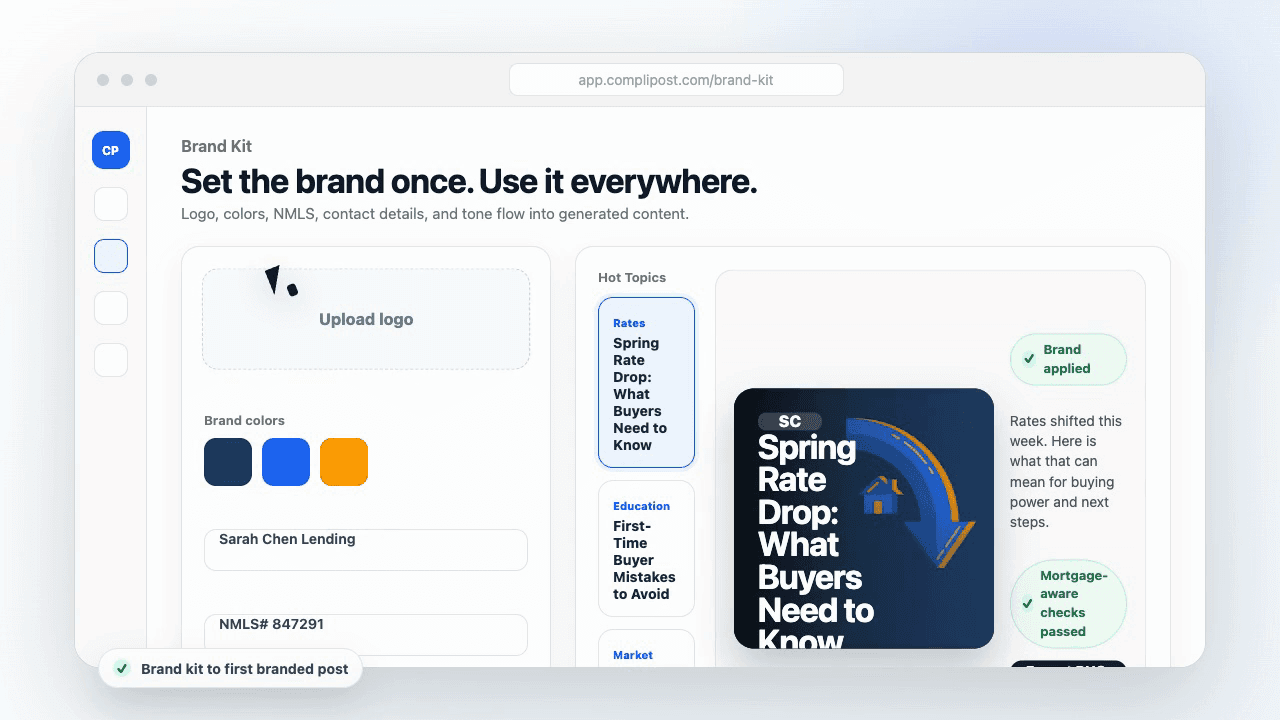
Product workflow
From blank page to export-ready mortgage content
- Start with a borrower topic
- Generate copy and a visual direction
- Review, save, and export the finished asset
These previews reflect the core CompliPost workflow: create, review, save, and export assets for use in your own channels.
Workflow comparison
| Content approach | What happens | Why it matters |
|---|---|---|
| Random posting | One-off ideas created when there is spare time | Inconsistent visibility and weak reuse |
| Template-only posting | Faster design but still requires rewriting and review | Helpful starting point, but not a full system |
| CompliPost workflow | Plan, generate, review, save, and export from one place | Better consistency with mortgage-aware review context |
| Done-for-you service | Someone else creates much of the content | Useful for some teams, but less control and less immediate reuse |
Who this guide helps
This guide is for loan officers working on solo loan officers who need a repeatable mortgage content workflow. The goal is to turn a broad mortgage topic into one borrower question, one useful takeaway, and one asset that can be reviewed before it is shared.
- You need content that sounds like a loan officer, not a generic brand account
- You want examples that can become captions, graphics, GIFs, or PDFs
- You need a clear place to review claims before export
- You want finished work saved for reuse, not lost in a chat thread
A practical workflow for this use case
Start with a narrow scenario, then move through planning, drafting, visual creation, review, and export. For FHA loan specialist content, that means the topic should be specific enough that a borrower or referral partner can immediately understand what decision the content helps with.
- Choose the borrower type, loan topic, or platform before generating copy
- Draft the caption and visual together so the asset feels cohesive
- Use the federal baseline review aid to flag claims and disclosure gaps
- Export the finished asset and save the post as a reusable starting point
What makes the content stronger
Strong mortgage content is usually specific, plain-spoken, and calm. It explains tradeoffs without pretending one answer fits every borrower. That is especially important on public social channels, where a short post can be interpreted without the full context of a loan conversation.
- Name the borrower question in the first line
- Explain one decision or tradeoff instead of covering everything
- Use examples without implying approval, savings, or rate outcomes
- End with a soft next step, checklist, or guide rather than pressure
Compliance-aware review notes
CompliPost should be treated as a review aid, not a compliance approval system. The public page, generated draft, graphic, and exported asset should all stay honest about that boundary.
- Review specific payment, APR, rate, savings, and qualification language
- Avoid “best,” “lowest,” “guaranteed,” “free,” and urgency claims unless approved
- Check NMLS, Equal Housing, company, and state-specific requirements
- Use company or legal review for anything outside the federal baseline
How this connects to the rest of CompliPost
A focused guide should leave you with a usable next step. After you understand the topic, you can turn it into a calendar slot, a reviewed social post, a downloadable guide, or a platform-specific version for the channel where your audience already spends time.
- Use the content calendar to turn the idea into a weekly plan
- Use the compliance page when claims or disclosures need a slower pass
- Use lead magnets when the topic deserves a deeper PDF guide
- Use platform pages to adapt the same idea for LinkedIn, Facebook, or Instagram
Recommended next steps
FHA loan content hub
Create FHA loan explainers and buyer guidance.
First-time buyer specialist content
Positioning strategy for loan officers who specialize in first-time buyers.
Non-QM loan specialist content
Content strategy for loan officers serving borrowers outside conventional guidelines.
Loan officer niche marketing
Why specialization consistently outperforms generalist mortgage marketing.
Examples
FAQ
What content should an FHA loan specialist post on social media?+
Education-first content that addresses the real questions FHA borrowers carry: credit score reality, down payment sources, mortgage insurance, appraisal requirements, and how FHA compares to conventional in specific scenarios. The most effective FHA specialist content answers the question the buyer was afraid to ask publicly — which is why it gets shared within first-time buyer and credit-recovery communities.
How is FHA loan specialist content different from general FHA loan content?+
The FHA loan product page is about what the program offers. FHA specialist content is about the loan officer's positioning — demonstrating niche knowledge, building trust with the overlooked-buyer community, and creating a referral identity as the lender who specializes in this buyer type. The audience and intent are different: one informs, the other positions.
What compliance risks should FHA specialists watch in their content?+
The main risks are overstating qualification ease, implying FHA is always better than alternatives without a fact-based comparison framework, and stating credit or income thresholds in ways that read as individual advice rather than general education. CompliPost's federal-baseline review aid flags these risk signals before export; final review belongs with your compliance team.
How does niche content help an FHA specialist compete with larger lenders?+
Large lenders have volume but rarely have specialist voice. An FHA specialist who consistently posts accurate, empathetic education for the buyer who has been turned away builds a reputation the buyer community trusts and refers to. A 30-day analysis of loan-officer social content found the consistent theme is trust-building and reputation infrastructure — the loan officers who win are the ones who showed up consistently for their specific buyer community.
Does CompliPost guarantee FHA loan content is compliant?+
No. CompliPost provides a federal-baseline review aid that surfaces risk signals in FHA loan copy before you export — including TILA-adjacent claims, qualification language, and payment-related wording. It does not replace your company compliance policy, state advertising rules, or legal review.
Create mortgage content with a calmer workflow
CompliPost helps you plan, generate, review, save, and export useful mortgage content without pretending compliance or social distribution is automatic.
Start free