Platform planning
Facebook content calendar built for community and local presence
Facebook's strongest format for loan officers is not the page feed — it is local community groups. A Facebook content calendar should allocate slots for group participation, local market posts, and shareable buyer education that community members pass along organically.
Plan around Facebook Groups, not just your page
Facebook Page reach without paid promotion is limited. The loan officers who get consistent organic reach on Facebook invest in community groups — neighborhood groups, first-time homebuyer groups, local parent groups. A Facebook calendar should distinguish between content you post on your page (education, lead magnets, market context) and content you contribute to relevant groups (answers to homebuyer questions, helpful resources, local insights).
- Page content: educational posts, lead magnets, market updates, testimonials
- Group participation: answering buyer questions, sharing relevant guides, local commentary
- Group-specific rule: answer first, promote never — groups penalize promotional posts
Facebook rewards local and shareable content
Facebook users share content about their community — local market data, neighborhood news, first-time buyer education that a friend moving nearby would appreciate. Shareable content multiplies reach without requiring a follower base. A weekly calendar should include at least one post designed to be shared: a buyer checklist, a local market graphic, or a myth-correction post that a friend could tag another friend in.
Calendar anchored to local events and seasonal cycles
Facebook audiences respond well to timely, local content. A mortgage content calendar that anticipates seasonal buying cycles — spring market activity, end-of-year closings, school-year timing — gives the calendar natural variety beyond the weekly structure. National homeownership month, VA loan awareness days, and local market report releases are natural calendar anchors that feel timely rather than manufactured.
Compliance in a community context
Group posts and page posts both carry compliance exposure. Casual replies in a group comment thread count as marketing communications — avoid implying approval promises or specific rate offers in any Facebook post or comment. A federal-baseline review aid designed for mortgage content helps review the planned posts in your calendar before they go live.
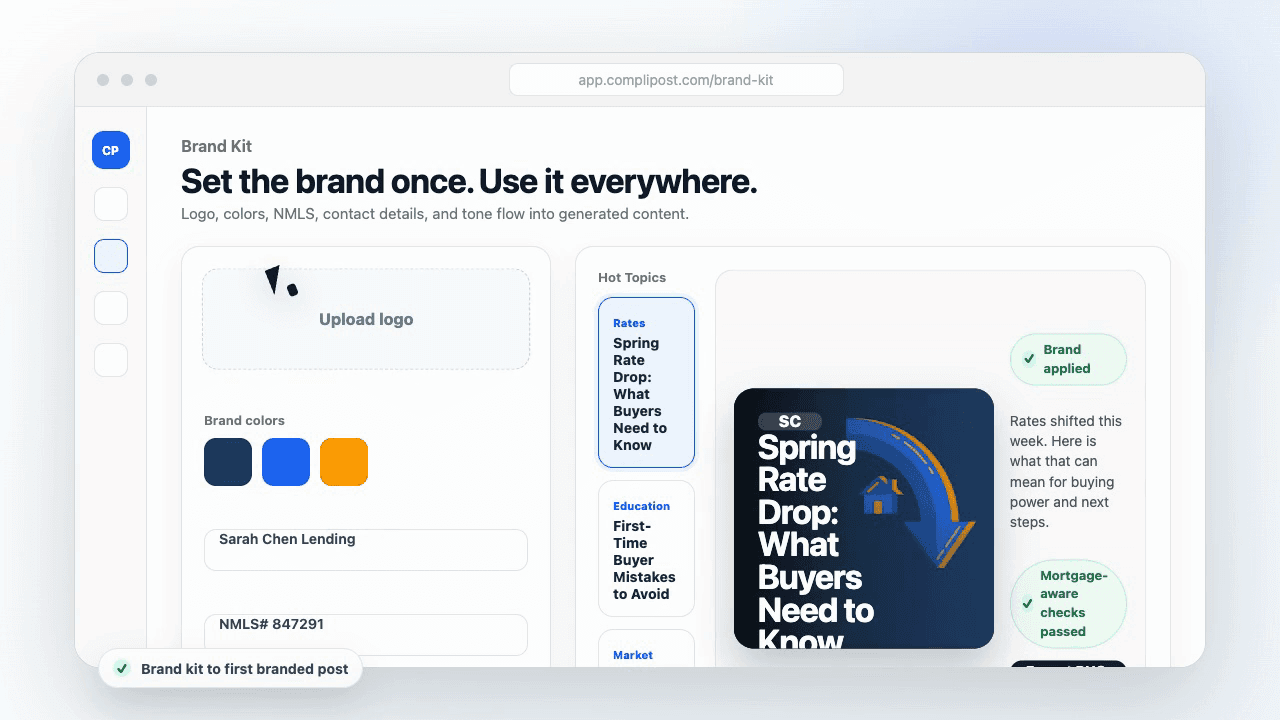
Product workflow
From blank page to export-ready mortgage content
- Start with a borrower topic
- Generate copy and a visual direction
- Review, save, and export the finished asset
These previews reflect the core CompliPost workflow: create, review, save, and export assets for use in your own channels.
Platform fit table
| Content job | Best format | Review note |
|---|---|---|
| Borrower education | Short explainer, carousel, or checklist | Keep claims general and educational |
| Referral partner trust | Process insight or local market context | Avoid borrower-identifying details |
| Lead magnet promotion | Guide preview plus soft CTA | Do not imply qualification or approval |
| Market update | Plain-language context | Avoid rate promises or panic language |
Who this guide helps
This guide is for loan officers working on local borrowers and community audiences on Facebook. The goal is to turn a broad mortgage topic into one borrower question, one useful takeaway, and one asset that can be reviewed before it is shared.
- You need content that sounds like a loan officer, not a generic brand account
- You want examples that can become captions, graphics, GIFs, or PDFs
- You need a clear place to review claims before export
- You want finished work saved for reuse, not lost in a chat thread
A practical workflow for this use case
Start with a narrow scenario, then move through planning, drafting, visual creation, review, and export. For Facebook content calendar loan officer, that means the topic should be specific enough that a borrower or referral partner can immediately understand what decision the content helps with.
- Choose the borrower type, loan topic, or platform before generating copy
- Draft the caption and visual together so the asset feels cohesive
- Use the federal baseline review aid to flag claims and disclosure gaps
- Export the finished asset and save the post as a reusable starting point
What makes the content stronger
Strong mortgage content is usually specific, plain-spoken, and calm. It explains tradeoffs without pretending one answer fits every borrower. That is especially important on public social channels, where a short post can be interpreted without the full context of a loan conversation.
- Name the borrower question in the first line
- Explain one decision or tradeoff instead of covering everything
- Use examples without implying approval, savings, or rate outcomes
- End with a soft next step, checklist, or guide rather than pressure
Compliance-aware review notes
CompliPost should be treated as a review aid, not a compliance approval system. The public page, generated draft, graphic, and exported asset should all stay honest about that boundary.
- Review specific payment, APR, rate, savings, and qualification language
- Avoid “best,” “lowest,” “guaranteed,” “free,” and urgency claims unless approved
- Check NMLS, Equal Housing, company, and state-specific requirements
- Use company or legal review for anything outside the federal baseline
How this connects to the rest of CompliPost
A focused guide should leave you with a usable next step. After you understand the topic, you can turn it into a calendar slot, a reviewed social post, a downloadable guide, or a platform-specific version for the channel where your audience already spends time.
- Use the content calendar to turn the idea into a weekly plan
- Use the compliance page when claims or disclosures need a slower pass
- Use lead magnets when the topic deserves a deeper PDF guide
- Use platform pages to adapt the same idea for LinkedIn, Facebook, or Instagram
Recommended next steps
Facebook content hub
Create local, shareable mortgage education for Facebook.
Facebook captions for loan officers
Write shareable Facebook captions that reach local community audiences.
Loan officer local market content
Content angles specific to your local housing market.
Mortgage content calendar
Plan a weekly rhythm so loan-type education posts on a schedule you can keep.
Examples
FAQ
How often should a loan officer post on Facebook?+
Three to five times per week on your page, plus organic participation in relevant local and community groups. Page posts should prioritize usefulness over frequency — three genuinely helpful posts per week outperform seven generic ones.
Should loan officers use Facebook Groups or just a business page?+
Both. Your Facebook business page is your branded home base. Groups are where community conversations happen organically. Loan officers who participate genuinely in local groups — answering questions, sharing useful resources, not self-promoting — build visibility with audiences who haven't already followed them.
What Facebook content gets the most engagement for loan officers?+
Local market posts, myth-correction carousels, and shareable buyer checklists consistently outperform promotional posts. Content people share to help a friend or family member generates the highest organic reach on Facebook for mortgage professionals.
Can I use Facebook to reach first-time buyers?+
Yes. Facebook is particularly effective for reaching first-time buyers through local groups and shareable educational content. A first-time buyer guide shared in a neighborhood group reaches audiences that are actively exploring homeownership in your market.
Does CompliPost help create Facebook content?+
Yes. CompliPost generates captions and branded graphics for each slot in your Facebook content calendar, then runs a federal-baseline review aid before export. You post from Facebook directly — CompliPost handles the creation and review workflow.
Create mortgage content with a calmer workflow
CompliPost helps you plan, generate, review, save, and export useful mortgage content without pretending compliance or social distribution is automatic.
Start free