Savings
Down Payment Savings Strategies: Build Cash While You Apply for Help
Down payment assistance helps, but most borrowers combine it with personal savings. Understanding both sides of the equation—how much to save personally and when to apply for assistance—helps borrowers get to homeownership faster. This guide teaches loan officers how to help borrowers balance personal savings with program applications.
How much should borrowers aim to save?
The target depends on the mortgage program and assistance available. Conventional mortgages typically require 3–20% down, but with assistance, a borrower might put down as little as 2–3%. FHA loans allow 3.5% down. The key is working backward: if the home costs $300,000 and you want 5% down ($15,000), and you expect a $10,000 grant, then save $5,000 yourself. Don't save in isolation from assistance; coordinate the two so you're not over-saving or under-preparing.
- Target down payment depends on loan program (conventional 3–20%, FHA 3.5%)
- Calculate: target down payment minus expected assistance equals personal savings goal
- Factor in closing costs (typically 2–5% of loan amount) when estimating total cash needed
- Over-saving wastes time; under-saving risks closing delays
Strategies for accelerating savings
Once you know your savings target, accelerate toward it. Cut unnecessary spending, redirect bonuses or tax refunds to savings, pick up side income, or move down (delay a major purchase or upgrade). Some borrowers set up automatic transfers to a dedicated savings account to stay disciplined. Others use a savings app that gamifies the process. The timeline matters: if assistance approval takes 3 months, you have 3 months to save. If you're targeting a 2-year timeline, be more aggressive.
- Automatic transfers: set up recurring deposits (even small amounts add up)
- Redirect bonuses, tax refunds, and raises entirely to down payment savings
- Cut discretionary spending: streaming subscriptions, dining out, shopping
- Side income: gig work, freelancing, or asking for overtime
- Delay major purchases: postpone a car upgrade or vacation to free up cash
The role of assistance in reducing personal savings needs
This is the power of assistance: a $10,000 grant reduces personal savings needed by $10,000. So if you're aiming for a $20,000 down payment and you secure a $10,000 grant, you only need to save $10,000 yourself. This is why applying for assistance early is crucial—knowing the amount of help you'll receive lets you set a realistic personal savings target. Some borrowers delay applying for assistance, save hard for 2 years, and then realize they could have qualified for a grant and saved that time and effort.
- Each $1,000 of assistance reduces personal savings goal by $1,000
- Knowing assistance amount lets you set realistic savings targets
- Waiting for assistance approval before you close doesn't delay the process if you apply early
- Combining assistance with personal savings accelerates the timeline to homeownership
Documenting savings for your lender
Lenders verify that down payment funds are legitimate—they'll ask for bank statements showing your savings accumulated over time. If you suddenly deposit a large sum, the lender may ask where it came from (gift, inheritance, bonus, loan?). This is why documenting your savings is important: show consistent growth in your savings account, not a sudden lump sum. If you receive a gift or bonus, provide a gift letter or paystub. Gifts must be documented as gifts; bonuses must be verified with payroll. Transparency prevents underwriting delays.
- Lenders review 2 months of bank statements to verify savings
- Show consistent, documented growth over time, not sudden deposits
- Gift funds must have a gift letter; bonuses need pay stubs or award letters
- Inheritance should be documented with the will or trust document
- Don't hide sources of down payment money—disclose everything to the lender
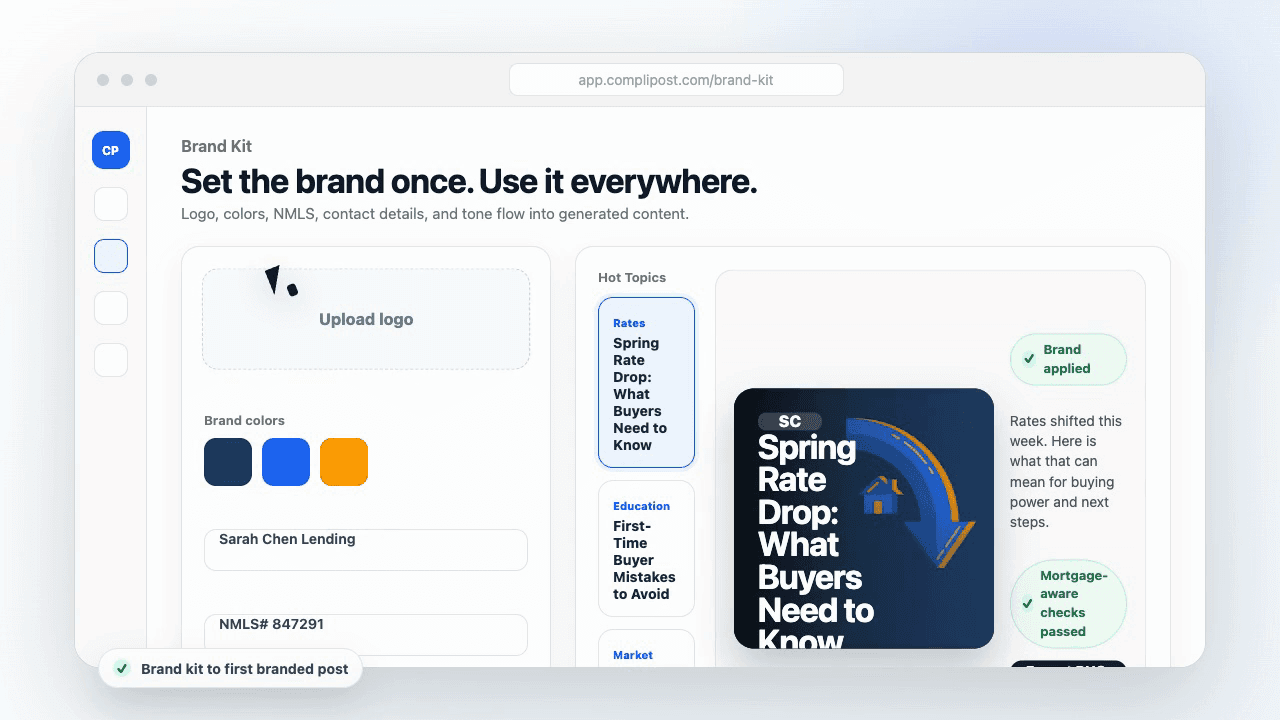
Product workflow
From blank page to export-ready mortgage content
- Start with a borrower topic
- Generate copy and a visual direction
- Review, save, and export the finished asset
These previews reflect the core CompliPost workflow: create, review, save, and export assets for use in your own channels.
Workflow comparison
| Content approach | What happens | Why it matters |
|---|---|---|
| Random posting | One-off ideas created when there is spare time | Inconsistent visibility and weak reuse |
| Template-only posting | Faster design but still requires rewriting and review | Helpful starting point, but not a full system |
| CompliPost workflow | Plan, generate, review, save, and export from one place | Better consistency with mortgage-aware review context |
| Done-for-you service | Someone else creates much of the content | Useful for some teams, but less control and less immediate reuse |
Who this guide helps
This guide is for loan officers working on solo loan officers who need a repeatable mortgage content workflow. The goal is to turn a broad mortgage topic into one borrower question, one useful takeaway, and one asset that can be reviewed before it is shared.
- You need content that sounds like a loan officer, not a generic brand account
- You want examples that can become captions, graphics, GIFs, or PDFs
- You need a clear place to review claims before export
- You want finished work saved for reuse, not lost in a chat thread
A practical workflow for this use case
Start with a narrow scenario, then move through planning, drafting, visual creation, review, and export. For down payment savings strategies, that means the topic should be specific enough that a borrower or referral partner can immediately understand what decision the content helps with.
- Choose the borrower type, loan topic, or platform before generating copy
- Draft the caption and visual together so the asset feels cohesive
- Use the federal baseline review aid to flag claims and disclosure gaps
- Export the finished asset and save the post as a reusable starting point
What makes the content stronger
Strong mortgage content is usually specific, plain-spoken, and calm. It explains tradeoffs without pretending one answer fits every borrower. That is especially important on public social channels, where a short post can be interpreted without the full context of a loan conversation.
- Name the borrower question in the first line
- Explain one decision or tradeoff instead of covering everything
- Use examples without implying approval, savings, or rate outcomes
- End with a soft next step, checklist, or guide rather than pressure
Compliance-aware review notes
CompliPost should be treated as a review aid, not a compliance approval system. The public page, generated draft, graphic, and exported asset should all stay honest about that boundary.
- Review specific payment, APR, rate, savings, and qualification language
- Avoid “best,” “lowest,” “guaranteed,” “free,” and urgency claims unless approved
- Check NMLS, Equal Housing, company, and state-specific requirements
- Use company or legal review for anything outside the federal baseline
How this connects to the rest of CompliPost
A focused guide should leave you with a usable next step. After you understand the topic, you can turn it into a calendar slot, a reviewed social post, a downloadable guide, or a platform-specific version for the channel where your audience already spends time.
- Use the content calendar to turn the idea into a weekly plan
- Use the compliance page when claims or disclosures need a slower pass
- Use lead magnets when the topic deserves a deeper PDF guide
- Use platform pages to adapt the same idea for LinkedIn, Facebook, or Instagram
Recommended next steps
Down payment assistance hub
Create borrower education around down payment help.
Down Payment Help Types: Grants, Loans, and Gifts Explained
Understand all the major types of down payment assistance.
Down Payment Help for First-Time Buyers
Explore assistance programs available to first-time buyers.
Down Payment Help: Questions to Ask Your Lender
Discuss your savings and assistance plan with your lender.
Examples
FAQ
How long should I plan to save for a down payment?+
It depends on your target and income. If you're aiming for a $20,000 down payment and can save $500/month, you're looking at 40 months (3+ years). With a $10,000 grant, you only need $10,000, reducing the timeline to 20 months. Apply for assistance early to reduce your personal savings burden. If you can save aggressively (over 10% of income), you can reach a down payment in 1–2 years.
Should I save aggressively or apply for assistance first?+
Apply for assistance first. Why save $20,000 if you can get a $10,000 grant? Knowing the assistance available reduces your personal savings target. Start applying for assistance (grants, employer programs, state programs) immediately, then set a realistic personal savings goal based on the assistance you expect. This takes weeks or months; meanwhile, you can save. By the time you're ready to apply for a mortgage, you have both savings and assistance lined up.
Will my lender care if my savings came from selling stuff or side income?+
Not as long as it's documented. If you sold a car and deposited the proceeds, show the bill of sale and deposit slip. If you did freelance work, show invoices and deposits. If you sold items online, the lender might ask for documentation but typically accepts it. The key is showing that the money is legitimate income or asset sales, not borrowed funds. Transparency is key.
What if I receive a large bonus right before closing—will it affect my approval?+
Tell your lender immediately. Large deposits near closing trigger underwriting questions. Show the bonus on a paystub or award letter, and the lender will verify it with your employer. Most bonuses are accepted as income; the lender just needs to verify it's real. Hiding a bonus or large deposit can cause closing delays, so transparency upfront is better than surprises later.
Is there a minimum amount I need to have saved before I qualify for assistance?+
No. Many assistance programs have no savings requirement; they only require income documentation. Some programs even prefer borrowers who are saving actively (showing financial discipline) but don't require a minimum. If you're starting from zero savings, you can often qualify for a grant or second mortgage. Don't think you have to save a certain amount before applying—just apply.
Create mortgage content with a calmer workflow
CompliPost helps you plan, generate, review, save, and export useful mortgage content without pretending compliance or social distribution is automatic.
Start free