Benefits
Employer Down Payment Programs: A Hidden Benefit Many Borrowers Miss
Many employers offer down payment assistance as an employee benefit, but few employees know it exists. Programs vary from outright grants ($5,000–$25,000 free money) to matching contributions (you save, employer matches) to low-rate loans. Some employers partner with lenders; others manage programs directly. The key is checking your benefits early—you might qualify for significant help without realizing it.
Why employers offer down payment help
Employers offer down payment assistance to attract and retain talent, especially for professional roles where young employees struggle with housing costs. Teachers, healthcare workers, tech workers, and government employees often have access to programs. Employers see it as a benefit that builds loyalty and supports workforce stability. Some programs are direct (the employer funds it); others are partnerships with lenders or nonprofit organizations. The motivation is employer branding and retention, so the programs are genuine and well-funded.
- Employers target younger, high-potential employees who are cost-sensitive
- Programs build loyalty and reduce turnover
- Common in tech, healthcare, education, and government sectors
- Some are employer-funded; others are partnership programs with lenders
Types of employer programs
Employer down payment programs fall into a few categories: outright grants ($5k–$25k free money), matching contributions (you save $1,000, employer adds $1,000), forgivable loans (loans that are forgiven if you stay X years), and low-rate loans (employer provides capital at preferential rates). Some programs cap how much you can use annually or require you to stay employed for a vesting period. Always read the plan document to understand vesting, repayment, and any conditions attached.
- Grants: free money, no repayment, no conditions
- Matching: you contribute, employer matches (often 1:1 or 50 cents per dollar)
- Forgivable loans: repayment waived if you stay employed for X years
- Low-rate loans: employer provides below-market rates, must repay
How to find employer programs
Start with your benefits guide—down payment assistance is usually listed under housing benefits or employee programs. If the guide doesn't mention it, call HR or your benefits administrator and ask directly: 'Does our company offer down payment assistance?' Many HR reps don't proactively mention housing benefits because they assume employees will ask. Larger employers (100+ employees) are more likely to have programs; smaller companies may not. Ask before you assume it doesn't exist.
- Check your benefits guide or handbook for 'housing,' 'down payment,' or 'homebuyer' sections
- Call HR or benefits administrator and ask directly
- Ask whether the program is direct funding or a partnership with a lender
- If your company doesn't have one, check whether a trade association or professional group offers programs
How to apply and coordinate with your mortgage
Once you've confirmed your employer offers down payment help, get the application and start early. Programs may take weeks to process, so timing is crucial. Some employers require you to apply and receive approval before you start the mortgage process; others allow you to apply during mortgage underwriting. Coordinate with your lender: tell them about the employer program and provide the formal award letter once you have approval. The lender will verify the program and include it in the down payment strategy.
- Apply for employer program early—don't wait until mortgage application
- Gather required documentation: proof of employment, income verification
- Get a formal award letter from the program to show your lender
- Tell your lender about the program during application so they can account for it
- Confirm timing: does employer funding arrive at closing or after?
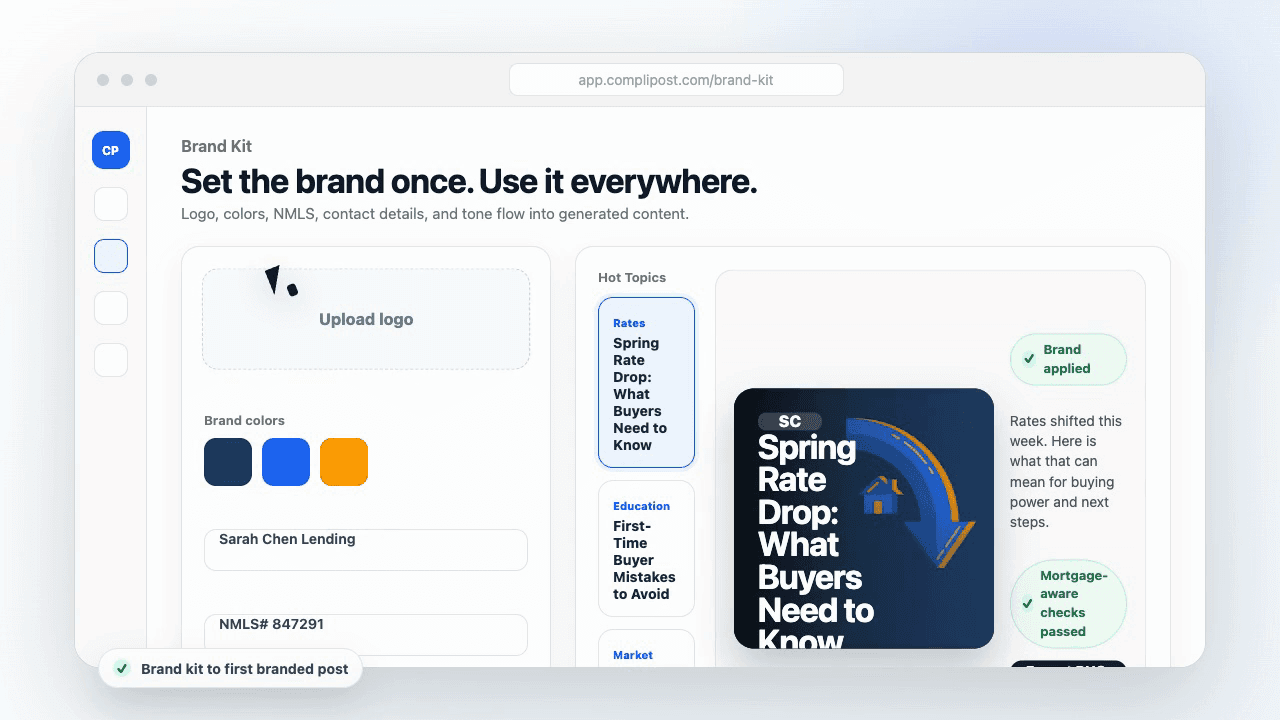
Product workflow
From blank page to export-ready mortgage content
- Start with a borrower topic
- Generate copy and a visual direction
- Review, save, and export the finished asset
These previews reflect the core CompliPost workflow: create, review, save, and export assets for use in your own channels.
Workflow comparison
| Content approach | What happens | Why it matters |
|---|---|---|
| Random posting | One-off ideas created when there is spare time | Inconsistent visibility and weak reuse |
| Template-only posting | Faster design but still requires rewriting and review | Helpful starting point, but not a full system |
| CompliPost workflow | Plan, generate, review, save, and export from one place | Better consistency with mortgage-aware review context |
| Done-for-you service | Someone else creates much of the content | Useful for some teams, but less control and less immediate reuse |
Who this guide helps
This guide is for loan officers working on solo loan officers who need a repeatable mortgage content workflow. The goal is to turn a broad mortgage topic into one borrower question, one useful takeaway, and one asset that can be reviewed before it is shared.
- You need content that sounds like a loan officer, not a generic brand account
- You want examples that can become captions, graphics, GIFs, or PDFs
- You need a clear place to review claims before export
- You want finished work saved for reuse, not lost in a chat thread
A practical workflow for this use case
Start with a narrow scenario, then move through planning, drafting, visual creation, review, and export. For employer down payment assistance programs, that means the topic should be specific enough that a borrower or referral partner can immediately understand what decision the content helps with.
- Choose the borrower type, loan topic, or platform before generating copy
- Draft the caption and visual together so the asset feels cohesive
- Use the federal baseline review aid to flag claims and disclosure gaps
- Export the finished asset and save the post as a reusable starting point
What makes the content stronger
Strong mortgage content is usually specific, plain-spoken, and calm. It explains tradeoffs without pretending one answer fits every borrower. That is especially important on public social channels, where a short post can be interpreted without the full context of a loan conversation.
- Name the borrower question in the first line
- Explain one decision or tradeoff instead of covering everything
- Use examples without implying approval, savings, or rate outcomes
- End with a soft next step, checklist, or guide rather than pressure
Compliance-aware review notes
CompliPost should be treated as a review aid, not a compliance approval system. The public page, generated draft, graphic, and exported asset should all stay honest about that boundary.
- Review specific payment, APR, rate, savings, and qualification language
- Avoid “best,” “lowest,” “guaranteed,” “free,” and urgency claims unless approved
- Check NMLS, Equal Housing, company, and state-specific requirements
- Use company or legal review for anything outside the federal baseline
How this connects to the rest of CompliPost
A focused guide should leave you with a usable next step. After you understand the topic, you can turn it into a calendar slot, a reviewed social post, a downloadable guide, or a platform-specific version for the channel where your audience already spends time.
- Use the content calendar to turn the idea into a weekly plan
- Use the compliance page when claims or disclosures need a slower pass
- Use lead magnets when the topic deserves a deeper PDF guide
- Use platform pages to adapt the same idea for LinkedIn, Facebook, or Instagram
Recommended next steps
Down payment assistance hub
Create borrower education around down payment help.
Down Payment Help Types: Grants, Loans, and Gifts Explained
Understand all categories of down payment assistance, including employer programs.
Down Payment Help for First-Time Buyers
Explore assistance designed specifically for first-time homebuyers.
Down Payment Help: Questions to Ask Your Lender
Know what to ask your lender about coordinating employer and down payment programs.
Examples
FAQ
Can I use an employer down payment program if I'm switching jobs?+
It depends on the program's rules. Some programs vest over time—if you leave within 2–5 years, you must repay the funds. Some forgivable loans become due if you leave before the vesting period. Others have no strings attached and work even if you change jobs immediately. Always read the plan document and ask your HR administrator about leaving the company. If you're planning to switch jobs soon, factor this into your decision.
How much can I get from an employer program?+
It varies widely. Grants typically range from $2,000 to $25,000. Matching programs may cap at 5–10% of salary per year. Low-rate loans may have no cap if they're traditional lending products. Ask your program administrator for the maximum available and any annual limits. Some programs allow multiple draws over time; others are one-time gifts.
Do I have to use the employer program funds immediately?+
That depends on the program. Some funds must be used within 6–12 months of approval or they're forfeited. Others can be held indefinitely. Some programs allow you to defer receiving funds until you're ready to close. Ask the program administrator about use-it-or-lose-it deadlines so you can plan your mortgage timeline accordingly.
Can my lender work with my employer's program?+
Yes, most lenders are experienced with employer programs. Tell your lender during application that you have employer down payment help available. They'll ask for an award letter or formal documentation from the program. Some lenders have existing relationships with employer programs (especially large corporate programs) and have streamlined processes. Coordination between the lender and your employer program is important for smooth closing.
What if my employer doesn't have a down payment program?+
Some trade associations, professional groups, or alumni networks offer programs even if your employer doesn't. For example, teacher associations, engineering societies, or graduate alumni associations sometimes have down payment programs for members. Also, ask your union rep (if applicable)—some unions negotiate down payment assistance as a benefit. Finally, explore public down payment assistance programs and other options.
Create mortgage content with a calmer workflow
CompliPost helps you plan, generate, review, save, and export useful mortgage content without pretending compliance or social distribution is automatic.
Start free