Legal Professional
Mortgage Content for Attorneys with Side Business and Consulting Income
Many attorneys supplement their primary law practice income with consulting, expert witness work, or side legal services. This income is real but requires two years of documented history to count toward mortgage qualification. Your content for this segment should guide attorneys through documentation and show that well-documented side income strengthens applications.
How do lenders treat side business income for attorney borrowers?
Side business income is legitimate but requires documentation and history. Social content should normalize the earning pattern and show the path to qualification.
- Two-year requirement: most lenders want two years of tax returns showing side income before they'll count it
- Documentation: 1099s, Schedule C (if sole proprietor) or K-1 (if partnership), tax returns, and business bank statements
- Stability matters: lenders want to see income sustained or growing; declining side income may not qualify
- Professional vs. hobby: lenders evaluate whether side work is professional (consistent income) or hobby (irregular); frequency matters
- Impact on DTI: side income improves DTI if documented; can significantly increase borrowing power
What documentation strengthens side business income qualification?
Clear, organized documentation accelerates underwriting. Content should guide attorneys through the paper trail that makes side income count.
- Separate business bank account: shows that side income is tracked professionally, not commingled
- Contracts or retainer agreements: demonstrate that side work is ongoing, not one-time projects
- Tax returns with Schedule C or K-1: show the actual income reported to the IRS
- Recent 1099s: verify that the side income is recent and documented
- Business records: time tracking, invoices, client list; shows the work is professional and ongoing
What messaging appeals to attorney-consultants and side-business earners?
Attorneys with side income often worry it complicates qualification. Content should normalize the income and show that you value entrepreneurship.
- Acknowledge that many attorneys diversify income: consulting, expert witness, legal writing, etc.
- Show that well-documented side income strengthens applications
- Share stories of attorneys whose side income helped them qualify for larger mortgages
- Offer a consultation specifically for borrowers with side business income; highlight your experience
- Position yourself as the lender who supports attorney entrepreneurship
How do you help attorneys document and maximize side business income?
Export content that guides attorneys through documentation and strategic presentation. This is where you add real value.
- Create a side-income documentation checklist: tax returns, 1099s, contracts, bank statements
- Develop content on best practices for side business documentation (separate accounts, business structure, etc.)
- Build email sequences that guide attorneys through the qualification process with side income
- Offer to review documentation before formal application; reduce surprises and accelerate underwriting
- Export content as downloadable guides on side business structuring for maximum tax and mortgage benefit
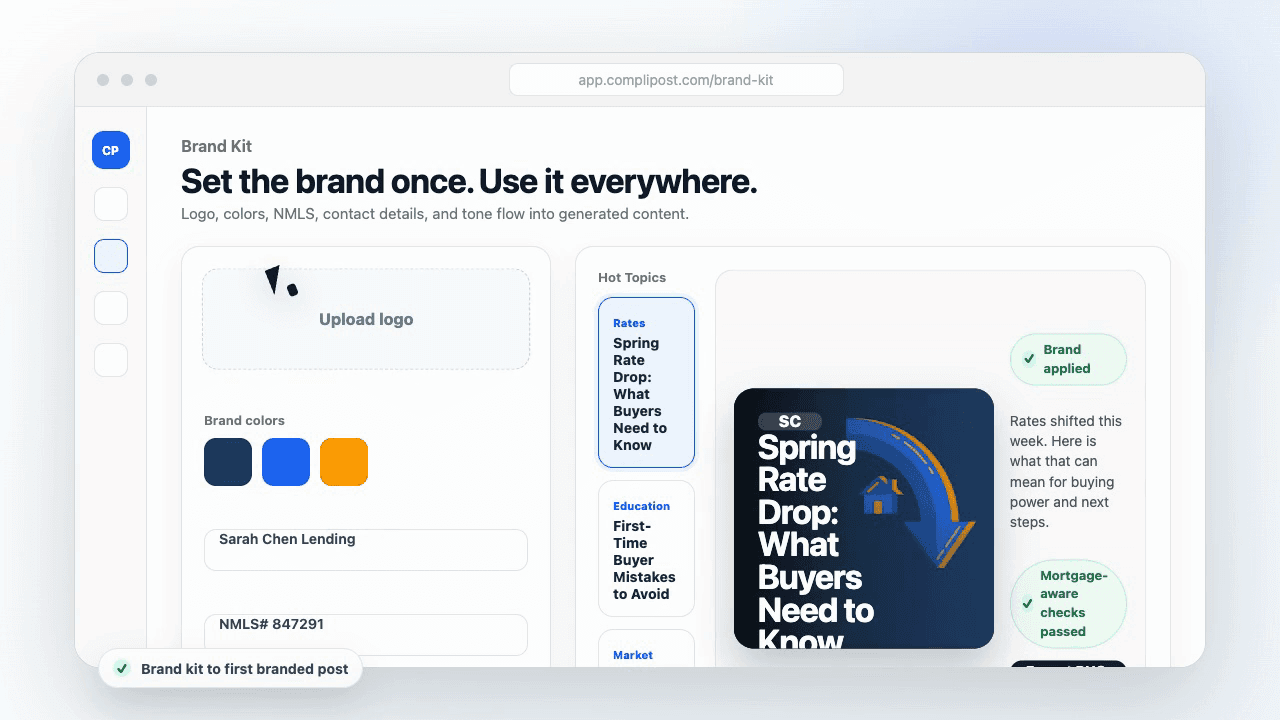
Product workflow
From blank page to export-ready mortgage content
- Start with a borrower topic
- Generate copy and a visual direction
- Review, save, and export the finished asset
These previews reflect the core CompliPost workflow: create, review, save, and export assets for use in your own channels.
Workflow comparison
| Content approach | What happens | Why it matters |
|---|---|---|
| Random posting | One-off ideas created when there is spare time | Inconsistent visibility and weak reuse |
| Template-only posting | Faster design but still requires rewriting and review | Helpful starting point, but not a full system |
| CompliPost workflow | Plan, generate, review, save, and export from one place | Better consistency with mortgage-aware review context |
| Done-for-you service | Someone else creates much of the content | Useful for some teams, but less control and less immediate reuse |
Who this guide helps
This guide is for loan officers working on solo loan officers who need a repeatable mortgage content workflow. The goal is to turn a broad mortgage topic into one borrower question, one useful takeaway, and one asset that can be reviewed before it is shared.
- You need content that sounds like a loan officer, not a generic brand account
- You want examples that can become captions, graphics, GIFs, or PDFs
- You need a clear place to review claims before export
- You want finished work saved for reuse, not lost in a chat thread
A practical workflow for this use case
Start with a narrow scenario, then move through planning, drafting, visual creation, review, and export. For attorney side business consulting mortgage income content, that means the topic should be specific enough that a borrower or referral partner can immediately understand what decision the content helps with.
- Choose the borrower type, loan topic, or platform before generating copy
- Draft the caption and visual together so the asset feels cohesive
- Use the federal baseline review aid to flag claims and disclosure gaps
- Export the finished asset and save the post as a reusable starting point
What makes the content stronger
Strong mortgage content is usually specific, plain-spoken, and calm. It explains tradeoffs without pretending one answer fits every borrower. That is especially important on public social channels, where a short post can be interpreted without the full context of a loan conversation.
- Name the borrower question in the first line
- Explain one decision or tradeoff instead of covering everything
- Use examples without implying approval, savings, or rate outcomes
- End with a soft next step, checklist, or guide rather than pressure
Compliance-aware review notes
CompliPost should be treated as a review aid, not a compliance approval system. The public page, generated draft, graphic, and exported asset should all stay honest about that boundary.
- Review specific payment, APR, rate, savings, and qualification language
- Avoid “best,” “lowest,” “guaranteed,” “free,” and urgency claims unless approved
- Check NMLS, Equal Housing, company, and state-specific requirements
- Use company or legal review for anything outside the federal baseline
How this connects to the rest of CompliPost
A focused guide should leave you with a usable next step. After you understand the topic, you can turn it into a calendar slot, a reviewed social post, a downloadable guide, or a platform-specific version for the channel where your audience already spends time.
- Use the content calendar to turn the idea into a weekly plan
- Use the compliance page when claims or disclosures need a slower pass
- Use lead magnets when the topic deserves a deeper PDF guide
- Use platform pages to adapt the same idea for LinkedIn, Facebook, or Instagram
Recommended next steps
Self-employed borrower hub
Create income-documentation education for self-employed borrowers.
Self-Employed Bank Statement Loan Officer Content
Content strategy for financing self-employed borrowers with variable income documentation.
Attorney Mortgage Guide
Comprehensive guide for attorney borrowers including side business strategies.
Income Documentation and Qualification Requirements
Detailed breakdown of documentation for various income types.
Examples
"Attorney with $120K law practice income + $30K annual consulting income. Here's how the side business boosted her mortgage qualification."
Share as a case study showing the impact of documented side income.
"Expert witness work as a side business? Here's how lenders evaluate consulting income."
Educational post addressing common side income questions from attorneys.
"Your 1099s and consulting contracts are gold for mortgage qualification. Here's what lenders want to see."
Create a documentation guide specific to side business income.
"Side business income strategy: separate accounts, documentation, and timing for mortgage qualification."
Write as a comprehensive guide for attorney-consultants.
FAQ
When can I count my side consulting income toward a mortgage application?+
After you have two years of documented income. Most lenders require two years of tax returns showing the side income before they'll count it. If you're in year one of consulting, wait until you have year-two tax returns. Some lenders (particularly portfolio lenders) may count side income after 12 months with strong documentation (retainer agreements, 1099s, business bank statements), but this is less common. If you're in year two or beyond, bring two years of tax returns, recent 1099s, and any retainer or service agreements showing the income is ongoing. The clearer the documentation, the more likely lenders count it.
Should I keep side business income and law practice income separate (different bank accounts)?+
Yes, absolutely. Separating business income into different bank accounts makes documentation clean and underwriting fast. Commingling income makes it harder for lenders to verify what portion is from consulting vs. law practice. Use a separate business account for your side business; it shows professionalism and accelerates the mortgage underwriting process. It's also better for tax and accounting purposes. If you haven't separated accounts yet, consider doing so before you apply for the mortgage; it strengthens your application.
Does declining side income disqualify me from using it?+
Not necessarily, but declining income is evaluated carefully. If year one of consulting was $40K and year two was $25K, lenders may only count $25K or average the two at $32.5K. If the decline is temporary and you have contracts showing recovery, explain that. If the decline is permanent (you're winding down consulting), lenders may not count it going forward. Be transparent about the trend and provide context. Recent 1099s and retainer agreements showing current and ongoing income help. If your side income is stable or growing, you're in a stronger position.
Can I use a letter from my consulting client as proof of ongoing income?+
A letter helps, but lenders primarily want tax returns and 1099s. A letter from a client stating the ongoing retainer or engagement is supplementary documentation; it doesn't replace the two-year tax return requirement. If you have a signed service agreement with your client showing the ongoing retainer, that's valuable—bring it. But the core documentation lenders want is tax returns (showing historical income) and recent 1099s or business bank statements (showing current income). Build your documentation: two years of tax returns + recent 1099s + service agreement = strong case for including side income.
Should I incorporate my side business as an LLC or S-corp before applying for a mortgage?+
Don't restructure specifically for the mortgage unless you're planning it for tax reasons with your CPA. Restructuring (changing from sole proprietor Schedule C to LLC or S-corp) creates a tax return gap that complicates underwriting. If you're thinking about incorporating for legitimate tax planning, do it well before you apply for the mortgage—ideally a year ahead so you have tax returns under the new structure. If you're currently a sole proprietor reporting side income on Schedule C and it's working for tax purposes, don't change it just to apply for the mortgage. Consult your CPA on the long-term tax strategy, and coordinate timing with your loan officer if any restructuring is planned.
Create mortgage content with a calmer workflow
CompliPost helps you plan, generate, review, save, and export useful mortgage content without pretending compliance or social distribution is automatic.
Start free