Legal Professional
Social Content for Attorneys Managing Law School Debt and Mortgage Qualification
Law school debt is substantial and often the biggest obstacle to attorney homeownership. Your content for this segment should normalize the challenge, explain how DTI is calculated with education debt, and show concrete paths to qualification. Position yourself as the lender who understands law school debt and doesn't judge it—this is expected in the legal profession.
How much does law school debt really affect my mortgage qualification?
This is the question keeping many attorneys up at night. Content should provide honest math, show real scenarios, and explain that significant debt is not disqualifying when paired with attorney income. Make this concrete and less scary.
- DTI calculation includes all debts: student loans, credit cards, car loans—these reduce your mortgage capacity
- High debt-to-income ratio can limit your mortgage size, but doesn't disqualify you if income is sufficient
- Attorney income supports attorney debt: lenders expect attorneys to carry education debt; this is baked into their underwriting
- Repayment strategy matters: income-driven repayment can lower your monthly payment, improving DTI
- Timing is key: waiting to pay down student debt before buying may not be optimal; buying now while building equity may be smarter
What are the best repayment strategies for attorneys buying homes?
Repayment strategy directly affects mortgage qualification. Content should explain the major options and show how each affects DTI and overall financial position. This is where lenders add real value.
- Standard 10-year repayment: highest monthly payment, fastest payoff, minimal mortgage impact savings
- Income-driven repayment (PAYE, REPAYE, IBR, ICR): lower monthly payment (good for DTI), but possible tax bill at forgiveness
- PSLF path: lower payments, forgiveness after ten years of public service, but requires committed career plan
- Refinance private loans: can lower rates if you have good credit, but gives up federal protections
- Hybrid approach: aggressive paydown for some loans, income-driven for others—coordinate with loan officer
How do you position yourself as the loan officer who understands attorney debt?
Attorneys need a lender who gets it—who doesn't make them feel irresponsible about debt, and who can articulate how to work with it. Social content should show expertise and empathy.
- Acknowledge the reality: law school costs real money; debt is expected
- Show the math: present real scenarios of attorneys with $100K-$200K+ debt who qualified for mortgages
- Offer strategic guidance: help borrowers think through repayment vs. buying timing vs. wealth building
- Partner with career counselors and student loan advisors: cross-refer clients and build joint content
- Create attorney-specific resources: calculators, scenario planning, repayment strategy guides
How do you help attorneys plan the buying timeline when they're managing education debt?
The decision to buy isn't just financial—it's strategic. Content should help attorneys think through the timeline and decision-making process. Export this as planning guides, consultation frameworks, and educational tools.
- Create a decision matrix: buy now and delay debt paydown, or wait and build home equity?
- Develop DTI scenarios: show how different repayment strategies affect mortgage capacity
- Build email sequences that walk attorneys through the planning process step-by-step
- Offer a free consultation specifically for attorneys with education debt; charge for detailed financial planning
- Export content as downloadable guides and calculators specific to attorney finances
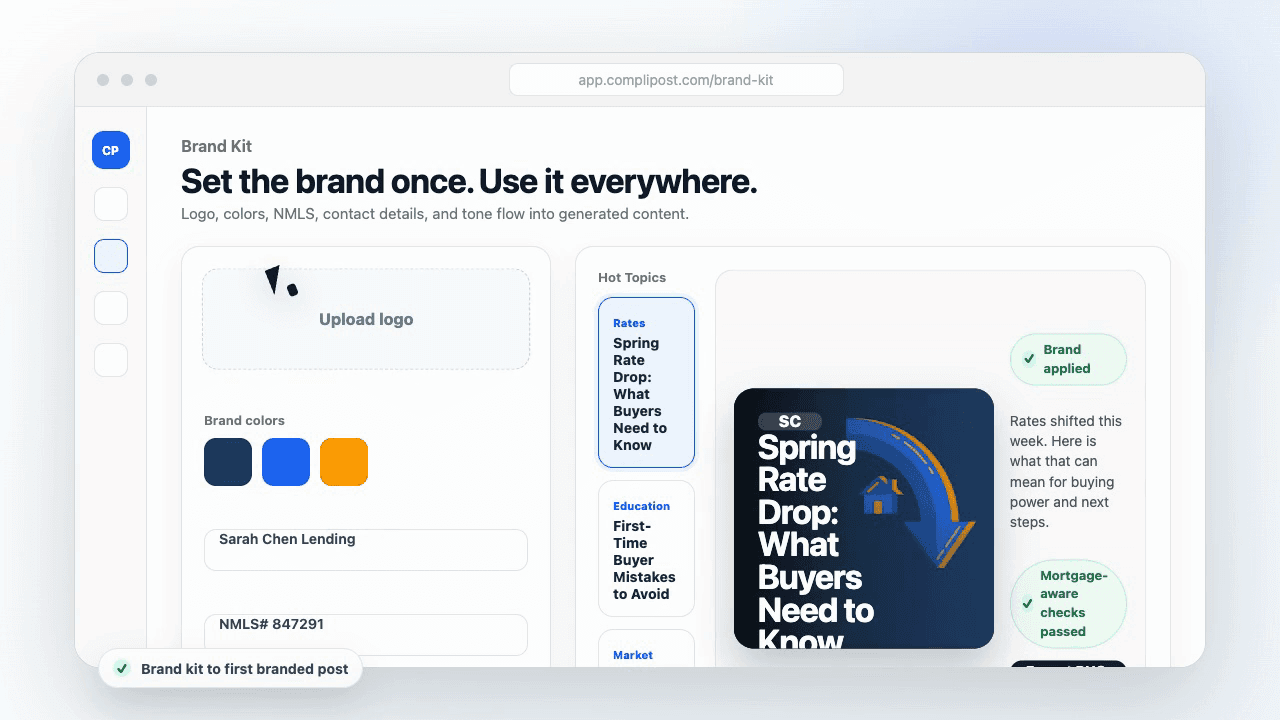
Product workflow
From blank page to export-ready mortgage content
- Start with a borrower topic
- Generate copy and a visual direction
- Review, save, and export the finished asset
These previews reflect the core CompliPost workflow: create, review, save, and export assets for use in your own channels.
Workflow comparison
| Content approach | What happens | Why it matters |
|---|---|---|
| Random posting | One-off ideas created when there is spare time | Inconsistent visibility and weak reuse |
| Template-only posting | Faster design but still requires rewriting and review | Helpful starting point, but not a full system |
| CompliPost workflow | Plan, generate, review, save, and export from one place | Better consistency with mortgage-aware review context |
| Done-for-you service | Someone else creates much of the content | Useful for some teams, but less control and less immediate reuse |
Who this guide helps
This guide is for loan officers working on solo loan officers who need a repeatable mortgage content workflow. The goal is to turn a broad mortgage topic into one borrower question, one useful takeaway, and one asset that can be reviewed before it is shared.
- You need content that sounds like a loan officer, not a generic brand account
- You want examples that can become captions, graphics, GIFs, or PDFs
- You need a clear place to review claims before export
- You want finished work saved for reuse, not lost in a chat thread
A practical workflow for this use case
Start with a narrow scenario, then move through planning, drafting, visual creation, review, and export. For attorney law school debt mortgage qualification, that means the topic should be specific enough that a borrower or referral partner can immediately understand what decision the content helps with.
- Choose the borrower type, loan topic, or platform before generating copy
- Draft the caption and visual together so the asset feels cohesive
- Use the federal baseline review aid to flag claims and disclosure gaps
- Export the finished asset and save the post as a reusable starting point
What makes the content stronger
Strong mortgage content is usually specific, plain-spoken, and calm. It explains tradeoffs without pretending one answer fits every borrower. That is especially important on public social channels, where a short post can be interpreted without the full context of a loan conversation.
- Name the borrower question in the first line
- Explain one decision or tradeoff instead of covering everything
- Use examples without implying approval, savings, or rate outcomes
- End with a soft next step, checklist, or guide rather than pressure
Compliance-aware review notes
CompliPost should be treated as a review aid, not a compliance approval system. The public page, generated draft, graphic, and exported asset should all stay honest about that boundary.
- Review specific payment, APR, rate, savings, and qualification language
- Avoid “best,” “lowest,” “guaranteed,” “free,” and urgency claims unless approved
- Check NMLS, Equal Housing, company, and state-specific requirements
- Use company or legal review for anything outside the federal baseline
How this connects to the rest of CompliPost
A focused guide should leave you with a usable next step. After you understand the topic, you can turn it into a calendar slot, a reviewed social post, a downloadable guide, or a platform-specific version for the channel where your audience already spends time.
- Use the content calendar to turn the idea into a weekly plan
- Use the compliance page when claims or disclosures need a slower pass
- Use lead magnets when the topic deserves a deeper PDF guide
- Use platform pages to adapt the same idea for LinkedIn, Facebook, or Instagram
Recommended next steps
Self-employed borrower hub
Create income-documentation education for self-employed borrowers.
Student Loan Debt and Mortgage Qualification
Comprehensive breakdown of how student loans affect mortgage qualification and DTI.
Attorney Mortgage Guide
Full guide for attorney borrowers including education debt strategies.
Debt-to-Income Ratio Calculation and Qualification
Detailed explanation of DTI math and qualification strategy.
Examples
"Attorney, $140K salary, $180K student debt. Here's the mortgage she got and the repayment strategy that made it work."
Share as a case study on LinkedIn or in-depth blog post with real numbers and decision framework.
"Should you pay down student loans before buying? Here's what the math says."
Create a detailed comparison showing scenarios: aggressive debt paydown vs. buying now.
"Law school debt doesn't disqualify you—your income does. Here's the calculation that matters."
Educational post explaining DTI and how attorney income is evaluated relative to education debt.
"Income-driven repayment + homeownership = here's the strategy that actually works."
Write as a comprehensive guide for attorneys managing both education debt and mortgage planning.
FAQ
I have $150K in student debt and a $120K salary. Can I really qualify for a mortgage?+
Yes, and you're not alone. Attorneys routinely carry education debt larger than their starting salary. What matters is your debt-to-income ratio. Using simplified numbers: if your student loan payment is $1,500/month and your gross income is $10,000/month, your DTI from student loans alone is 15%. If you add other debts (car, credit card) and then calculate the mortgage payment lenders will support, you'll likely qualify for a mortgage in the $350K-$450K range (depending on your credit, down payment, and full debt picture). The exact number depends on your situation, but the answer is almost always yes. Talk to a loan officer; they'll run your actual numbers and show you what you can afford.
Which repayment strategy is best for my mortgage qualification?+
Income-driven repayment (PAYE, REPAYE, IBR) lowers your monthly payment, which improves your DTI and mortgage qualification. However, you may owe taxes on forgiven debt if you don't reach PSLF. Standard 10-year repayment has a higher monthly payment but no tax surprise at the end. The answer depends on your long-term career plans and whether you're pursuing PSLF. Work with your CPA and loan officer before applying for the mortgage. Some attorneys strategically use income-driven repayment to maximize borrowing power, planning to refinance the mortgage later or switch repayment strategies. Others prefer the simplicity and certainty of standard repayment. There's no universally right answer—your situation is unique.
Should I try to pay down student loans before applying for a mortgage?+
This depends on your timeline and financial capacity. If you have six months to aggressively pay down debt and improve your DTI substantially, that may be worth it. If it would take you years to make a dent in six-figure debt, the opportunity cost of delaying homeownership (and building equity) probably isn't worth it. A better strategy: apply for the mortgage now with your current debt picture, see what you qualify for, and then decide whether waiting makes sense. Once you own a home, you're building equity; meanwhile, you can still work on debt paydown. Talk this through with your loan officer and a financial advisor.
If I refinance my private student loans, does that affect my mortgage qualification?+
Refinancing private loans (with a private lender) creates a new debt obligation that shows up on your credit report and affects your DTI. If you're refinancing to a lower rate and lower payment, the new payment is what matters for your mortgage qualification—so it may actually help. If you're refinancing to a higher payment, it hurts. Federal loans refinanced privately lose federal protections (income-driven repayment, deferment options, PSLF eligibility), so make sure the benefit outweighs the lost protections. Time any student loan refinancing before you apply for the mortgage so your loan officer can see your final debt picture. Never refinance loans during the mortgage application process; it complicates underwriting.
Can I use a PSLF plan to improve my mortgage qualification?+
Yes, if it's genuine. If you're committed to public service for ten years and pursuing PSLF, using income-driven repayment lowers your monthly payment and improves your DTI immediately. This makes sense if you're truly committed to the path. If you're not genuinely planning to stay in public service, don't use PSLF strategy to game your mortgage qualification—lenders will see through it, and you'll be setting yourself up for a tax bill you didn't plan for. Assuming you're sincere about PSLF, income-driven repayment is a legitimate financial planning tool that can improve your mortgage capacity. Coordinate with your CPA and loan officer.
Create mortgage content with a calmer workflow
CompliPost helps you plan, generate, review, save, and export useful mortgage content without pretending compliance or social distribution is automatic.
Start free