Legal Professional
Mortgage Content for Judicial Clerks and Law Clerks
Judicial clerks occupy a unique position: excellent salary for a short tenure (usually one to two years), followed by transition to private practice, government, or academia. Your content for this segment should address the real challenge—how to qualify for a mortgage when you know you're changing jobs soon. Position yourself as the lender who understands judicial careers and can bridge the gap between clerkship and the next chapter.
What's unique about the financial picture of a judicial clerk?
Clerks have solid income during their clerkship but face a planned career transition. Lenders view this carefully: they want assurance that you have a path after the clerkship ends. Social content should acknowledge this reality and show that lenders have strategies to work with it—typically by looking at post-clerkship income, solid credit, and strong assets.
- Income is temporary: the clerkship is one to two years; lenders need to understand your post-clerkship plan
- Post-clerkship income varies: some clerks join law firms, others go to government, academics, or policy work
- Credit and assets matter more: with limited tenure, lenders rely heavily on credit history and assets to assess stability
- The transition period is key: ideally, you have a job offer or signed contract with your next employer before the clerkship ends
- Career prestige is an asset: federal clerkship experience is highly valued in the legal market; this signals stability post-clerkship
How do lenders evaluate income after a clerkship ends?
This is where documentation becomes critical. Clerks who can show a signed offer letter or contract with their next employer significantly improve their qualification. Content should guide clerks through the documentation path and explain what lenders need to see.
- Offer letter from next employer: this is gold; start the mortgage application once you have a signed offer
- Timeline alignment: ideally, your clerkship ends and your new job starts with minimal gap; lenders want to see continuity
- Salary comparison: if your post-clerkship job pays less, lenders may allow a gap but will want to see the decrease isn't dramatic
- Alternative income sources: if you're transitioning to a lower-paying role, assets or side income can help offset the decrease
- Delay the application: consider waiting to apply until you have your next position locked in; it eliminates qualification complexity
What messaging resonates with judicial clerks and their career transitions?
Clerks are high-achievers accustomed to excellence and prestige. They respond to content that respects their career trajectory and acknowledges the specific challenges they face. Avoid treating them as entry-level; frame them as strategists planning their next moves.
- Acknowledge the clerkship-to-practice transition; many young attorneys are navigating this for the first time
- Share stories of clerks who successfully purchased homes while navigating career transitions
- Highlight the value of federal or prestigious state clerkship on your application (lenders see this as a signal of competence)
- Offer specific guidance on the offer letter and timing strategy; position yourself as a strategic partner
- Create content targeting law school hiring events or clerkship application seasons
How do you help clerks plan the mortgage timeline around their career transition?
Timing is everything. Content should guide clerks through the decision: apply during clerkship, after securing an offer, or wait until settling in the next role. Export this as a strategic planning guide and consultation framework.
- Create a timeline tool: when to start mortgage conversations, when to formally apply, when to lock a rate
- Develop content around the three scenarios: apply during clerkship, apply with offer letter, apply after starting new job
- Build email sequences for clerks: when you should be talking to your loan officer relative to your clerkship end date
- Partner with clerkship placement organizations and law schools to reach clerks during placement seasons
- Export content as downloadable timelines and strategic guides for individuals and firms recruiting clerks
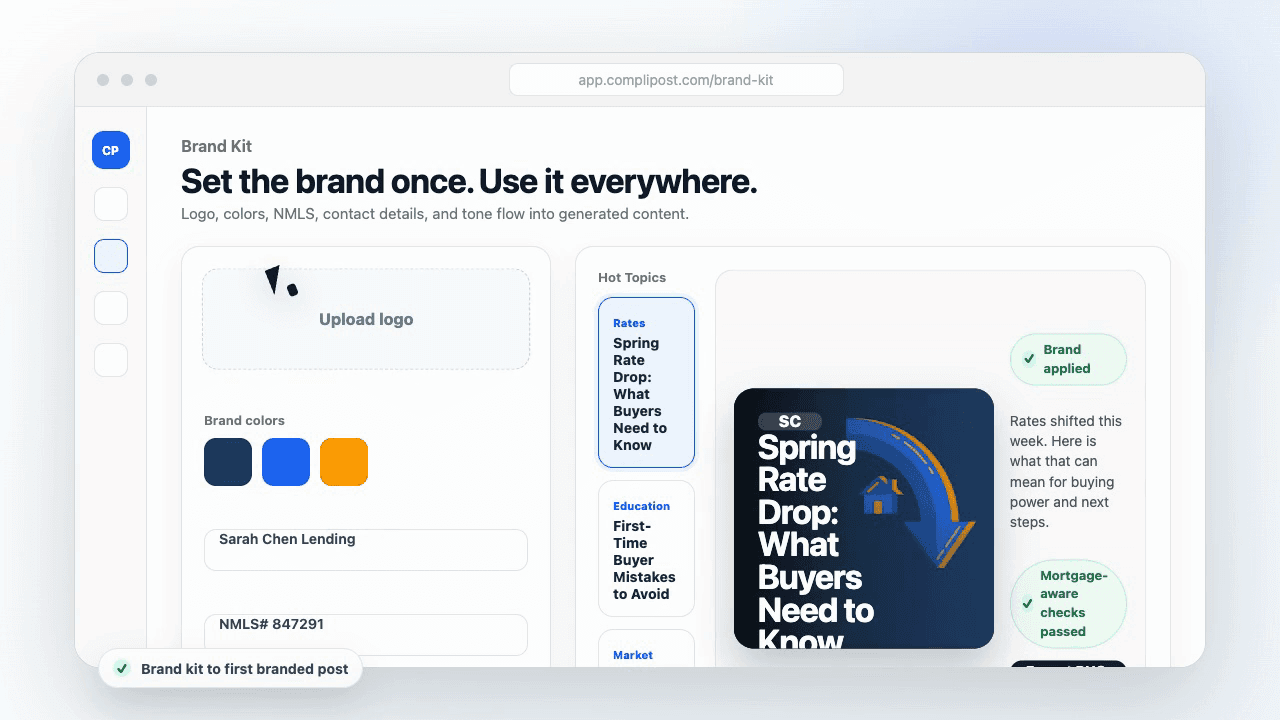
Product workflow
From blank page to export-ready mortgage content
- Start with a borrower topic
- Generate copy and a visual direction
- Review, save, and export the finished asset
These previews reflect the core CompliPost workflow: create, review, save, and export assets for use in your own channels.
Workflow comparison
| Content approach | What happens | Why it matters |
|---|---|---|
| Random posting | One-off ideas created when there is spare time | Inconsistent visibility and weak reuse |
| Template-only posting | Faster design but still requires rewriting and review | Helpful starting point, but not a full system |
| CompliPost workflow | Plan, generate, review, save, and export from one place | Better consistency with mortgage-aware review context |
| Done-for-you service | Someone else creates much of the content | Useful for some teams, but less control and less immediate reuse |
Who this guide helps
This guide is for loan officers working on solo loan officers who need a repeatable mortgage content workflow. The goal is to turn a broad mortgage topic into one borrower question, one useful takeaway, and one asset that can be reviewed before it is shared.
- You need content that sounds like a loan officer, not a generic brand account
- You want examples that can become captions, graphics, GIFs, or PDFs
- You need a clear place to review claims before export
- You want finished work saved for reuse, not lost in a chat thread
A practical workflow for this use case
Start with a narrow scenario, then move through planning, drafting, visual creation, review, and export. For judicial clerk law clerk mortgage content, that means the topic should be specific enough that a borrower or referral partner can immediately understand what decision the content helps with.
- Choose the borrower type, loan topic, or platform before generating copy
- Draft the caption and visual together so the asset feels cohesive
- Use the federal baseline review aid to flag claims and disclosure gaps
- Export the finished asset and save the post as a reusable starting point
What makes the content stronger
Strong mortgage content is usually specific, plain-spoken, and calm. It explains tradeoffs without pretending one answer fits every borrower. That is especially important on public social channels, where a short post can be interpreted without the full context of a loan conversation.
- Name the borrower question in the first line
- Explain one decision or tradeoff instead of covering everything
- Use examples without implying approval, savings, or rate outcomes
- End with a soft next step, checklist, or guide rather than pressure
Compliance-aware review notes
CompliPost should be treated as a review aid, not a compliance approval system. The public page, generated draft, graphic, and exported asset should all stay honest about that boundary.
- Review specific payment, APR, rate, savings, and qualification language
- Avoid “best,” “lowest,” “guaranteed,” “free,” and urgency claims unless approved
- Check NMLS, Equal Housing, company, and state-specific requirements
- Use company or legal review for anything outside the federal baseline
How this connects to the rest of CompliPost
A focused guide should leave you with a usable next step. After you understand the topic, you can turn it into a calendar slot, a reviewed social post, a downloadable guide, or a platform-specific version for the channel where your audience already spends time.
- Use the content calendar to turn the idea into a weekly plan
- Use the compliance page when claims or disclosures need a slower pass
- Use lead magnets when the topic deserves a deeper PDF guide
- Use platform pages to adapt the same idea for LinkedIn, Facebook, or Instagram
Recommended next steps
Self-employed borrower hub
Create income-documentation education for self-employed borrowers.
Attorney Mortgage Guide
Comprehensive guide for attorney borrowers across practice types and career stages.
Income Documentation and Qualification Requirements
Detailed breakdown of how different income sources and employment types are documented for mortgages.
First-Time Buyer vs. Experienced Buyer Lending
Guide addressing first-time home buyer considerations and strategies.
Examples
"Clerk, good salary, job ending in 6 months. Here's the mortgage strategy that lets you buy before you transition."
Share as a LinkedIn post or detailed email guide; address timing and offer letter strategy.
"Your clerkship is an asset in your mortgage application—here's how to frame it."
Educational post explaining how lenders view judicial clerkship experience and why it matters.
"Transitioning from clerkship to law firm (or government)? Three mortgage strategies for planned career changes."
Create a comprehensive guide addressing different post-clerkship destinations.
"Federal clerkship + law firm offer = here's the mortgage path. (And it's faster than you think.)"
Write as a case study or strategic breakdown for clerks with signed offers.
FAQ
Can I apply for a mortgage while I'm still a judicial clerk if my clerkship ends in 6 months?+
Yes, but success depends on your post-clerkship plan. If you have a signed offer letter from your next employer, you're in great shape—lenders will evaluate you based on that offer's salary and terms. If your clerkship ends and you're still job hunting, underwriting becomes trickier. Most lenders will allow a brief gap (30-90 days), but they want to see a clear path to employment. The ideal scenario: apply during your clerkship with an offer letter in hand, so underwriting can proceed on the strength of the offer. If you don't have an offer yet, have a serious conversation with your loan officer about timing. You may be better off waiting until you've locked in your next position.
What if my post-clerkship salary is lower than my clerkship salary?+
It happens often—clerks sometimes move to lower-paying government jobs, nonprofits, or academia. If the salary decrease is modest (say, $120K clerkship to $110K law firm job), lenders may not care; they're evaluating your stable income going forward. If the decrease is significant (clerkship to public interest, for example), lenders will look at your overall financial picture: credit, assets, debt. They may approve you for a slightly smaller mortgage or require a co-signer, but the decrease itself isn't disqualifying. The key: get your post-clerkship offer letter in front of your loan officer early. They'll tell you exactly how the salary change affects your qualification and what you can do about it.
Should I buy before or after my clerkship ends?+
Ideally, you close *before* your clerkship ends, while your clerkship income is supporting the qualification. This requires having an offer letter from your next employer so that lenders feel confident about your post-clerkship income. If you don't have an offer yet, wait until you do. Applying after your clerkship has ended (and before your new job starts) creates a qualification nightmare—lenders see employment gap, and your income documentation becomes messy. If you can swing it, have your next position locked in before you close on the home. If that's not possible, consult with your loan officer on the timing; they may recommend a bridge strategy or waiting until you've started the new job.
What documentation do I need from a federal court employer for a mortgage application?+
For a federal clerkship, you need recent paystubs (typically two to three months) and a letter from the chambers verifying your employment and salary. Federal employers are straightforward from a lending perspective; your salary is fixed, there's no commission or bonus, and your tenure is easily verified. Bring your offer letter for the clerkship and a brief statement from your judge's office confirming your role and compensation. For post-clerkship employment, bring your offer letter or employment contract with your new employer. Lenders will verify both the current clerkship (to confirm you're employed) and the next job (to confirm you have income post-clerkship).
Does my judicial clerkship give me any advantage in a mortgage application?+
Yes, indirectly. Federal and prestigious state clerkships signal competence, selectivity, and professional achievement to lenders. This doesn't change your qualification numbers, but it may influence how your loan officer presents your application to underwriting or whether a lender is willing to work with you on a borderline scenario. More importantly, the clerkship is likely a springboard to a strong career path—your next job offer will be in a prestigious firm, government agency, or academic institution. Lenders view judicial clerks favorably because they're typically well-positioned for stable, professional careers. So the advantage is less about the clerkship itself and more about what comes after it. Make sure your post-clerkship offer is clear and strong; that's what moves the needle.
Create mortgage content with a calmer workflow
CompliPost helps you plan, generate, review, save, and export useful mortgage content without pretending compliance or social distribution is automatic.
Start free