Legal Professional
Social Content for Asset-Rich Attorneys with Lower Current Income
Some attorneys have substantial assets (investments, inheritances, retirement accounts, real estate) but lower current W-2 or practice income. Traditional income-based lending underestimates their financial strength. Your content for this segment should address asset-based lending and show that net worth matters alongside income.
Can I qualify for a mortgage based on assets instead of income?
Yes, with the right lender and loan program. Social content should explain asset-based lending and show that borrowers with strong net worth have options.
- Asset-based loans: evaluate net worth and liquid assets; alternative to income-focused underwriting
- Portfolio loans: lenders hold mortgages; can use flexible underwriting including assets
- Qualified mortgages: traditional conforming loans focus on income; asset-based options are niche
- Liquid vs. illiquid assets: lenders prioritize liquid (investments, bank accounts); illiquid (real estate, retirement) matter less
- Asset to income ratio: lenders may evaluate whether your assets support the mortgage payment
What assets count toward qualification in asset-based lending?
Not all assets are treated equally. Content should guide borrowers through which assets lenders accept.
- Liquid investments: stocks, bonds, mutual funds (documented by recent statements)
- Bank accounts and CDs: cash reserves and savings accounts (30-60 days of statements)
- Retirement accounts: 401k, IRA, SEP-IRA (though withdrawal penalties limit accessibility)
- Real estate equity: investment properties, vacation homes (documented with recent appraisals or sales)
- Other assets: collectibles, art, precious metals (rarely counted unless readily convertible to cash)
What messaging appeals to asset-rich attorneys?
Asset-rich borrowers are sophisticated and may feel frustrated by income-only underwriting. Content should validate their perspective.
- Acknowledge that traditional lending undervalues net worth and long-term financial strength
- Show that portfolio lenders and asset-based programs exist specifically for this situation
- Share stories of asset-rich borrowers who qualified when traditional lenders said no
- Position yourself as the lender who sees the full financial picture, not just W-2 income
- Emphasize that assets = financial stability and low default risk
How do you help asset-rich borrowers find the right loan program?
Export content that guides asset-rich borrowers through program options. This is where you differentiate.
- Create content explaining asset-based loans vs. traditional mortgages
- Develop guides on portfolio lenders and their flexibility with asset-based qualification
- Build email sequences: help borrowers document assets and understand evaluation options
- Offer a specialized consultation: asset analysis and program matching
- Export content as downloadable asset documentation guides and program comparisons
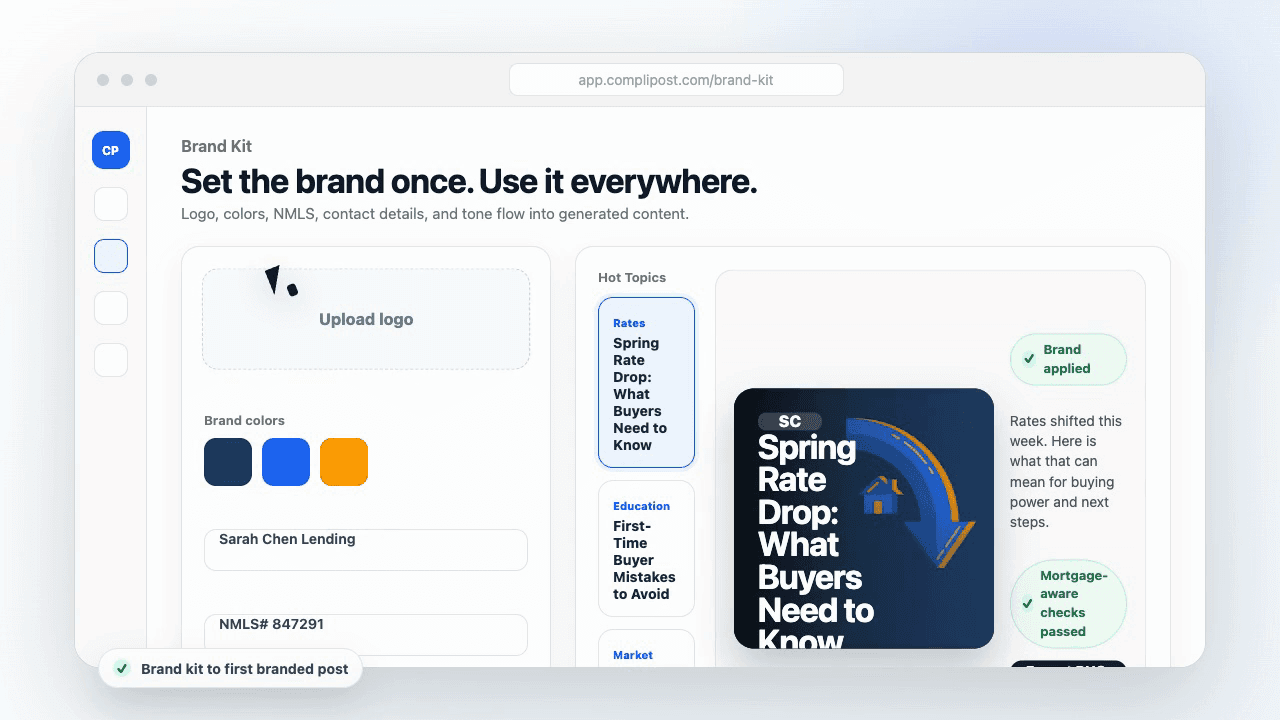
Product workflow
From blank page to export-ready mortgage content
- Start with a borrower topic
- Generate copy and a visual direction
- Review, save, and export the finished asset
These previews reflect the core CompliPost workflow: create, review, save, and export assets for use in your own channels.
Workflow comparison
| Content approach | What happens | Why it matters |
|---|---|---|
| Random posting | One-off ideas created when there is spare time | Inconsistent visibility and weak reuse |
| Template-only posting | Faster design but still requires rewriting and review | Helpful starting point, but not a full system |
| CompliPost workflow | Plan, generate, review, save, and export from one place | Better consistency with mortgage-aware review context |
| Done-for-you service | Someone else creates much of the content | Useful for some teams, but less control and less immediate reuse |
Who this guide helps
This guide is for loan officers working on solo loan officers who need a repeatable mortgage content workflow. The goal is to turn a broad mortgage topic into one borrower question, one useful takeaway, and one asset that can be reviewed before it is shared.
- You need content that sounds like a loan officer, not a generic brand account
- You want examples that can become captions, graphics, GIFs, or PDFs
- You need a clear place to review claims before export
- You want finished work saved for reuse, not lost in a chat thread
A practical workflow for this use case
Start with a narrow scenario, then move through planning, drafting, visual creation, review, and export. For attorney asset-rich wealth portfolio lending content, that means the topic should be specific enough that a borrower or referral partner can immediately understand what decision the content helps with.
- Choose the borrower type, loan topic, or platform before generating copy
- Draft the caption and visual together so the asset feels cohesive
- Use the federal baseline review aid to flag claims and disclosure gaps
- Export the finished asset and save the post as a reusable starting point
What makes the content stronger
Strong mortgage content is usually specific, plain-spoken, and calm. It explains tradeoffs without pretending one answer fits every borrower. That is especially important on public social channels, where a short post can be interpreted without the full context of a loan conversation.
- Name the borrower question in the first line
- Explain one decision or tradeoff instead of covering everything
- Use examples without implying approval, savings, or rate outcomes
- End with a soft next step, checklist, or guide rather than pressure
Compliance-aware review notes
CompliPost should be treated as a review aid, not a compliance approval system. The public page, generated draft, graphic, and exported asset should all stay honest about that boundary.
- Review specific payment, APR, rate, savings, and qualification language
- Avoid “best,” “lowest,” “guaranteed,” “free,” and urgency claims unless approved
- Check NMLS, Equal Housing, company, and state-specific requirements
- Use company or legal review for anything outside the federal baseline
How this connects to the rest of CompliPost
A focused guide should leave you with a usable next step. After you understand the topic, you can turn it into a calendar slot, a reviewed social post, a downloadable guide, or a platform-specific version for the channel where your audience already spends time.
- Use the content calendar to turn the idea into a weekly plan
- Use the compliance page when claims or disclosures need a slower pass
- Use lead magnets when the topic deserves a deeper PDF guide
- Use platform pages to adapt the same idea for LinkedIn, Facebook, or Instagram
Recommended next steps
Self-employed borrower hub
Create income-documentation education for self-employed borrowers.
Portfolio Loan High Net Worth Content
Comprehensive content on portfolio loans and alternative lending for high-net-worth borrowers.
Attorney Mortgage Guide
Full guide for attorney borrowers across all financial situations.
Debt-to-Income Ratio Calculation and Qualification
DTI mechanics and alternative qualification methods.
Examples
"Attorney, $60K law practice income, $1.2M investment portfolio. Asset-based loan qualified her. Here's how."
Case study showing asset-rich qualification despite modest income.
"Your investment portfolio doesn't show on paystubs, but lenders see it. Here's how asset-based lending works."
Educational post explaining asset-based qualification to investors.
"Income isn't your only qualification tool. Here's why lenders should see your net worth."
Perspective piece challenging traditional income-only underwriting.
"Portfolio loans for asset-rich borrowers: more flexibility, more options, better outcomes."
Strategic guide to portfolio lending for high-net-worth professionals.
FAQ
How do lenders evaluate my investment portfolio for mortgage qualification?+
Lenders want to see 60 days of recent statements showing your investments. They typically use a conservative approach: if you have $1M in stocks, they may count only 60-70% as accessible assets (accounting for volatility and market risk). They evaluate your total net worth and look at whether liquid assets are sufficient to cover mortgage payments if your income disappears. Asset-based lenders are more flexible; traditional lenders are stricter. Asset-based programs use a formula: perhaps 80% of total net worth / 360 months = monthly income capacity. Example: $1M net worth = $800K / 360 months = $2,200/month mortgage capacity. It's not a dollar-for-dollar conversion, but assets absolutely matter.
What if most of my assets are in retirement accounts like a 401k?+
Retirement assets count, but less favorably because they're hard to access (early withdrawal penalties, taxes). Lenders may count 50% of retirement account value (after accounting for tax consequences) toward asset qualification. If you have $500K in a 401k, lenders might count only $250K as accessible. Non-retirement investments (brokerage accounts, investment real estate) are more valuable for qualification because they're more liquid. If you have flexibility, converting non-retirement assets before applying strengthens your qualification. Talk to your tax advisor and loan officer about the best strategy.
Can I use home equity from an investment property for qualification?+
Yes, home equity counts as an asset. If you own a rental property worth $400K with a $200K mortgage, you have $200K in equity. Asset-based lenders will count this in your net worth calculation. However, they're conservative; they may count only 60-80% of equity (discounting for liquidity and market risk). If you also have a mortgage on the investment property, they may subtract that debt from your overall net worth calculation. Bring current appraisals or recent sales data for investment properties; lenders want recent valuations, not outdated estimates.
What are portfolio loans, and how are they different from conventional mortgages?+
Portfolio loans are mortgages held by the lender (not sold to investors like Fannie Mae or Freddie Mac). Because the lender holds the loan, they have flexibility in underwriting. They can evaluate asset-rich borrowers more favorably, accept non-traditional income documentation, and use alternative qualification methods. Portfolio loans often have slightly higher rates than conventional mortgages (because the lender carries more risk), but they open doors for borrowers who don't fit conventional boxes. If traditional lending declined you due to income, portfolio lenders may approve you based on net worth. Ask your loan officer whether portfolio options are available; they're often worth exploring for asset-rich borrowers.
Should I liquidate investments to build a down payment, or keep them as assets for qualification?+
Generally, keep your investments intact for qualification if possible. Larger liquid assets strengthen asset-based qualification more than a slightly larger down payment improves conventional qualification. However, if you have high-yield savings or non-investment assets, use those for down payment. If you must liquidate investments, do it well before you apply (60+ days) so the cash is "seasoned" and documented. Consult your tax advisor on capital gains implications; liquidating investments may trigger taxes that affect your income and qualification. The strategy depends on your specific situation: talk to both your tax advisor and loan officer before making moves.
Create mortgage content with a calmer workflow
CompliPost helps you plan, generate, review, save, and export useful mortgage content without pretending compliance or social distribution is automatic.
Start free