Life Planning
Mortgage Timing: How Life Events Shape ARM vs Fixed-Rate Decisions
Borrowers often have major life events on the horizon: marriages, job relocations, kids, retirements. These events often determine whether an ARM or fixed-rate mortgage fits. Your education can help borrowers map their life timeline to their mortgage choice.
Job Relocations: The Clearest ARM Case
A borrower with a clear relocation (corporate transfer, job offer, military assignment) in 3–5 years is an ideal ARM candidate. They'll capture ARM savings for the years they own, then sell or rent the home as they relocate. No adjustments, genuine savings, simple exit. This is the strongest ARM scenario, and your education should highlight it clearly.
- Corporate relocations often come with timelines: 3, 5, or 7 years
- ARM savings are locked in for these known years
- No need to worry about adjustments post-relocation
- Relocation costs are often company-covered, increasing ARM appeal
- This is the clearest, least controversial ARM recommendation scenario
Marriage, Blended Families, Kids: Changing Timelines
Life events like marriage, remarriage, or having kids change borrowers' timelines and priorities. A single borrower planning to stay 5 years might become part of a couple committed to staying 20. These shifts should trigger a mortgage review. Educate borrowers to revisit their choice if major life events occur.
- Marriage or blended family can extend intended holding period
- First child often signals longer-term homeownership intentions
- Changes in timeline can flip the ARM/fixed-rate calculation
- Borrowers should revisit their choice if major life events shift plans
- Refinancing is an option if plans genuinely change significantly
Retirement Planning: Why Fixed-Rate Usually Wins
Borrowers approaching retirement often choose fixed-rate mortgages to lock in a known payment for their retirement years. Income becomes fixed or declining; adjustable payments introduce unwanted uncertainty. For retirees or near-retirees, fixed-rate usually aligns better with their financial reality.
- Retirees live on fixed income; adjustments introduce unwanted risk
- Fixed-rate payment stays same for 15, 20, or 30 years
- Peace of mind in retirement is worth paying for upfront
- Refinancing becomes harder in retirement; choose wisely at origination
- This is another clear scenario where fixed-rate usually makes sense
Using Life Timeline to Guide Mortgage Choice
The strongest ARM/fixed-rate conversations start with the life timeline question: 'Where do you see yourself in 5, 10, 20 years?' Family plans, job stability, retirement timing—these answers reveal whether an ARM or fixed-rate aligns with their life. This is education, not steering.
- Ask about major events: job moves, retirement, family changes
- Map the timeline: 'You're retiring in 12 years; fixed-rate gives you certainty'
- Acknowledge that life changes: 'If plans shift, you can refinance'
- Use life events as honest anchors for product recommendations
- This frames the choice as life-aligned, not product-driven
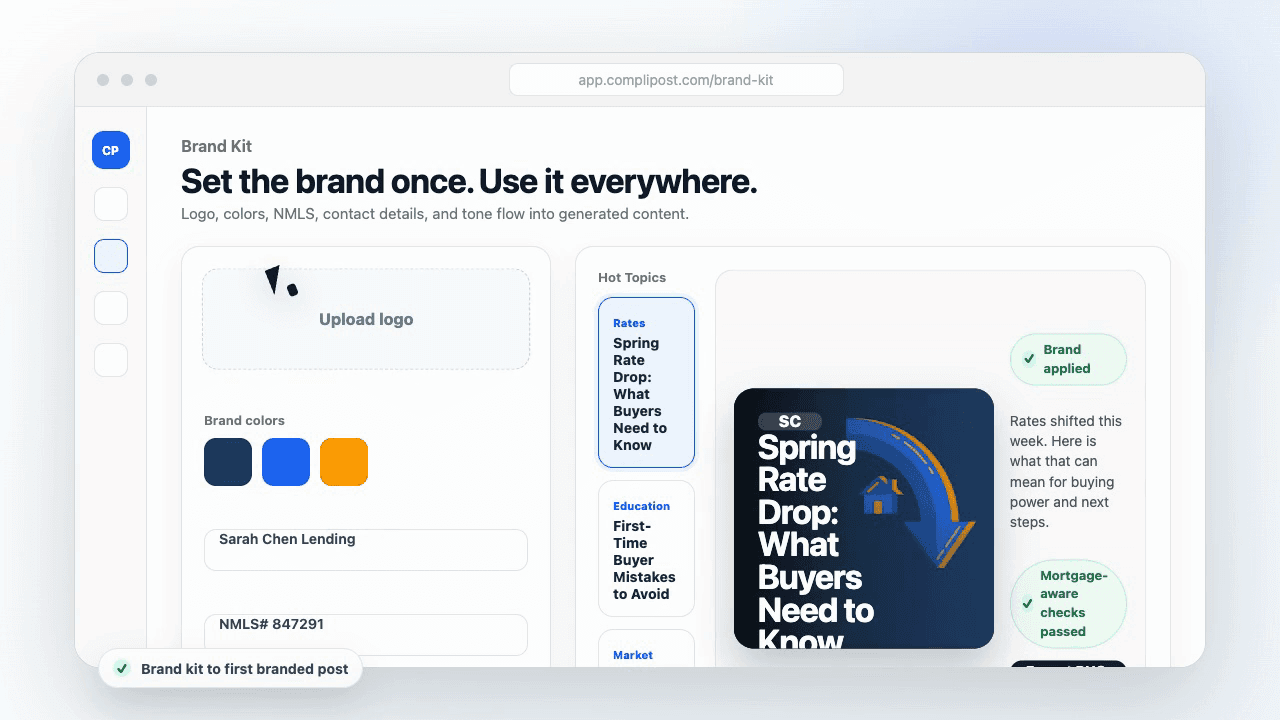
Product workflow
From blank page to export-ready mortgage content
- Start with a borrower topic
- Generate copy and a visual direction
- Review, save, and export the finished asset
These previews reflect the core CompliPost workflow: create, review, save, and export assets for use in your own channels.
Workflow comparison
| Content approach | What happens | Why it matters |
|---|---|---|
| Random posting | One-off ideas created when there is spare time | Inconsistent visibility and weak reuse |
| Template-only posting | Faster design but still requires rewriting and review | Helpful starting point, but not a full system |
| CompliPost workflow | Plan, generate, review, save, and export from one place | Better consistency with mortgage-aware review context |
| Done-for-you service | Someone else creates much of the content | Useful for some teams, but less control and less immediate reuse |
Who this guide helps
This guide is for loan officers working on solo loan officers who need a repeatable mortgage content workflow. The goal is to turn a broad mortgage topic into one borrower question, one useful takeaway, and one asset that can be reviewed before it is shared.
- You need content that sounds like a loan officer, not a generic brand account
- You want examples that can become captions, graphics, GIFs, or PDFs
- You need a clear place to review claims before export
- You want finished work saved for reuse, not lost in a chat thread
A practical workflow for this use case
Start with a narrow scenario, then move through planning, drafting, visual creation, review, and export. For ARM fixed-rate life events marriage relocation retirement, that means the topic should be specific enough that a borrower or referral partner can immediately understand what decision the content helps with.
- Choose the borrower type, loan topic, or platform before generating copy
- Draft the caption and visual together so the asset feels cohesive
- Use the federal baseline review aid to flag claims and disclosure gaps
- Export the finished asset and save the post as a reusable starting point
What makes the content stronger
Strong mortgage content is usually specific, plain-spoken, and calm. It explains tradeoffs without pretending one answer fits every borrower. That is especially important on public social channels, where a short post can be interpreted without the full context of a loan conversation.
- Name the borrower question in the first line
- Explain one decision or tradeoff instead of covering everything
- Use examples without implying approval, savings, or rate outcomes
- End with a soft next step, checklist, or guide rather than pressure
Compliance-aware review notes
CompliPost should be treated as a review aid, not a compliance approval system. The public page, generated draft, graphic, and exported asset should all stay honest about that boundary.
- Review specific payment, APR, rate, savings, and qualification language
- Avoid “best,” “lowest,” “guaranteed,” “free,” and urgency claims unless approved
- Check NMLS, Equal Housing, company, and state-specific requirements
- Use company or legal review for anything outside the federal baseline
How this connects to the rest of CompliPost
A focused guide should leave you with a usable next step. After you understand the topic, you can turn it into a calendar slot, a reviewed social post, a downloadable guide, or a platform-specific version for the channel where your audience already spends time.
- Use the content calendar to turn the idea into a weekly plan
- Use the compliance page when claims or disclosures need a slower pass
- Use lead magnets when the topic deserves a deeper PDF guide
- Use platform pages to adapt the same idea for LinkedIn, Facebook, or Instagram
Recommended next steps
Refinance content hub
Create refinance education without overpromising outcomes.
Who Is an ARM Right For? Borrower Profiles and Timelines
Life events help define borrower profiles—explore this alongside the timeline question.
ARM vs Fixed: When to Recommend Each Option
The decision framework—life events are a key input to the three questions.
Fixed-Rate Mortgages: Stability and Peace of Mind
Retirees and long-term owners often find fixed-rate stability appeals most.
Examples
FAQ
What if a borrower's life plans are uncertain?+
Default to fixed-rate. Uncertainty in timeline argues for certainty in payment. Fixed-rate is the safer choice when you don't know where you'll be in 5–10 years. If plans crystallize later and you need an ARM, you can refinance (though refinancing has costs).
Should retirement timing be the main factor in mortgage choice?+
It's a major factor. If retirement is 10+ years away, you have time; if it's 5 years away, an ARM gets risky because adjustments might land during early retirement. Use retirement timing as one data point alongside income stability and risk tolerance.
What if someone plans to relocate but wants to keep the house as a rental?+
That changes the calculation. Renters pay the mortgage, but the ARM landlord bears adjustment risk. This is more complex—they should model worst-case ARM payment as a landlord (cash flow matters). This is a good referral point to their accountant/financial advisor.
How do I help borrowers distinguish real life plans from speculation?+
Ask for concrete signs: job offers in writing, engagement announced, kids in progress (not hypothetical). Be skeptical of 'I might move in 5 years.' That's not concrete enough for an ARM recommendation. Focus on plans that have some certainty attached.
Can life events justify changing mortgages mid-loan?+
Yes, through refinancing. If life changes significantly (relocation, major income shift, early retirement), a refinance into a different product can align better with the new reality. Emphasize that refinancing has costs, but it's a valid adjustment option if circumstances truly change.
Create mortgage content with a calmer workflow
CompliPost helps you plan, generate, review, save, and export useful mortgage content without pretending compliance or social distribution is automatic.
Start free