Special Circumstances
Fixed-Rate Mortgages: Why They Matter for Borrowers on Limited Income
Borrowers on disability, SSDI, Social Security, or other limited-income sources face a special situation: their income is unlikely to grow, and budgets are often tight. An ARM's potential payment increases create serious risk. For this population, fixed-rate mortgages usually make clear financial sense.
Why ARMs Risk Limited-Income Budgets
An ARM borrower's budget assumes an initial payment they can afford. But what happens when the rate adjusts and the payment rises 10%, 20%, or more? A limited-income borrower has no room to absorb that shock. Their income isn't growing to match; they're not expecting a bonus or promotion. The adjustment hits the budget directly and painfully.
- Limited-income borrowers have zero margin for error in budgeting
- Income won't grow to absorb ARM adjustments (typically)
- Payment shocks of $200–400/month are genuine hardship
- SSDI, Social Security, disability: income is fixed and known
- ARM worst-case scenario is unmanageable for this population
Fixed-Rate as Certainty and Stability
For borrowers on limited income, a fixed-rate mortgage isn't a luxury—it's essential risk management. The same payment every month for 30 years is predictable, sustainable, and protects the borrower from the financial shock of adjustments. This is one scenario where recommending fixed-rate is straightforward and honest.
- Fixed-rate locks payment in for the life of the loan
- No surprises, no adjustments, no uncertainty
- Predictable budgeting aligns with predictable income
- Limited-income borrowers can plan their finances with confidence
- This is one of the clearest fixed-rate recommendation scenarios
Educating Limited-Income Borrowers About ARMs
If a limited-income borrower is considering an ARM (maybe due to rate difference or qualification reasons), educate honestly on the worst-case scenario. 'Your ARM's worst-case payment is [amount]. On your income of [amount], can you absorb that if it happens?' If the answer is no, fixed-rate is the right choice. No hedging, no hope—just honesty.
- Model worst-case ARM payment using lifetime cap
- Compare to borrower's monthly income and existing obligations
- Ask directly: 'Can you afford this payment if it arrives?'
- If answer is no, recommend fixed-rate firmly (not a soft suggestion)
- Use this population's lower ARM tolerance as honest education
Special Programs and Fixed-Rate Options
Some programs specifically serve limited-income borrowers with favorable fixed-rate options: HUD, down-payment assistance programs, Community Development Financial Institution (CDFI) programs. These often prioritize fixed-rate mortgages for borrower protection. Loan officers should know what's available in their market to serve this population well.
- HUD programs often favor fixed-rate mortgages
- Down-payment assistance programs typically include fixed-rate loans
- CDFI lenders often offer fixed-rate mortgages at favorable terms
- Non-profit lenders may offer fixed-rate specifically for limited-income borrowers
- Research what's available in your market; offer these options proactively
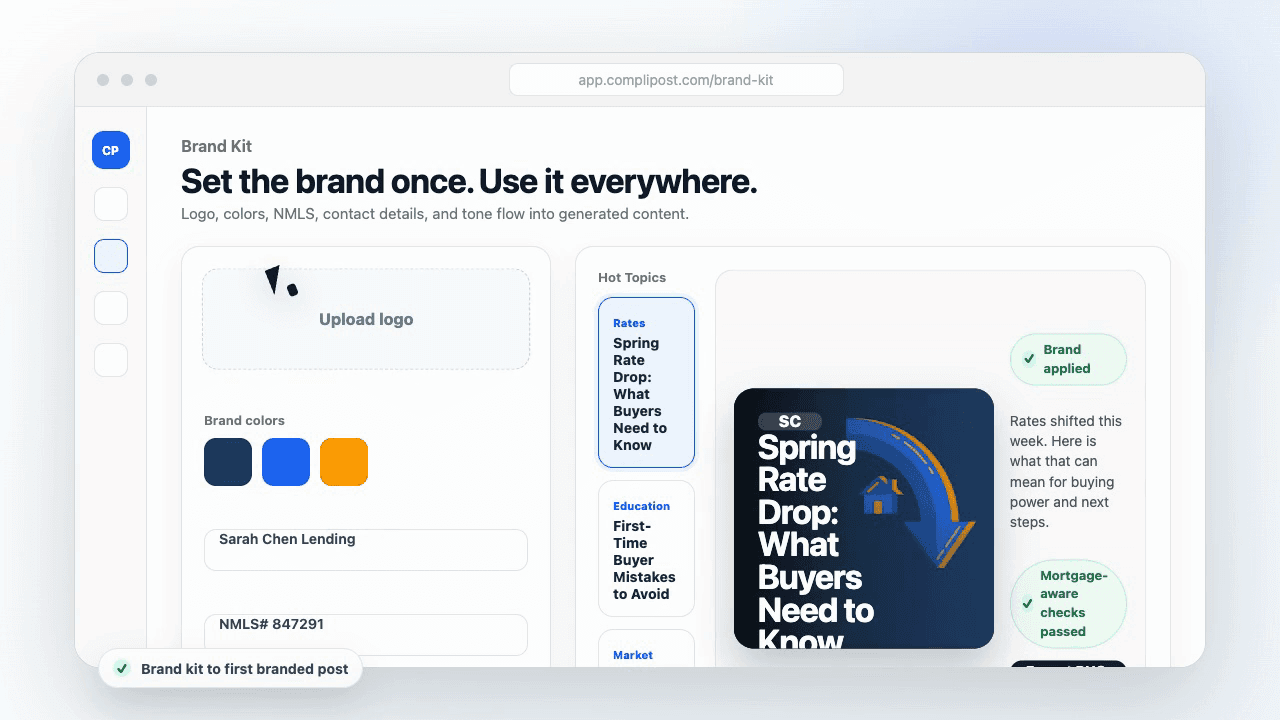
Product workflow
From blank page to export-ready mortgage content
- Start with a borrower topic
- Generate copy and a visual direction
- Review, save, and export the finished asset
These previews reflect the core CompliPost workflow: create, review, save, and export assets for use in your own channels.
Workflow comparison
| Content approach | What happens | Why it matters |
|---|---|---|
| Random posting | One-off ideas created when there is spare time | Inconsistent visibility and weak reuse |
| Template-only posting | Faster design but still requires rewriting and review | Helpful starting point, but not a full system |
| CompliPost workflow | Plan, generate, review, save, and export from one place | Better consistency with mortgage-aware review context |
| Done-for-you service | Someone else creates much of the content | Useful for some teams, but less control and less immediate reuse |
Who this guide helps
This guide is for loan officers working on solo loan officers who need a repeatable mortgage content workflow. The goal is to turn a broad mortgage topic into one borrower question, one useful takeaway, and one asset that can be reviewed before it is shared.
- You need content that sounds like a loan officer, not a generic brand account
- You want examples that can become captions, graphics, GIFs, or PDFs
- You need a clear place to review claims before export
- You want finished work saved for reuse, not lost in a chat thread
A practical workflow for this use case
Start with a narrow scenario, then move through planning, drafting, visual creation, review, and export. For ARM fixed-rate disability SSDI limited income, that means the topic should be specific enough that a borrower or referral partner can immediately understand what decision the content helps with.
- Choose the borrower type, loan topic, or platform before generating copy
- Draft the caption and visual together so the asset feels cohesive
- Use the federal baseline review aid to flag claims and disclosure gaps
- Export the finished asset and save the post as a reusable starting point
What makes the content stronger
Strong mortgage content is usually specific, plain-spoken, and calm. It explains tradeoffs without pretending one answer fits every borrower. That is especially important on public social channels, where a short post can be interpreted without the full context of a loan conversation.
- Name the borrower question in the first line
- Explain one decision or tradeoff instead of covering everything
- Use examples without implying approval, savings, or rate outcomes
- End with a soft next step, checklist, or guide rather than pressure
Compliance-aware review notes
CompliPost should be treated as a review aid, not a compliance approval system. The public page, generated draft, graphic, and exported asset should all stay honest about that boundary.
- Review specific payment, APR, rate, savings, and qualification language
- Avoid “best,” “lowest,” “guaranteed,” “free,” and urgency claims unless approved
- Check NMLS, Equal Housing, company, and state-specific requirements
- Use company or legal review for anything outside the federal baseline
How this connects to the rest of CompliPost
A focused guide should leave you with a usable next step. After you understand the topic, you can turn it into a calendar slot, a reviewed social post, a downloadable guide, or a platform-specific version for the channel where your audience already spends time.
- Use the content calendar to turn the idea into a weekly plan
- Use the compliance page when claims or disclosures need a slower pass
- Use lead magnets when the topic deserves a deeper PDF guide
- Use platform pages to adapt the same idea for LinkedIn, Facebook, or Instagram
Recommended next steps
Refinance content hub
Create refinance education without overpromising outcomes.
Fixed-Rate Mortgages: Stability and Peace of Mind
Explore fixed-rate benefits with emphasis on stability for this population.
ARM Rate Caps: Periodic and Lifetime Caps Explained
Limited-income borrowers must understand caps deeply before considering any ARM.
ARM vs Fixed: When to Recommend Each Option
The decision framework—limited income is a clear signal for fixed-rate recommendation.
Examples
FAQ
Should I ever recommend an ARM to a limited-income borrower?+
Only in rare circumstances, and only if they genuinely understand worst-case payment and can afford it. Most limited-income borrowers should choose fixed-rate. The default recommendation for this population is fixed-rate unless there's a compelling reason otherwise.
What if a limited-income borrower qualifies for ARM but not fixed-rate?+
That's a red flag. It suggests the borrower might be stretching beyond sustainable debt levels. Recommend working with a mortgage professional or non-profit housing counselor to find options that protect the borrower. Sometimes waiting, saving more down-payment, or improving credit is smarter than accepting an ARM they can't truly afford.
How do I discuss worst-case payments without scaring limited-income borrowers?+
Be direct and respectful: 'Let's make sure you're comfortable before we proceed. Your ARM's worst-case payment, if rates hit the cap, would be [amount]. Can you afford that if it happens?' This isn't fearmongering; it's responsible counseling for this vulnerable population.
Are there resources for limited-income borrowers beyond what I can offer?+
Yes: HUD housing counselors, non-profit housing organizations, CDFI lenders, and down-payment assistance programs often have expertise and products specifically for limited-income borrowers. Knowing these resources and referring borrowers to them shows you're putting their interests first.
What if a limited-income borrower insists on an ARM despite my recommendation?+
Document your counseling and recommendation in writing. Ensure they understand worst-case payment and confirm they accept the risk. This protects the borrower (they were informed) and you (you documented responsible counseling). Never coerce them to choose fixed-rate, but make your recommendation clear and documented.
Create mortgage content with a calmer workflow
CompliPost helps you plan, generate, review, save, and export useful mortgage content without pretending compliance or social distribution is automatic.
Start free