Loan product comparison
VA Loans vs Conventional Mortgages: A Clear Comparison
As a loan officer, understanding the nuances between VA and conventional mortgages can greatly enhance your ability to guide eligible veteran borrowers effectively. VA loans offer significant benefits such as limited upfront down-payment requirement when eligible requirements and the absence of mortgage insurance, making them an attractive option for eligible veterans. On the other hand, conventional mortgages have their own set of advantages that might appeal to other segments of borrowers. This comprehensive guide will equip you with the knowledge needed to explain these differences clearly to your clients, ensuring they make informed decisions about their mortgage options.
Down Payment and Mortgage Insurance: The VA Advantage
One of the most compelling features of VA loans is the limited upfront down-payment requirement when eligible requirement, a benefit that sets it apart from conventional loans, which typically require a minimum down escrow amount for 3% or more. Additionally, VA loans do not require monthly mortgage insurance, which can lead to substantial savings over time. In contrast, conventional loans often necessitate private mortgage insurance (PMI) until the borrower achieves 20% equity in their home. This can add significant costs to monthly payments, making VA loans a more cost-effective choice for eligible veterans. As a loan officer, highlighting these distinctions can help veterans understand the financial advantages of choosing a VA loan.
- VA: $0 down payment, no mortgage insurance.
- Conventional: 3%+ down, PMI required until 20% equity.
The Funding Fee vs. PMI: Cost Considerations
While VA loans eliminate the need for monthly mortgage insurance, they do include a one-time funding fee, ranging from 1.25% to 3.6% of the loan amount. This fee can be financed into the loan, minimizing upfront costs for the borrower. In comparison, conventional loans often require PMI, which is a recurring cost until sufficient equity is built. The total cost implications of these fees and insurance should be discussed with clients to ensure they understand the long-term financial impacts. Educating borrowers on these differences can empower them to choose the mortgage option that aligns strong with their financial goals.
- VA funding fee: 1.25% to 3.6%, can be financed.
- Conventional: PMI monthly until 20% equity achieved.
Interest Rates and Appraisals: What to Expect
VA loans often feature interest rates that are generally lower than those associated with conventional loans, providing additional savings to eligible borrowers. However, note that VA appraisals tend to be more stringent in terms of property condition, which is designed to protect the borrower by ensuring the home meets certain livability standards. This can be an advantage for borrowers concerned about the condition of the property they are purchasing. By explaining these aspects, loan officers can help veterans weigh the benefits and potential challenges associated with VA loans.
- VA rates: Typically lower than conventional.
- VA appraisals: Stricter on property condition.
Eligibility and Reuse: Maximizing VA Benefits
Eligibility for VA loans is a significant factor that distinguishes them from conventional mortgages. VA loans are available to veterans, active-duty service members, and certain members of the National Guard and Reserves, as well as some surviving spouses. One of the unique benefits of VA loans is the ability to use them multiple times, provided the previous loan is paid off or assumed by another eligible veteran. This flexibility can be a major selling point when discussing options with eligible clients. As a loan officer, you should be prepared to explain the eligibility requirements and how clients can reuse their VA loan benefits effectively.
- Eligibility: Veterans, active duty, National Guard, Reserves.
- Reuse: Possible after paying off prior VA loan.
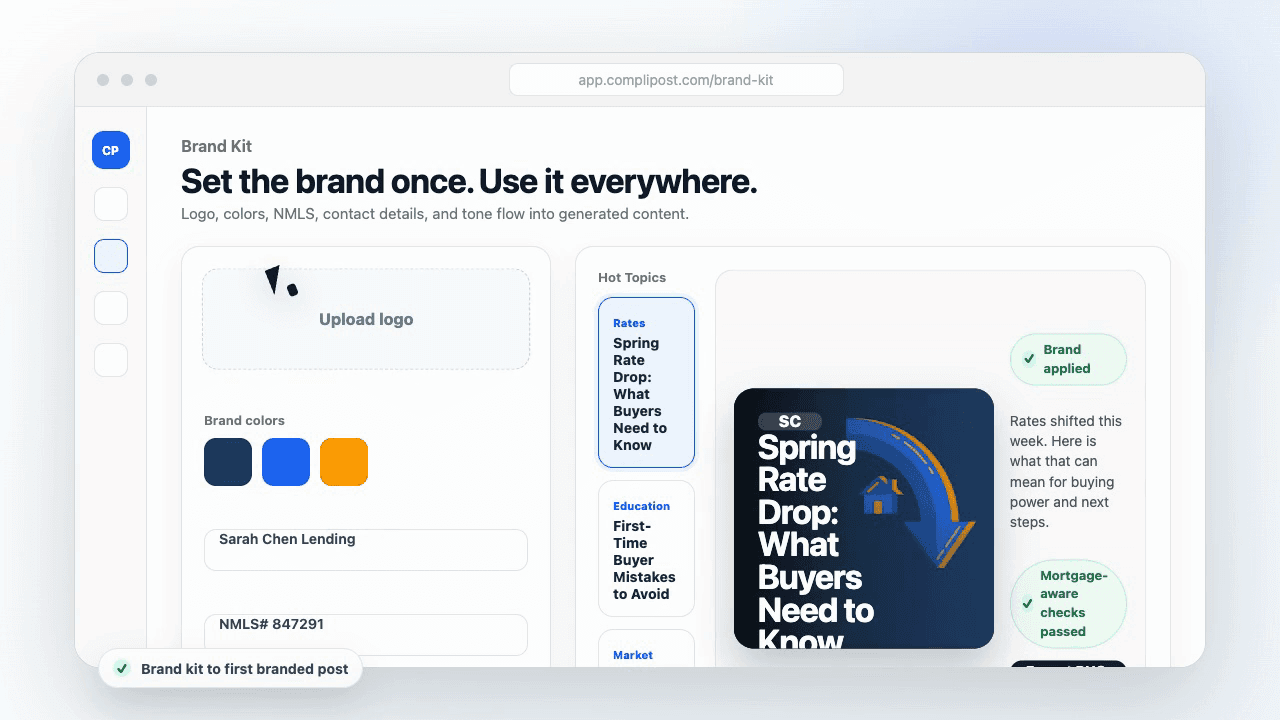
Product workflow
From blank page to export-ready mortgage content
- Start with a borrower topic
- Generate copy and a visual direction
- Review, save, and export the finished asset
These previews reflect the core CompliPost workflow: create, review, save, and export assets for use in your own channels.
Workflow comparison
| Content approach | What happens | Why it matters |
|---|---|---|
| Random posting | One-off ideas created when there is spare time | Inconsistent visibility and weak reuse |
| Template-only posting | Faster design but still requires rewriting and review | Helpful starting point, but not a full system |
| CompliPost workflow | Plan, generate, review, save, and export from one place | Better consistency with mortgage-aware review context |
| Done-for-you service | Someone else creates much of the content | Useful for some teams, but less control and less immediate reuse |
Who this guide helps
This guide is for loan officers working on solo loan officers who need a repeatable mortgage content workflow. The goal is to turn a broad mortgage topic into one borrower question, one useful takeaway, and one asset that can be reviewed before it is shared.
- You need content that sounds like a loan officer, not a generic brand account
- You want examples that can become captions, graphics, GIFs, or PDFs
- You need a clear place to review claims before export
- You want finished work saved for reuse, not lost in a chat thread
A practical workflow for this use case
Start with a narrow scenario, then move through planning, drafting, visual creation, review, and export. For VA vs conventional mortgage comparison, that means the topic should be specific enough that a borrower or referral partner can immediately understand what decision the content helps with.
- Choose the borrower type, loan topic, or platform before generating copy
- Draft the caption and visual together so the asset feels cohesive
- Use the federal baseline review aid to flag claims and disclosure gaps
- Export the finished asset and save the post as a reusable starting point
What makes the content stronger
Strong mortgage content is usually specific, plain-spoken, and calm. It explains tradeoffs without pretending one answer fits every borrower. That is especially important on public social channels, where a short post can be interpreted without the full context of a loan conversation.
- Name the borrower question in the first line
- Explain one decision or tradeoff instead of covering everything
- Use examples without implying approval, savings, or rate outcomes
- End with a soft next step, checklist, or guide rather than pressure
Compliance-aware review notes
CompliPost should be treated as a review aid, not a compliance approval system. The public page, generated draft, graphic, and exported asset should all stay honest about that boundary.
- Review specific payment, APR, rate, savings, and qualification language
- Avoid “best,” “lowest,” “guaranteed,” “free,” and urgency claims unless approved
- Check NMLS, Equal Housing, company, and state-specific requirements
- Use company or legal review for anything outside the federal baseline
How this connects to the rest of CompliPost
A focused guide should leave you with a usable next step. After you understand the topic, you can turn it into a calendar slot, a reviewed social post, a downloadable guide, or a platform-specific version for the channel where your audience already spends time.
- Use the content calendar to turn the idea into a weekly plan
- Use the compliance page when claims or disclosures need a slower pass
- Use lead magnets when the topic deserves a deeper PDF guide
- Use platform pages to adapt the same idea for LinkedIn, Facebook, or Instagram
Recommended next steps
VA loan content hub
Create VA loan education for eligible borrowers.
Mortgage content calendar
Plan a weekly rhythm of useful borrower and referral-partner posts.
Calendar generator
Turn one mortgage topic into a practical weekly content plan.
Canva + ChatGPT alternative
Compare DIY tools with a mortgage-specific content workflow.
Examples
FAQ
Can a veteran use a VA loan more than once?+
Yes, a veteran can use a VA loan multiple times. After a previous VA loan is paid off or assumed by another eligible veteran, the borrower can reuse their VA loan benefits for another home purchase. This flexibility allows veterans to take advantage of VA loans throughout their lifetime, provided they meet eligibility requirements and have sufficient entitlement available.
What is the VA funding fee and can it be avoided?+
The VA funding fee is a one-time fee applied to VA loans, ranging from 1.25% to 3.6% of the loan amount. This fee helps fund the VA loan program and can typically be financed into the loan, reducing upfront costs. Borrowers with a VA disability rating of 10% or more may be exempt from paying this fee, providing additional savings opportunities for eligible veterans.
Are VA appraisals more stringent than conventional ones?+
Yes, VA appraisals are generally more stringent than conventional appraisals, focusing heavily on the property's condition to ensure it meets livability standards. This is intended to protect the borrower by verifying the property is safe and sound. Loan officers should prepare clients for this process and explain how it safeguards their investment.
What are the key benefits of choosing a VA loan over a conventional loan?+
VA loans offer several key benefits over conventional loans, including limited upfront down-payment requirement when eligible requirements and no monthly mortgage insurance, which can significantly lower monthly payments. Additionally, VA loans often have lower interest rates and provide protections through rigorous appraisals. These factors make VA loans an attractive option for eligible veterans seeking cost-effective home financing.
Create mortgage content with a calmer workflow
CompliPost helps you plan, generate, review, save, and export useful mortgage content without pretending compliance or social distribution is automatic.
Start free