Mortgage content specialty
Guide Texas Loan Officers on Self-Employed Mortgages
Loan officers in Texas have a unique opportunity to serve the self-employed market by offering tailored mortgage solutions. This segment often finds traditional lending routes challenging due to non-traditional income documentation. By focusing on bank-statement programs and portfolio lending, loan officers can position themselves as trusted advisors. CompliPost equips you with the tools to develop content that resonates with entrepreneurs and business owners, building your authority and expanding your client base. With our guidance, you'll learn to navigate the nuances of self-employed mortgage paths, ensuring your content addresses their specific needs and positions you as a go-to resource in this niche market.
Why Self-Employed Buyers Require Specialized Mortgage Paths
For self-employed buyers, traditional mortgage products often fall short due to the unique nature of their income. Loan officers must understand the importance of offering alternative solutions like bank-statement programs and portfolio lending. These options consider the diverse income streams of business owners and provide more flexibility. By creating content that explains these alternatives, loan officers can effectively communicate with self-employed clients, helping them understand their options. This not only builds trust but also enhances the loan officer's reputation as a knowledgeable and resourceful professional.
- Understanding non-traditional income documentation
- Communicating the benefits of alternative lending programs
- Addressing unique self-employed borrower challenges
- Enhancing trust through specialized mortgage knowledge
Establishing Expertise in Non-QM Mortgage Solutions
Loan officers specializing in non-qualified mortgage (non-QM) products can set themselves apart by effectively communicating the benefits to self-employed buyers. Non-QM products, such as bank-statement loans, cater specifically to those who might not meet traditional lending criteria. Creating content that demystifies these products and clearly explains the qualification process is essential. This positions loan officers as experts in a niche market, attracting clients who need guidance through the complexities of securing a mortgage without conventional documentation. texas self-employed mortgage content borrower concern: explain what a lender may verify, why the step matters, and how a reader can prepare. texas self-employed mortgage content content should clarify without becoming personal advice.
- Highlighting the flexibility of non-QM products
- Explaining qualification differences for self-employed applicants
- Positioning as an expert in non-QM solutions
- Attracting a niche audience with specialized content
Timing Content with Business and Tax Cycles
The timing of content releases can significantly impact engagement and effectiveness. Loan officers should align their content strategies with key business and tax cycles that affect self-employed individuals. By anchoring content around tax-filing season, year-end financial planning, and other business milestones, loan officers can provide timely, relevant information. This approach not only ensures content is seen by the right audience but also positions the loan officer as a proactive partner in the financial planning process, ready to assist with tailored mortgage solutions when they are most needed.
- Aligning content with tax and business cycles
- Providing timely advice during peak financial planning periods
- Reinforcing expertise with seasonal content
- Engaging with self-employed clients at critical decision points
Crafting Compelling Stories and Case Studies
Storytelling is a powerful tool for loan officers looking to connect with self-employed clients. By sharing success stories and case studies of previous clients who navigated the mortgage process successfully, loan officers can illustrate the benefits of specialized mortgage solutions. This content not only serves as social proof but also helps potential clients visualize their own success. Crafting narratives that resonate with the challenges and triumphs of self-employed individuals can significantly enhance a loan officer's credibility and appeal. texas self-employed mortgage content reuse plan: make one caption, one carousel point, one email follow-up, and one saved template. texas self-employed mortgage content then supports social, partner, and nurture workflows.
- Utilizing storytelling to connect with clients
- Showcasing client successes with specialized mortgage products
- Building credibility through relatable case studies
- Encouraging potential clients with real-world examples
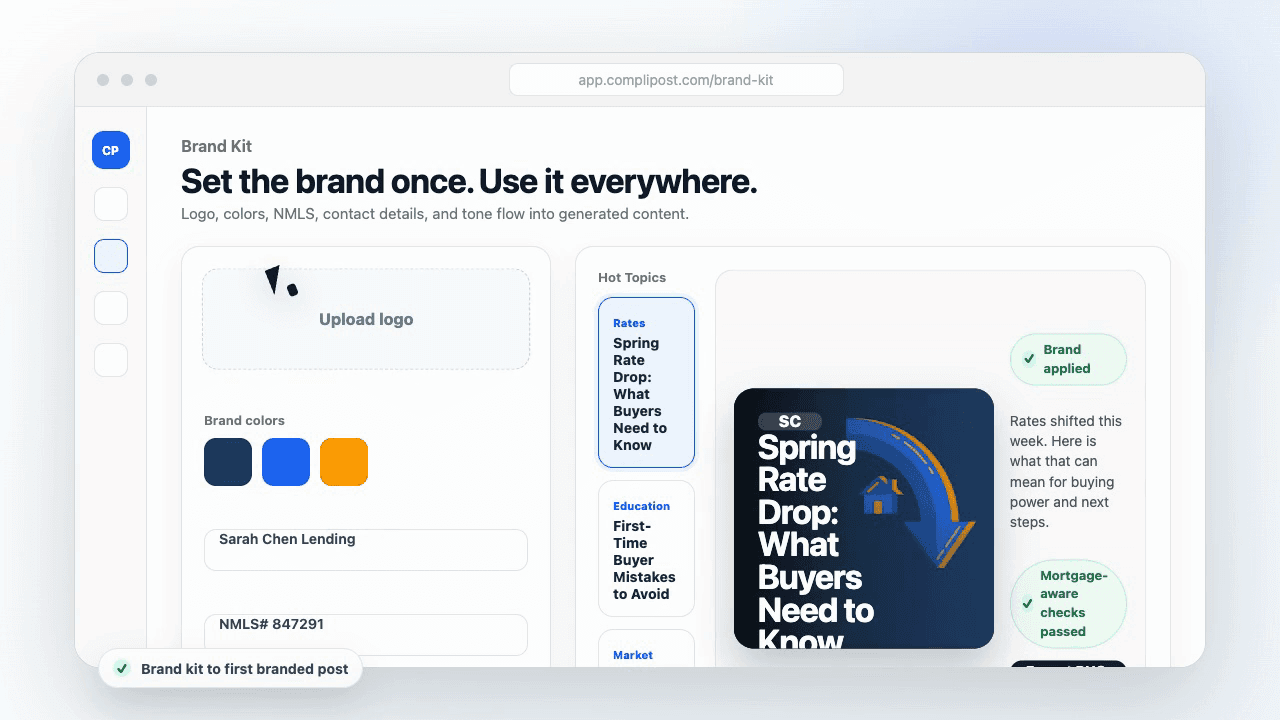
Product workflow
From blank page to export-ready mortgage content
- Start with a borrower topic
- Generate copy and a visual direction
- Review, save, and export the finished asset
These previews reflect the core CompliPost workflow: create, review, save, and export assets for use in your own channels.
Workflow comparison
| Content approach | What happens | Why it matters |
|---|---|---|
| Random posting | One-off ideas created when there is spare time | Inconsistent visibility and weak reuse |
| Template-only posting | Faster design but still requires rewriting and review | Helpful starting point, but not a full system |
| CompliPost workflow | Plan, generate, review, save, and export from one place | Better consistency with mortgage-aware review context |
| Done-for-you service | Someone else creates much of the content | Useful for some teams, but less control and less immediate reuse |
Who this guide helps
This guide is for loan officers working on solo loan officers who need a repeatable mortgage content workflow. The goal is to turn a broad mortgage topic into one borrower question, one useful takeaway, and one asset that can be reviewed before it is shared.
- You need content that sounds like a loan officer, not a generic brand account
- You want examples that can become captions, graphics, GIFs, or PDFs
- You need a clear place to review claims before export
- You want finished work saved for reuse, not lost in a chat thread
A practical workflow for this use case
Start with a narrow scenario, then move through planning, drafting, visual creation, review, and export. For Texas self-employed mortgage content, that means the topic should be specific enough that a borrower or referral partner can immediately understand what decision the content helps with.
- Choose the borrower type, loan topic, or platform before generating copy
- Draft the caption and visual together so the asset feels cohesive
- Use the federal baseline review aid to flag claims and disclosure gaps
- Export the finished asset and save the post as a reusable starting point
What makes the content stronger
Strong mortgage content is usually specific, plain-spoken, and calm. It explains tradeoffs without pretending one answer fits every borrower. That is especially important on public social channels, where a short post can be interpreted without the full context of a loan conversation.
- Name the borrower question in the first line
- Explain one decision or tradeoff instead of covering everything
- Use examples without implying approval, savings, or rate outcomes
- End with a soft next step, checklist, or guide rather than pressure
Compliance-aware review notes
CompliPost should be treated as a review aid, not a compliance approval system. The public page, generated draft, graphic, and exported asset should all stay honest about that boundary.
- Review specific payment, APR, rate, savings, and qualification language
- Avoid “best,” “lowest,” “guaranteed,” “free,” and urgency claims unless approved
- Check NMLS, Equal Housing, company, and state-specific requirements
- Use company or legal review for anything outside the federal baseline
How this connects to the rest of CompliPost
A focused guide should leave you with a usable next step. After you understand the topic, you can turn it into a calendar slot, a reviewed social post, a downloadable guide, or a platform-specific version for the channel where your audience already spends time.
- Use the content calendar to turn the idea into a weekly plan
- Use the compliance page when claims or disclosures need a slower pass
- Use lead magnets when the topic deserves a deeper PDF guide
- Use platform pages to adapt the same idea for LinkedIn, Facebook, or Instagram
Recommended next steps
Self-employed borrower hub
Create income-documentation education for self-employed borrowers.
Mortgage content calendar
Plan a weekly rhythm of useful borrower and referral-partner posts.
Self-employed buyer content
General self-employed guide.
Calendar generator
Turn one mortgage topic into a practical weekly content plan.
Examples
FAQ
What content should I focus on for self-employed buyers?+
Focus on creating content that explains bank-statement programs, portfolio lending, and non-QM qualification processes. Highlight the unique documentation requirements for self-employed individuals and provide tips for preparing successful applications. This approach builds trust and establishes you as a knowledgeable resource. The practical move is to keep the answer educational, mention that details vary by borrower profile and lender guidelines, and invite the reader to ask for a personal review instead of implying a certain result.
How can I explain bank-statement underwriting effectively?+
Yes, providing clear explanations about bank-statement underwriting can greatly benefit self-employed clients. Discuss the advantages of using bank statements over traditional tax returns and how this method offers a more accurate reflection of income streams. This educational content helps demystify the process for potential borrowers.
How should I address the timing of documentation for self-employed clients?+
Addressing documentation timing is crucial. Frame the conversation around strategic planning, especially during tax season and other business milestones. Emphasize the importance of preparing documentation early and maintaining good records to streamline the mortgage application process. Avoid making any assurances about approval to remain compliant.
Is it beneficial to tailor content to specific types of self-employed businesses?+
Yes, tailoring content to specific business types like contractors, consultants, or sole proprietors can resonate more effectively. Highlighting industry-specific challenges and solutions in your content makes it more relatable and useful, demonstrating your understanding of their unique needs and solidifying your role as a trusted advisor.
Create mortgage content with a calmer workflow
CompliPost helps you plan, generate, review, save, and export useful mortgage content without pretending compliance or social distribution is automatic.
Start free