Specialty Financing
Guide Borrowers Through Specialty Financing Language
As a loan officer, you can play a pivotal role in demystifying specialty financing for your borrowers. These terms, including DSCR, LTV, and ARV, often appear complex but are crucial for understanding financing options. By creating educational posts, you help borrowers feel more confident in their financing conversations and position yourself as a knowledgeable resource in the mortgage industry. This guide provides you with the tools to explain these terms clearly, ensuring your clients are well-informed and prepared. This gives you a reusable way to teach the topic, write captions, choose a soft call to action, and keep the message inside a safer mortgage marketing lane before you export it.
Key Metrics in Specialty Financing
Specialty lenders use specific metrics to evaluate loan applications. DSCR, or Debt Service Coverage Ratio, assesses if rental income is sufficient to cover debt obligations, crucial for investment properties. LTV, or Loan-to-Value ratio, compares the loan amount to the property's value, indicating the lender's risk exposure. ARV, or After-Repair Value, estimates a property's worth post-renovation, vital for fix-and-flip projects. Cap rate, calculated as NOI divided by the purchase price, reveals the potential income yield from an investment. Understanding these metrics can enhance your ability to guide clients through their financing options.
- DSCR: Ratio of rental income to debt obligations.
- LTV: Loan amount compared to property value.
- ARV: Projected value after property improvements.
- Cap rate: Income yield assessment from NOI and purchase price.
Supporting Terms Borrowers Should Know
Beyond primary metrics, additional terms play a role in specialty financing. NOI, or Net Operating Income, is the income after subtracting operating expenses, crucial for evaluating property profitability. Debt service refers to the total annual loan payments, including principal and interest. Occupancy rate measures the percentage of rented units, impacting cash flow predictions. Subordination determines the priority of liens, affecting the security of loans. As a loan officer, explaining these terms can empower your borrowers to make informed decisions, enhancing their understanding of the financial landscape.
- NOI: Income after operating expenses.
- Debt service: Total annual loan obligations.
- Occupancy rate: Percentage of rented units.
- Subordination: Lien priority in sale situations.
Ensuring Compliance in Educational Posts
When crafting educational content, accuracy and compliance are paramount. Define each term using industry-standard definitions and provide clear numeric examples to aid understanding. Avoid using these definitions to promote specific products or imply that one option is superior. Remember, terminology can vary slightly between lenders, so emphasizing this variability can prevent misconceptions. Always review your content through a compliance lens to ensure it aligns with regulatory standards, such as TILA and UDAAP, safeguarding both your practice and your clients. specialty financing terminology compliance note: avoid exact terms, certainty language, and rushed decisions. specialty financing terminology works better as education when it explains a tradeoff and invites a specific question.
- Use industry-standard definitions.
- Provide numeric examples for clarity.
- Avoid product superiority implications.
- Acknowledge terminology variations among lenders.
Leveraging Specialty Financing Knowledge
Your understanding of specialty financing terms can be a valuable asset in building trust with your clients. By sharing this knowledge through blog posts, social media, or newsletters, you can position yourself as a trusted advisor in the mortgage field. Highlighting how these metrics impact loan decisions and property evaluations can differentiate your service. Moreover, encouraging borrowers to ask questions about these terms can foster a collaborative relationship, enhancing their experience and potentially leading to more referrals. specialty financing terminology reuse plan: make one caption, one carousel point, one email follow-up, and one saved template. specialty financing terminology then supports social, partner, and nurture workflows.
- Share knowledge via various platforms.
- Highlight impact on loan decisions.
- Encourage borrower questions for engagement.
- Position yourself as a trusted mortgage advisor.
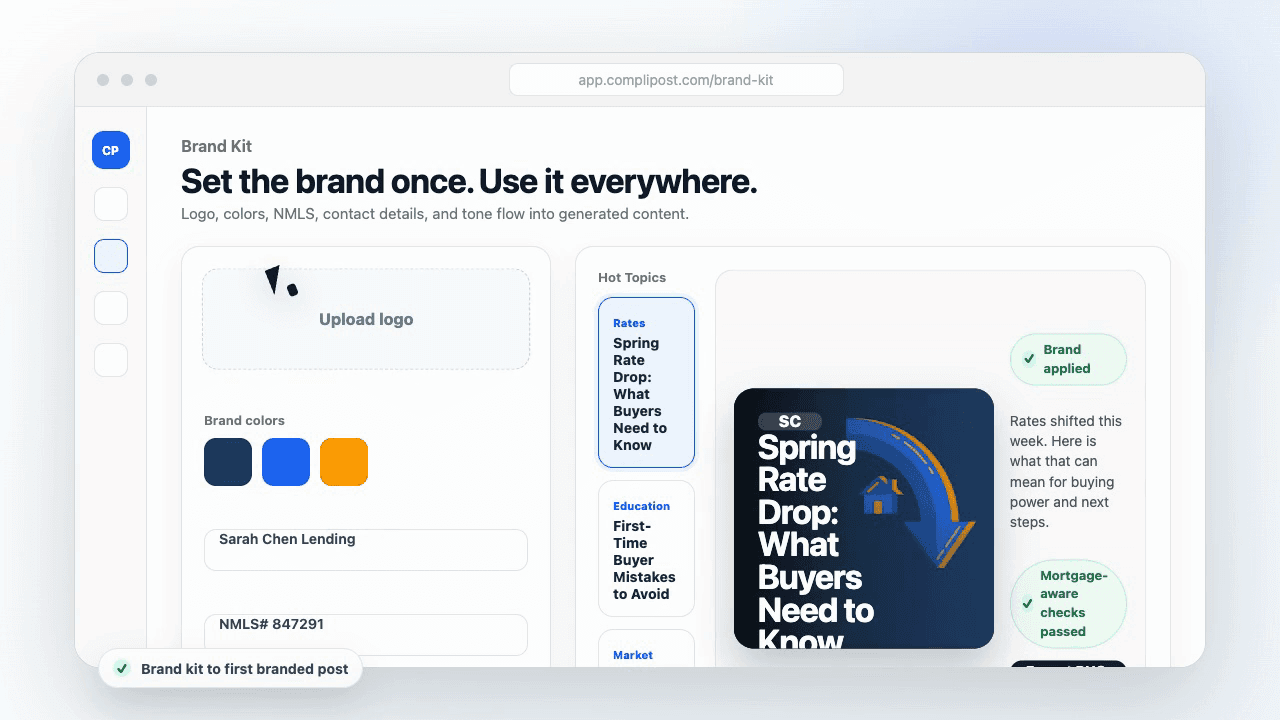
Product workflow
From blank page to export-ready mortgage content
- Start with a borrower topic
- Generate copy and a visual direction
- Review, save, and export the finished asset
These previews reflect the core CompliPost workflow: create, review, save, and export assets for use in your own channels.
Workflow comparison
| Content approach | What happens | Why it matters |
|---|---|---|
| Random posting | One-off ideas created when there is spare time | Inconsistent visibility and weak reuse |
| Template-only posting | Faster design but still requires rewriting and review | Helpful starting point, but not a full system |
| CompliPost workflow | Plan, generate, review, save, and export from one place | Better consistency with mortgage-aware review context |
| Done-for-you service | Someone else creates much of the content | Useful for some teams, but less control and less immediate reuse |
Who this guide helps
This guide is for loan officers working on solo loan officers who need a repeatable mortgage content workflow. The goal is to turn a broad mortgage topic into one borrower question, one useful takeaway, and one asset that can be reviewed before it is shared.
- You need content that sounds like a loan officer, not a generic brand account
- You want examples that can become captions, graphics, GIFs, or PDFs
- You need a clear place to review claims before export
- You want finished work saved for reuse, not lost in a chat thread
A practical workflow for this use case
Start with a narrow scenario, then move through planning, drafting, visual creation, review, and export. For specialty financing terminology, that means the topic should be specific enough that a borrower or referral partner can immediately understand what decision the content helps with.
- Choose the borrower type, loan topic, or platform before generating copy
- Draft the caption and visual together so the asset feels cohesive
- Use the federal baseline review aid to flag claims and disclosure gaps
- Export the finished asset and save the post as a reusable starting point
What makes the content stronger
Strong mortgage content is usually specific, plain-spoken, and calm. It explains tradeoffs without pretending one answer fits every borrower. That is especially important on public social channels, where a short post can be interpreted without the full context of a loan conversation.
- Name the borrower question in the first line
- Explain one decision or tradeoff instead of covering everything
- Use examples without implying approval, savings, or rate outcomes
- End with a soft next step, checklist, or guide rather than pressure
Compliance-aware review notes
CompliPost should be treated as a review aid, not a compliance approval system. The public page, generated draft, graphic, and exported asset should all stay honest about that boundary.
- Review specific payment, APR, rate, savings, and qualification language
- Avoid “best,” “lowest,” “guaranteed,” “free,” and urgency claims unless approved
- Check NMLS, Equal Housing, company, and state-specific requirements
- Use company or legal review for anything outside the federal baseline
How this connects to the rest of CompliPost
A focused guide should leave you with a usable next step. After you understand the topic, you can turn it into a calendar slot, a reviewed social post, a downloadable guide, or a platform-specific version for the channel where your audience already spends time.
- Use the content calendar to turn the idea into a weekly plan
- Use the compliance page when claims or disclosures need a slower pass
- Use lead magnets when the topic deserves a deeper PDF guide
- Use platform pages to adapt the same idea for LinkedIn, Facebook, or Instagram
Recommended next steps
Mortgage social media content
See the cross-platform content workflow for loan officers.
Mortgage content calendar
Plan a weekly rhythm of useful borrower and referral-partner posts.
DSCR Loans Explained
Deep dive into DSCR and how it's used for investor qualification.
Calendar generator
Turn one mortgage topic into a practical weekly content plan.
Examples
FAQ
Why do lenders use DSCR instead of personal income?+
DSCR focuses on the property's ability to generate enough income to cover its debts. For investment properties, lenders prioritize rental income over personal income because the property itself is the income source. This approach helps lenders assess the property's financial viability independently of the borrower's personal employment status.
What's a good LTV (loan-to-value ratio)?+
A lower LTV is generally preferable, with 75-80% being common for investment properties. This ratio indicates that the borrower has a significant equity stake, reducing risk for the lender. Higher LTVs may require stronger borrower credentials or specialized lenders due to increased risk. The practical move is to keep the answer educational, mention that details vary by borrower profile and lender guidelines, and invite the reader to ask for a personal review instead of implying a certain result.
How is NOI (net operating income) calculated?+
NOI is calculated by subtracting all operating expenses from the gross rental income. These expenses include property taxes, insurance, and maintenance. For instance, if a property earns $60k annually and incurs $20k in expenses, its NOI is $40k. Understanding NOI is crucial for evaluating investment profitability.
Why does ARV (after-repair value) matter?+
ARV is critical in renovation financing as it estimates a property's value after improvements. Lenders use ARV to determine loan limits since the property's enhanced value serves as collateral. note that ARV is an estimate and not a definitive valuation, impacting loan decisions accordingly. The practical move is to keep the answer educational, mention that details vary by borrower profile and lender guidelines, and invite the reader to ask for a personal review instead of implying a certain result.
Create mortgage content with a calmer workflow
CompliPost helps you plan, generate, review, save, and export useful mortgage content without pretending compliance or social distribution is automatic.
Start free