Refinance Decision
Refinancing Myths Debunked: What Borrowers Get Wrong
Borrowers hear conflicting advice about refinancing from friends, family, and the internet. Many myths persist—and they lead to poor decisions. Your job is to separate fact from fiction and help borrowers see refinancing clearly. CompliPost's compliance review aid ensures you're calling out myths accurately and replacing them with honest information.
Myth: 'If rates drop, I should always refinance.'
False. A rate drop alone doesn't justify refinancing if closing costs eat the savings or if the borrower's timeline is short. Break-even math determines whether a refi makes sense, not just the rate change. Help borrowers calculate break-even before they assume 'lower rate = automatic yes.'
- Rate drops are tempting but incomplete information
- Break-even is the real decision point, not the rate difference
- Closing costs are real and must be recovered through monthly savings
- Even a 0.5% drop might not justify closing costs if break-even is distant
- Timeline matters more than rate size; a lower rate is only good if you stay long enough
Myth: 'Refinancing resets your loan clock and delays payoff.'
False—but with nuance. If a borrower refinances after seven years on a 30-year loan and chooses another 30-year term, they resets the clock to 30 years from now. But they can choose a 15-year term or keep a shorter timeline. The refi doesn't force clock-resetting; the borrower's term choice does.
- Refinancing doesn't automatically reset your timeline
- You choose the term: 30 years, 20 years, 15 years, or shorter
- Staying on the same term shortens payoff compared to the original loan
- Borrowers who want to avoid payoff delays should refinance to a shorter term
- The 'clock reset' is a choice, not an automatic consequence
Myth: 'Refinancing is only for people with excellent credit.'
False. Borrowers with good (not just excellent) credit can refinance. Those with lower scores may face higher rates but can still benefit if the math works. Credit matters, but it's not a barrier; it's a factor in the rate offered.
- Excellent credit gets the best rates; good credit can still refi beneficially
- Lower credit scores may mean higher rates, but refi can still save money
- Improving credit before refinancing may open up better rates
- Some lenders specialize in borrowers with less-than-perfect credit
- The question isn't 'can I refi?' but 'does the math work at my rate?'
Myth: 'Refinancing guarantees I'll lower my monthly payment.'
False. Refinancing can lower payments, but it depends on rate, term, and whether you're cashing out. If you extend the term or cash out, your payment might increase even with a lower rate. Show scenarios, not guarantees.
- Lower rate usually means lower payment (all else equal)
- Longer term also lowers payment (but increases total interest)
- Cashing out increases the loan amount (higher balance = higher payment)
- Combination effects: lower rate + longer term might lower payment significantly or minimally
- Always calculate; never assume payment direction without numbers
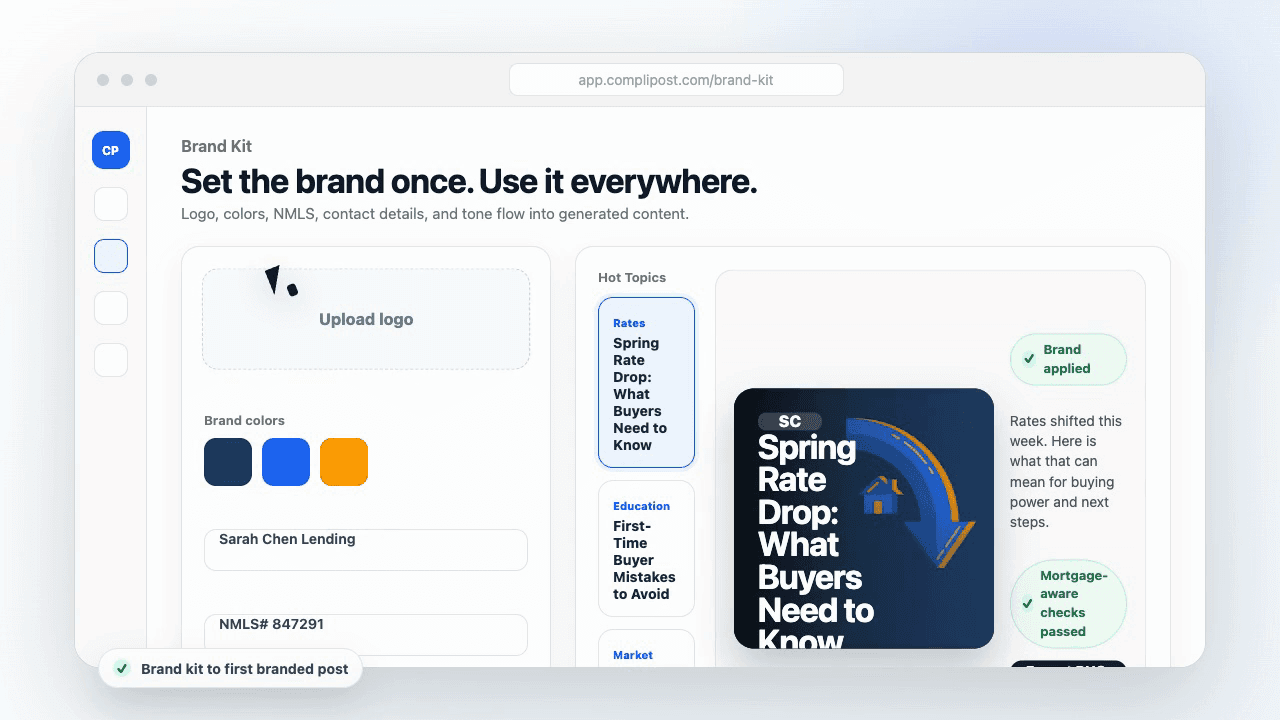
Product workflow
From blank page to export-ready mortgage content
- Start with a borrower topic
- Generate copy and a visual direction
- Review, save, and export the finished asset
These previews reflect the core CompliPost workflow: create, review, save, and export assets for use in your own channels.
Workflow comparison
| Content approach | What happens | Why it matters |
|---|---|---|
| Random posting | One-off ideas created when there is spare time | Inconsistent visibility and weak reuse |
| Template-only posting | Faster design but still requires rewriting and review | Helpful starting point, but not a full system |
| CompliPost workflow | Plan, generate, review, save, and export from one place | Better consistency with mortgage-aware review context |
| Done-for-you service | Someone else creates much of the content | Useful for some teams, but less control and less immediate reuse |
Who this guide helps
This guide is for loan officers working on homeowners deciding whether a refinance conversation is worth exploring. The goal is to turn a broad mortgage topic into one borrower question, one useful takeaway, and one asset that can be reviewed before it is shared.
- You need content that sounds like a loan officer, not a generic brand account
- You want examples that can become captions, graphics, GIFs, or PDFs
- You need a clear place to review claims before export
- You want finished work saved for reuse, not lost in a chat thread
A practical workflow for this use case
Start with a narrow scenario, then move through planning, drafting, visual creation, review, and export. For refinancing myths, that means the topic should be specific enough that a borrower or referral partner can immediately understand what decision the content helps with.
- Choose the borrower type, loan topic, or platform before generating copy
- Draft the caption and visual together so the asset feels cohesive
- Use the federal baseline review aid to flag claims and disclosure gaps
- Export the finished asset and save the post as a reusable starting point
What makes the content stronger
Strong mortgage content is usually specific, plain-spoken, and calm. It explains tradeoffs without pretending one answer fits every borrower. That is especially important on public social channels, where a short post can be interpreted without the full context of a loan conversation.
- Name the borrower question in the first line
- Explain one decision or tradeoff instead of covering everything
- Use examples without implying approval, savings, or rate outcomes
- End with a soft next step, checklist, or guide rather than pressure
Compliance-aware review notes
CompliPost should be treated as a review aid, not a compliance approval system. The public page, generated draft, graphic, and exported asset should all stay honest about that boundary.
- Review specific payment, APR, rate, savings, and qualification language
- Avoid “best,” “lowest,” “guaranteed,” “free,” and urgency claims unless approved
- Check NMLS, Equal Housing, company, and state-specific requirements
- Use company or legal review for anything outside the federal baseline
How this connects to the rest of CompliPost
A focused guide should leave you with a usable next step. After you understand the topic, you can turn it into a calendar slot, a reviewed social post, a downloadable guide, or a platform-specific version for the channel where your audience already spends time.
- Use the content calendar to turn the idea into a weekly plan
- Use the compliance page when claims or disclosures need a slower pass
- Use lead magnets when the topic deserves a deeper PDF guide
- Use platform pages to adapt the same idea for LinkedIn, Facebook, or Instagram
Recommended next steps
Refinance content hub
Create refinance education without overpromising outcomes.
When Refinancing Makes Sense: Break-Even Analysis
The antidote to myth-based decisions: math-based break-even analysis.
How to Educate Borrowers About Refinancing
Frame refinancing conversations around facts, not myths.
Borrower Objections: How to Address Them
When borrowers are skeptical, use facts and data to rebuild confidence.
Examples
FAQ
Is there ever a time when refinancing is definitely a bad idea?+
Yes. If break-even is longer than the borrower's expected timeline in the home, if credit score has dropped significantly, or if the home value has declined (and equity is weak), refinancing is risky. Honest evaluation prevents regret.
Do all refinances cost money upfront?+
Usually. Closing costs typically range from 2–5% of the loan. But some lenders offer 'no-cost' refis where costs are rolled into the rate (higher rate, no out-of-pocket cost). Borrowers should understand what they're choosing: cash cost now or rate cost over the life of the loan.
Can I refinance multiple times?+
Yes, but each refi costs money and has a break-even. Most borrowers refinance once or twice, not repeatedly. Help them think long-term: one thoughtful refi, not constant chasing of rate drops.
What's the most common refinancing mistake?+
Not calculating break-even and refinancing without understanding their timeline. Borrowers refi when rates drop, then move or refi again before recovering costs. Teach break-even; it prevents this trap.
Is refinancing different from a home equity loan or HELOC?+
Yes. Refinancing replaces your entire loan; a HELOC or home equity loan is a second loan on top of your existing mortgage. They serve different purposes and have different costs. Help borrowers understand which tool fits their goal.
Create mortgage content with a calmer workflow
CompliPost helps you plan, generate, review, save, and export useful mortgage content without pretending compliance or social distribution is automatic.
Start free