Refinance Decision
Refinance Closing Costs: A Guide for Loan Officers
Loan officers can enhance borrower trust by clearly explaining refinance closing costs. This guide helps you break down the components, show why they matter, and compare different offers effectively. By understanding these costs, you empower borrowers to make informed decisions. Use CompliPost's compliance tools to ensure your explanations meet regulatory standards and build borrower confidence. This gives you a reusable way to teach the topic, write captions, choose a soft call to action, and keep the message inside a safer mortgage marketing lane before you export it.
Understanding Closing Costs in Refinances
Closing costs are a crucial part of the refinance process, encompassing various fees and charges that borrowers must pay. As a loan officer, it's essential to explain that these costs include lender fees, title services, appraisal fees, and taxes. Each component serves a specific purpose, such as ensuring accurate property valuation or verifying ownership. By educating borrowers on these elements, you help demystify the process and highlight the value of these services. closing costs refinance caption angle: name one borrower decision, add one document cue,.
- Lender fees: Cover origination, processing, underwriting (percentage of loan amount)
- Appraisal: Ensures property value accuracy (typically $400–$600)
- Title services: Includes search and insurance for ownership verification
- Taxes and fees: Vary by location, essential for legal compliance
- Insurance: Often requires homeowners insurance prepayment
- Prepaid items: May include property taxes, HOA fees
Typical Range of Refinance Closing Costs
Refinance closing costs generally range from 2% to 5% of the loan amount, though this can vary widely. For instance, a $300,000 refinance might incur costs between $6,000 and $15,000. Factors influencing these costs include the lender, market conditions, property value, and geographic location. Encourage borrowers to obtain multiple lender quotes to identify the strong financial fit. Highlight the importance of comparing these quotes to understand potential savings. closing costs refinance borrower concern: explain what a lender may verify, why the step matters, and how a reader can prepare..
- Common range: 2%–5% of loan amount
- Example calculation: $300,000 × 3% = $9,000
- Lender variation: Costs differ based on lender policies
- Location impact: Certain states have higher costs due to additional fees
- No-cost options: Costs integrated into the loan rate, increasing long-term expense
Comparing Closing Costs Across Lenders
The Loan Estimate form is a vital tool for borrowers, providing a clear comparison of closing costs between different lenders. Encourage borrowers to review estimates from at least three lenders to get a comprehensive view. While some fees, like lender origination, are negotiable, others such as appraisal and title fees are fixed by market standards. By guiding borrowers through this process, you help them identify negotiable elements and make informed decisions. closing costs refinance compliance note: avoid exact terms, certainty language,...
- Loan Estimate: Federally mandated form detailing all costs
- Comparison: Obtain quotes from multiple lenders for thorough analysis
- Negotiable fees: Lender origination and processing fees
- Fixed fees: Market-determined costs like appraisal and title
- Bundled vs. itemized: Evaluate costs line-by-line for clarity
The Role of Closing Costs in Refinance Decisions
Closing costs play a pivotal role in the refinance decision, directly impacting the break-even analysis. These costs determine how long it will take for the borrower to recoup the expense through monthly savings. It's vital to include these costs in all financial calculations. Explain the concept of a no-cost refinance, where the borrower might face a higher interest rate instead of upfront costs. This understanding helps borrowers weigh immediate versus long-term financial implications. closing costs refinance reuse plan: make one caption,. closing costs refinance reuse plan: make one caption,.
- Break-even analysis: Closing costs are central to calculating savings
- No-cost refi: Costs incorporated into the loan rate, affecting overall cost
- Loan amount impact: Costs generally scale with loan size
- Financing options: Borrowers can choose to pay upfront or roll costs into the loan
- Informed decisions: Encourage understanding of both upfront and long-term impacts
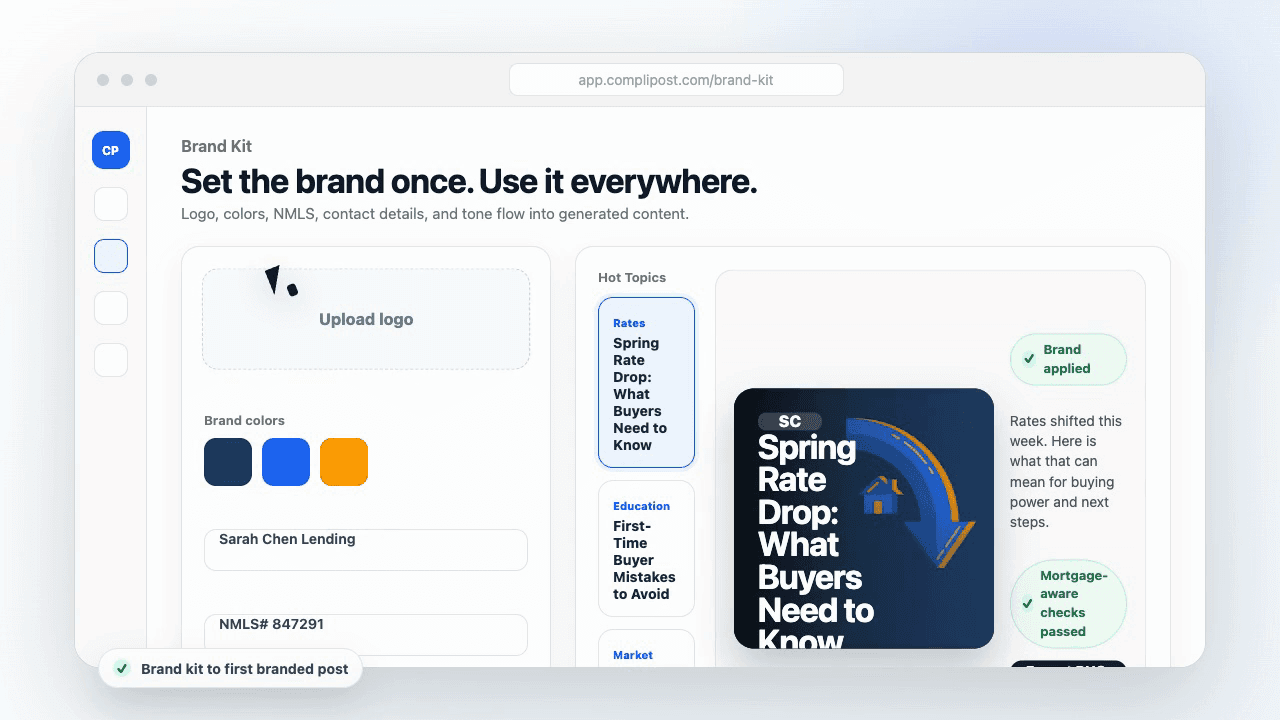
Product workflow
From blank page to export-ready mortgage content
- Start with a borrower topic
- Generate copy and a visual direction
- Review, save, and export the finished asset
These previews reflect the core CompliPost workflow: create, review, save, and export assets for use in your own channels.
Workflow comparison
| Content approach | What happens | Why it matters |
|---|---|---|
| Random posting | One-off ideas created when there is spare time | Inconsistent visibility and weak reuse |
| Template-only posting | Faster design but still requires rewriting and review | Helpful starting point, but not a full system |
| CompliPost workflow | Plan, generate, review, save, and export from one place | Better consistency with mortgage-aware review context |
| Done-for-you service | Someone else creates much of the content | Useful for some teams, but less control and less immediate reuse |
Who this guide helps
This guide is for loan officers working on homeowners deciding whether a refinance conversation is worth exploring. The goal is to turn a broad mortgage topic into one borrower question, one useful takeaway, and one asset that can be reviewed before it is shared.
- You need content that sounds like a loan officer, not a generic brand account
- You want examples that can become captions, graphics, GIFs, or PDFs
- You need a clear place to review claims before export
- You want finished work saved for reuse, not lost in a chat thread
A practical workflow for this use case
Start with a narrow scenario, then move through planning, drafting, visual creation, review, and export. For closing costs refinance, that means the topic should be specific enough that a borrower or referral partner can immediately understand what decision the content helps with.
- Choose the borrower type, loan topic, or platform before generating copy
- Draft the caption and visual together so the asset feels cohesive
- Use the federal baseline review aid to flag claims and disclosure gaps
- Export the finished asset and save the post as a reusable starting point
What makes the content stronger
Strong mortgage content is usually specific, plain-spoken, and calm. It explains tradeoffs without pretending one answer fits every borrower. That is especially important on public social channels, where a short post can be interpreted without the full context of a loan conversation.
- Name the borrower question in the first line
- Explain one decision or tradeoff instead of covering everything
- Use examples without implying approval, savings, or rate outcomes
- End with a soft next step, checklist, or guide rather than pressure
Compliance-aware review notes
CompliPost should be treated as a review aid, not a compliance approval system. The public page, generated draft, graphic, and exported asset should all stay honest about that boundary.
- Review specific payment, APR, rate, savings, and qualification language
- Avoid “best,” “lowest,” “guaranteed,” “free,” and urgency claims unless approved
- Check NMLS, Equal Housing, company, and state-specific requirements
- Use company or legal review for anything outside the federal baseline
How this connects to the rest of CompliPost
A focused guide should leave you with a usable next step. After you understand the topic, you can turn it into a calendar slot, a reviewed social post, a downloadable guide, or a platform-specific version for the channel where your audience already spends time.
- Use the content calendar to turn the idea into a weekly plan
- Use the compliance page when claims or disclosures need a slower pass
- Use lead magnets when the topic deserves a deeper PDF guide
- Use platform pages to adapt the same idea for LinkedIn, Facebook, or Instagram
Recommended next steps
Refinance content hub
Create refinance education without overpromising outcomes.
Mortgage content calendar
Plan a weekly rhythm of useful borrower and referral-partner posts.
When Refinancing Makes Sense: Break-Even Analysis
Closing costs are central to the break-even calculation.
Calendar generator
Turn one mortgage topic into a practical weekly content plan.
Examples
FAQ
Can borrowers negotiate closing costs?+
Yes, borrowers can negotiate certain closing costs like lender origination and processing fees. However, fees such as appraisal and title services are generally fixed. Encourage borrowers to shop around for better pricing and ask lenders about potential credits. The practical move is to keep the answer educational, mention that details vary by borrower profile and lender guidelines, and invite the reader to ask.
Should closing costs be included in the break-even calculation?+
Absolutely. Closing costs are integral to the break-even analysis, determining how long it will take for the borrower to recover the costs through monthly savings. It's a critical component of the refinance decision-making process. The practical move is to keep the answer educational, mention that details vary by borrower profile and lender guidelines, and invite the reader to ask for a personal review instead.
What's a 'no-cost' refi and is it always a good deal?+
A 'no-cost' refinance means the borrower pays higher interest rates instead of upfront closing costs. It's beneficial for those lacking immediate funds but increases long-term interest payments. Weighing short-term benefits against long-term costs is crucial. The practical move is to keep the answer educational, mention that details vary by borrower profile and lender guidelines, and invite the reader to ask.
Are closing costs the same for every loan amount?+
No, closing costs often vary with loan amounts since lender fees are typically a percentage of the loan. While some costs remain fixed, larger loans usually incur higher total closing costs, impacting the overall percentage. The practical move is to keep the answer educational, mention that details vary by borrower profile and lender guidelines, and invite the reader to ask for a personal review instead.
Create mortgage content with a calmer workflow
CompliPost helps you plan, generate, review, save, and export useful mortgage content without pretending compliance or social distribution is automatic.
Start free