Approval Stages
Clarifying Pre-Approval and Final Approval for Loan Officers
Loan officers often encounter borrowers who misunderstand the significance of pre-approval, thinking it equates to a finalized loan approval. This can lead to anxiety and confusion when further steps are required. By clearly explaining the distinction between pre-approval and final approval, you can better manage expectations and foster trust. Use the following strategies to create engaging and informative content that demystifies these stages. This will help you craft captions, checklists, and follow-up posts using the CompliPost planner, ensuring your borrowers are well-informed throughout the mortgage process.
Understanding Pre-Approval and Final Approval
Pre-approval serves as an initial assessment of a borrower's financial standing, providing a snapshot of what they might qualify for. It is based on self-reported information and preliminary checks. However, it is not a binding agreement. Final approval, on the other hand, is granted after a thorough verification of the borrower's financial details, including credit, income, and assets. This stage involves rigorous underwriting to ensure all criteria are met. By explaining these differences, loan officers can help borrowers appreciate the steps involved and reduce misunderstandings.
- Pre-approval: initial financial assessment
- Final approval: thorough verification and underwriting
- Pre-approval is not a binding agreement
- Final approval confirms all criteria are met
- Educate to reduce misunderstandings
Managing Borrower Expectations
Setting clear expectations from the start can significantly reduce borrower anxiety. Many borrowers mistakenly believe that obtaining pre-approval means their loan process is complete. By educating them early on about the subsequent steps required for final approval, loan officers can prevent panic and foster a smoother transaction. Emphasizing that additional documentation and verifications are standard procedures will help borrowers view these steps as routine rather than unexpected hurdles. pre-approval vs final approval content for loan officers borrower concern: explain what a lender may verify, why the step matters, and.
- Clarify that pre-approval is not the end
- Explain the necessity of further documentation
- Normalize additional verifications
- Reduce panic with early education
- Foster smoother transactions
Effective Content Formats
To effectively communicate the distinction between pre-approval and final approval, consider using various content formats. A comparison graphic can visually depict the differences, while a short explainer video can provide a more in-depth explanation. An FAQ post can address common borrower questions, and captions can succinctly clarify the process. By leveraging these formats, loan officers can create engaging and informative content that resonates with borrowers. pre-approval vs final approval content for loan officers compliance note: avoid exact terms, certainty language, and rushed decisions. pre-approval vs.
- Use visuals like comparison graphics
- Create explainer videos for depth
- Develop FAQ posts for common queries
- Craft captions for quick clarity
- Engage borrowers with varied content
Additional Resources and Compliance
When drafting content about pre-approval and final approval, it is crucial to adhere to compliance guidelines. Ensure that all content is educational and does not suggest specific outcomes. Incorporating compliance notes related to the Equal Housing Act can be beneficial. This helps maintain transparency and trust with borrowers. Additionally, providing resources such as templates and checklists can assist borrowers in navigating the approval process with confidence. pre-approval vs final approval content for loan officers reuse plan: make one caption, one carousel point, one email follow-up, and one saved template. pre-approval vs final approval content.
- Adhere to Equal Housing Act guidelines
- Avoid suggesting specific outcomes
- Provide educational resources
- Use templates and checklists
- Maintain transparency and trust
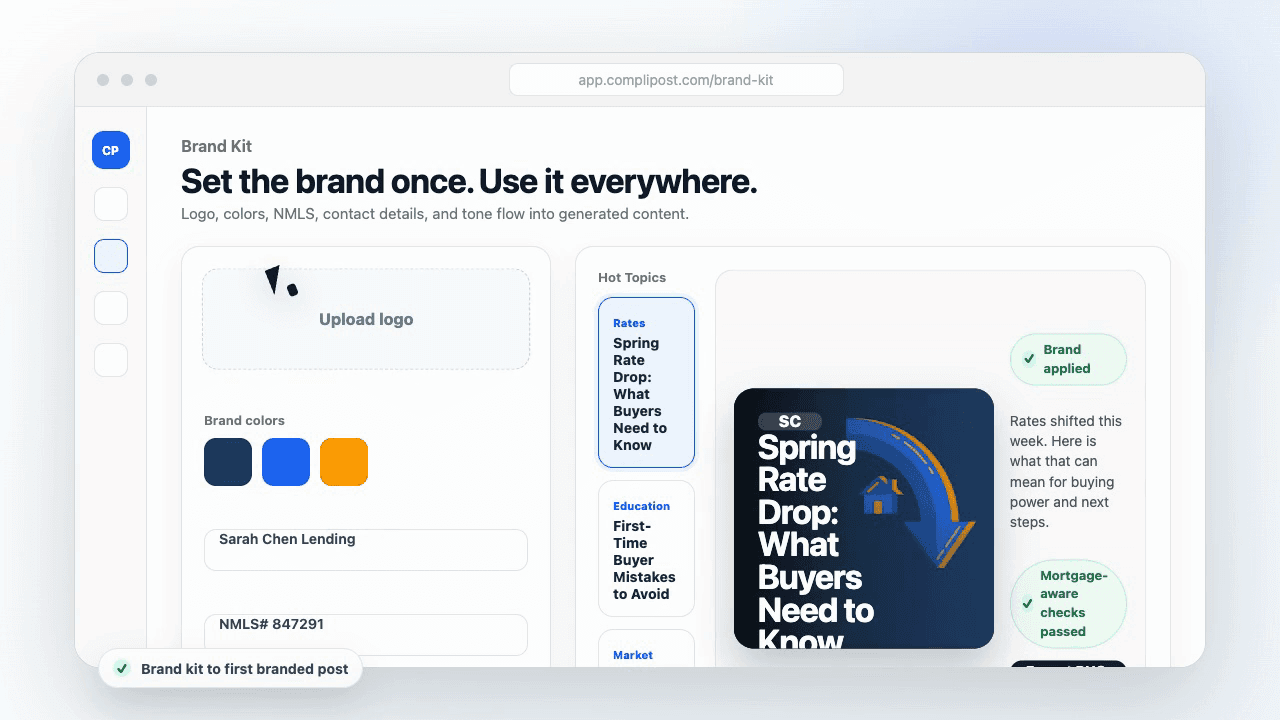
Product workflow
From blank page to export-ready mortgage content
- Start with a borrower topic
- Generate copy and a visual direction
- Review, save, and export the finished asset
These previews reflect the core CompliPost workflow: create, review, save, and export assets for use in your own channels.
Workflow comparison
| Content approach | What happens | Why it matters |
|---|---|---|
| Random posting | One-off ideas created when there is spare time | Inconsistent visibility and weak reuse |
| Template-only posting | Faster design but still requires rewriting and review | Helpful starting point, but not a full system |
| CompliPost workflow | Plan, generate, review, save, and export from one place | Better consistency with mortgage-aware review context |
| Done-for-you service | Someone else creates much of the content | Useful for some teams, but less control and less immediate reuse |
Who this guide helps
This guide is for loan officers working on solo loan officers who need a repeatable mortgage content workflow. The goal is to turn a broad mortgage topic into one borrower question, one useful takeaway, and one asset that can be reviewed before it is shared.
- You need content that sounds like a loan officer, not a generic brand account
- You want examples that can become captions, graphics, GIFs, or PDFs
- You need a clear place to review claims before export
- You want finished work saved for reuse, not lost in a chat thread
A practical workflow for this use case
Start with a narrow scenario, then move through planning, drafting, visual creation, review, and export. For pre-approval vs final approval content for loan officers, that means the topic should be specific enough that a borrower or referral partner can immediately understand what decision the content helps with.
- Choose the borrower type, loan topic, or platform before generating copy
- Draft the caption and visual together so the asset feels cohesive
- Use the federal baseline review aid to flag claims and disclosure gaps
- Export the finished asset and save the post as a reusable starting point
What makes the content stronger
Strong mortgage content is usually specific, plain-spoken, and calm. It explains tradeoffs without pretending one answer fits every borrower. That is especially important on public social channels, where a short post can be interpreted without the full context of a loan conversation.
- Name the borrower question in the first line
- Explain one decision or tradeoff instead of covering everything
- Use examples without implying approval, savings, or rate outcomes
- End with a soft next step, checklist, or guide rather than pressure
Compliance-aware review notes
CompliPost should be treated as a review aid, not a compliance approval system. The public page, generated draft, graphic, and exported asset should all stay honest about that boundary.
- Review specific payment, APR, rate, savings, and qualification language
- Avoid “best,” “lowest,” “guaranteed,” “free,” and urgency claims unless approved
- Check NMLS, Equal Housing, company, and state-specific requirements
- Use company or legal review for anything outside the federal baseline
How this connects to the rest of CompliPost
A focused guide should leave you with a usable next step. After you understand the topic, you can turn it into a calendar slot, a reviewed social post, a downloadable guide, or a platform-specific version for the channel where your audience already spends time.
- Use the content calendar to turn the idea into a weekly plan
- Use the compliance page when claims or disclosures need a slower pass
- Use lead magnets when the topic deserves a deeper PDF guide
- Use platform pages to adapt the same idea for LinkedIn, Facebook, or Instagram
Recommended next steps
First-time buyer content hub
Build clear education for first-time buyers.
Mortgage content calendar
Plan a weekly rhythm of useful borrower and referral-partner posts.
Conditional approval explained
Explain conditional approval too.
Compliance checklist tool
Check common mortgage marketing risk signals before export.
Examples
FAQ
Is pre-approval the same as final approval?+
No, pre-approval and final approval are distinct stages. Pre-approval provides an initial estimate based on preliminary data, while final approval follows a comprehensive review of financial documents. Clarifying this helps manage borrower expectations and avoid confusion. The practical move is to keep the answer educational, mention that details vary by borrower profile and lender guidelines, and invite the reader to ask for a personal review instead of implying a certain result.
Why do borrowers often confuse pre-approval with final approval?+
The term 'approval' can be misleading, leading borrowers to believe pre-approval is the final step. Educating borrowers about the process, including the need for additional documentation and underwriting, helps reduce this confusion and manage expectations effectively. The practical move is to keep the answer educational, mention that details vary by borrower profile and lender guidelines, and invite the reader to ask for a personal review instead of implying a certain result.
Can pre-approval assure final approval?+
Pre-approval does not assure final approval. It is an initial assessment based on preliminary information. Final approval requires a thorough verification of all financial details. Avoid making suggestions and focus on educating borrowers about the process. The practical move is to keep the answer educational, mention that details vary by borrower profile and lender guidelines, and invite the reader to ask for a personal review instead of implying a certain result.
How can I effectively communicate the difference to borrowers?+
Utilize various content formats such as graphics, videos, and FAQs to explain the differences. Setting clear expectations from the beginning helps borrowers understand the process. Maintaining transparency and providing educational resources builds trust and reduces anxiety. The practical move is to keep the answer educational, mention that details vary by borrower profile and lender guidelines, and invite the reader to ask for a personal review instead of implying a certain result.
Create mortgage content with a calmer workflow
CompliPost helps you plan, generate, review, save, and export useful mortgage content without pretending compliance or social distribution is automatic.
Start free