Process & Timeline
How Long Preapproval Takes: A Step-by-Step Timeline
Preapproval can take anywhere from one day to one week, depending on how organized you are and how complex your financial situation is. Understanding the timeline helps borrowers set expectations and prepares them to act quickly when they find the right home. Create content showing you understand borrower urgency and have streamlined your process.
The standard preapproval timeline
Most preapprovals are completed within 3-5 business days from application to letter, assuming documents are submitted promptly and employment is straightforward. The process has distinct phases: application, document collection, credit and employment verification, underwriting review, and conditional approval. Each phase takes 1-2 days on average.
- Day 1: application and initial document collection
- Days 2-3: credit pull, employment verification, and document review begins
- Days 3-4: underwriter reviews file, may request additional documentation
- Days 4-5: conditional approval issued and preapproval letter generated
Factors that speed up preapproval
Organization is the fastest path to preapproval. Borrowers who submit complete documentation on day one, have straightforward W2 employment, and respond quickly to lender requests close faster. Use this in social content to empower borrowers to control their timeline.
- Organized documents: submitting all required docs at application saves 1-2 days
- W2 employment: traditional employment is verified faster than self-employment
- Quick responses: answering lender questions immediately avoids delays
- Clear financial profile: straightforward assets and debts are underwritten quickly
Factors that slow down preapproval
Self-employment, recent job changes, gift funds, or complex asset structures require more underwriting review. Missing documentation, incomplete forms, or slow response times to lender requests delay approval. Be upfront with borrowers about potential delays so there are no surprises.
- Self-employment: requires 2 years of tax returns and profit-and-loss review (adds 1-2 days)
- Recent job changes: employer verification may require additional documentation
- Gift funds: donor verification and gift letter add time
- Missing documents: delays approval by 2-3 days per request
How to move faster through preapproval
Prepare before you apply. Gather all documents, submit a complete application, and respond to lender requests within 24 hours. Choose a lender with a streamlined process and technology platform. Communicate clearly about your timeline so your lender prioritizes your file if you're under time pressure.
- Prepare documents before applying: have ID, pay stubs, tax returns, and bank statements ready
- Submit complete application: don't delay with partial submissions
- Respond quickly to requests: reply to lender emails within 24 hours
- Communicate timeline: let your lender know if you're house hunting actively
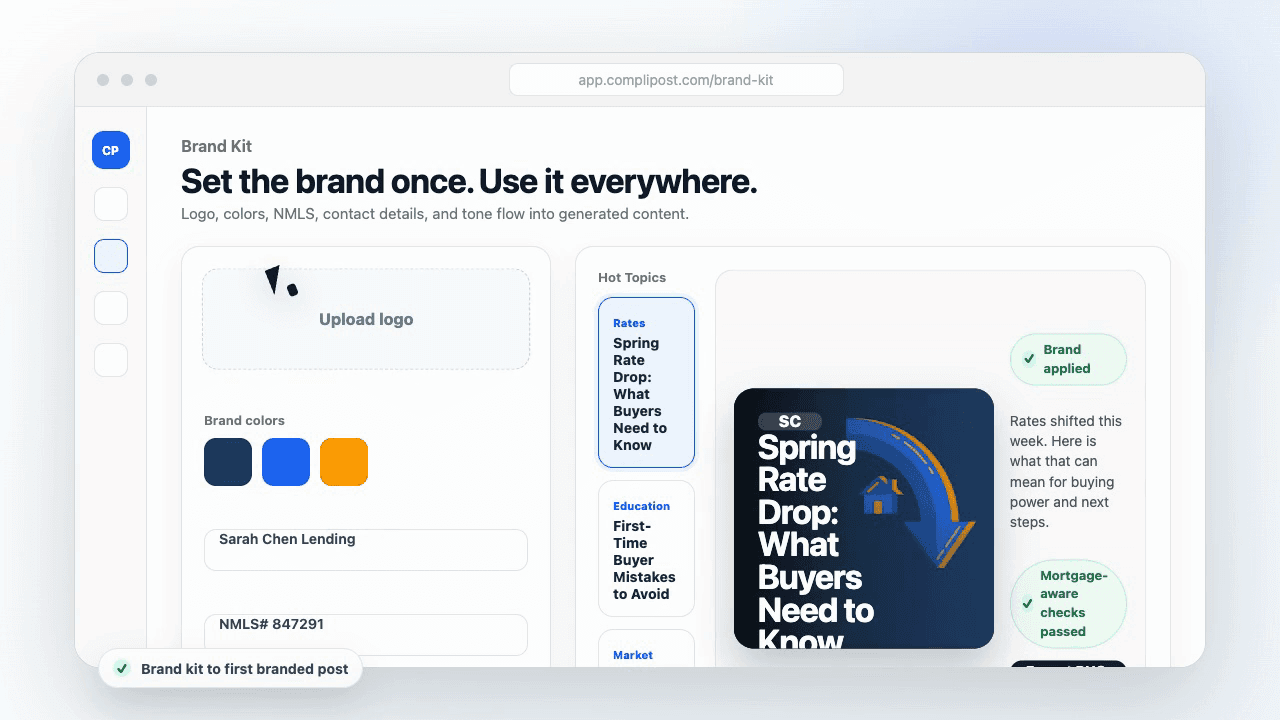
Product workflow
From blank page to export-ready mortgage content
- Start with a borrower topic
- Generate copy and a visual direction
- Review, save, and export the finished asset
These previews reflect the core CompliPost workflow: create, review, save, and export assets for use in your own channels.
Workflow comparison
| Content approach | What happens | Why it matters |
|---|---|---|
| Random posting | One-off ideas created when there is spare time | Inconsistent visibility and weak reuse |
| Template-only posting | Faster design but still requires rewriting and review | Helpful starting point, but not a full system |
| CompliPost workflow | Plan, generate, review, save, and export from one place | Better consistency with mortgage-aware review context |
| Done-for-you service | Someone else creates much of the content | Useful for some teams, but less control and less immediate reuse |
Who this guide helps
This guide is for loan officers working on solo loan officers who need a repeatable mortgage content workflow. The goal is to turn a broad mortgage topic into one borrower question, one useful takeaway, and one asset that can be reviewed before it is shared.
- You need content that sounds like a loan officer, not a generic brand account
- You want examples that can become captions, graphics, GIFs, or PDFs
- You need a clear place to review claims before export
- You want finished work saved for reuse, not lost in a chat thread
A practical workflow for this use case
Start with a narrow scenario, then move through planning, drafting, visual creation, review, and export. For preapproval timeline how long, that means the topic should be specific enough that a borrower or referral partner can immediately understand what decision the content helps with.
- Choose the borrower type, loan topic, or platform before generating copy
- Draft the caption and visual together so the asset feels cohesive
- Use the federal baseline review aid to flag claims and disclosure gaps
- Export the finished asset and save the post as a reusable starting point
What makes the content stronger
Strong mortgage content is usually specific, plain-spoken, and calm. It explains tradeoffs without pretending one answer fits every borrower. That is especially important on public social channels, where a short post can be interpreted without the full context of a loan conversation.
- Name the borrower question in the first line
- Explain one decision or tradeoff instead of covering everything
- Use examples without implying approval, savings, or rate outcomes
- End with a soft next step, checklist, or guide rather than pressure
Compliance-aware review notes
CompliPost should be treated as a review aid, not a compliance approval system. The public page, generated draft, graphic, and exported asset should all stay honest about that boundary.
- Review specific payment, APR, rate, savings, and qualification language
- Avoid “best,” “lowest,” “guaranteed,” “free,” and urgency claims unless approved
- Check NMLS, Equal Housing, company, and state-specific requirements
- Use company or legal review for anything outside the federal baseline
How this connects to the rest of CompliPost
A focused guide should leave you with a usable next step. After you understand the topic, you can turn it into a calendar slot, a reviewed social post, a downloadable guide, or a platform-specific version for the channel where your audience already spends time.
- Use the content calendar to turn the idea into a weekly plan
- Use the compliance page when claims or disclosures need a slower pass
- Use lead magnets when the topic deserves a deeper PDF guide
- Use platform pages to adapt the same idea for LinkedIn, Facebook, or Instagram
Recommended next steps
First-time buyer content hub
Build clear education for first-time buyers.
Preapproval Document Checklist
Know exactly what documents you need to submit for preapproval to avoid delays.
Mortgage Approval Timeline: Application to Closing
See the complete timeline from preapproval through closing.
Self-Employed Borrowers and Mortgage Qualification
Learn how self-employment affects the preapproval timeline and what extra steps to expect.
Examples
FAQ
Can I get preapproved in one day?+
Yes, if you're organized and employed with a W2. Submit a complete application with all documents on day one, and a fast lender can review and conditionally approve by the same day. However, most lenders need 1-2 days for employment verification and underwriting review. One-day preapproval is possible but rare.
Why does preapproval take 3-5 days instead of 1?+
Verification takes time. Your lender needs to pull credit (1 day), verify employment (1-2 days), review documents (1 day), and underwrite your file (1-2 days). Each step is sequential and necessary. Some lenders run these in parallel to save time, but there's a minimum time required for verification.
What if I'm self-employed? Does preapproval take longer?+
Yes, typically 5-7 business days instead of 3-5, because we're reviewing 2 years of tax returns, profit-and-loss statements, and business documentation. The extra time ensures we accurately assess your income. Have documents ready to submit on day one to avoid delays.
Can I use preapproval before the letter arrives?+
Technically, yes—once your lender gives you conditional approval, you have a verbal approval. However, sellers and real estate agents require a written preapproval letter. Wait for the formal letter before making offers, even if verbal approval came through earlier.
What happens if the lender needs more documents?+
Each request for additional documents delays approval by 1-2 days. A second request can push you back a week. Avoid delays by being thorough in your initial submission. If your lender asks for clarification, respond same day. This shows you're serious and keeps momentum.
Create mortgage content with a calmer workflow
CompliPost helps you plan, generate, review, save, and export useful mortgage content without pretending compliance or social distribution is automatic.
Start free