Financing Strategy
Understanding Your Down Payment Options During Preapproval
Your down payment doesn't have to come from savings alone. Lenders allow gifts, gifts of equity, and down payment assistance programs. Understanding your options helps you preapprove for the right loan amount and choose the strategy that makes sense for your situation.
Savings-based down payment
The most straightforward option: you've saved the down payment yourself. Lenders require 60 days of bank statements showing the funds are yours. This is the simplest to document and doesn't require gift letters or explanations. Use this in content to show appreciation for savers.
- Documentation: 60 days of bank statements showing the down payment amount
- Proof of funds: statements must show your name and account control
- Seasoning: funds should be in your account for 60+ days (no recent large deposits)
- Flexibility: no restrictions on how you use the funds once you close
Gift funds from family
Family members can gift down payment funds if proper documentation is provided. A gift letter from the donor stating the funds are a gift (not a loan) and won't be repaid is required. The donor must provide proof that the funds are theirs. Gift funds are common and lenders approve them regularly.
- Gift letter: donor states funds are a gift, not a loan, not to be repaid
- Proof of funds: donor's bank statement showing they have the funds
- Non-repayment: gift cannot be contingent on repayment or future obligations
- Multiple donors: if multiple people gift, each provides a letter and proof of funds
Gift of equity
If the seller owns the home outright and allows you to purchase below market value, the difference is a gift of equity. A gift of equity letter from the seller is required. This can significantly reduce your down payment requirement without borrowing from family.
- Definition: seller allows you to buy below market; difference is a gift
- Letter required: seller provides a gift of equity letter to lender
- Appraisal impact: if appraisal comes in below purchase price, gift of equity may not be allowed
- Strategy: common in family sales or motivated-seller situations
Down payment assistance programs
Many communities offer down payment assistance grants or soft-second mortgages for first-time buyers, teachers, healthcare workers, and other groups. These programs reduce or eliminate down payment requirements. Research local, state, and federal programs to see what you qualify for.
- Grant programs: free money that doesn't need to be repaid
- Soft seconds: low-interest loans that are forgiven if you stay in the home for X years
- Eligibility: varies by program; first-time buyers, income limits, occupancy requirements
- Timing: some programs require pre-qualification before applying
Borrowed down payment (generally not allowed)
Borrowing your down payment from a personal loan or line of credit creates multiple debts and affects your debt-to-income ratio. Most lenders don't allow down payment to be borrowed; it must be gift funds, savings, or assistance. Avoid borrowing for down payment.
- Personal loans: creates additional debt and increases DTI
- Credit cards: high-interest debt negatively affects qualification
- Family loans: treated as debt unless documented as a gift
- Recommendation: save, receive gifts, or explore assistance programs instead
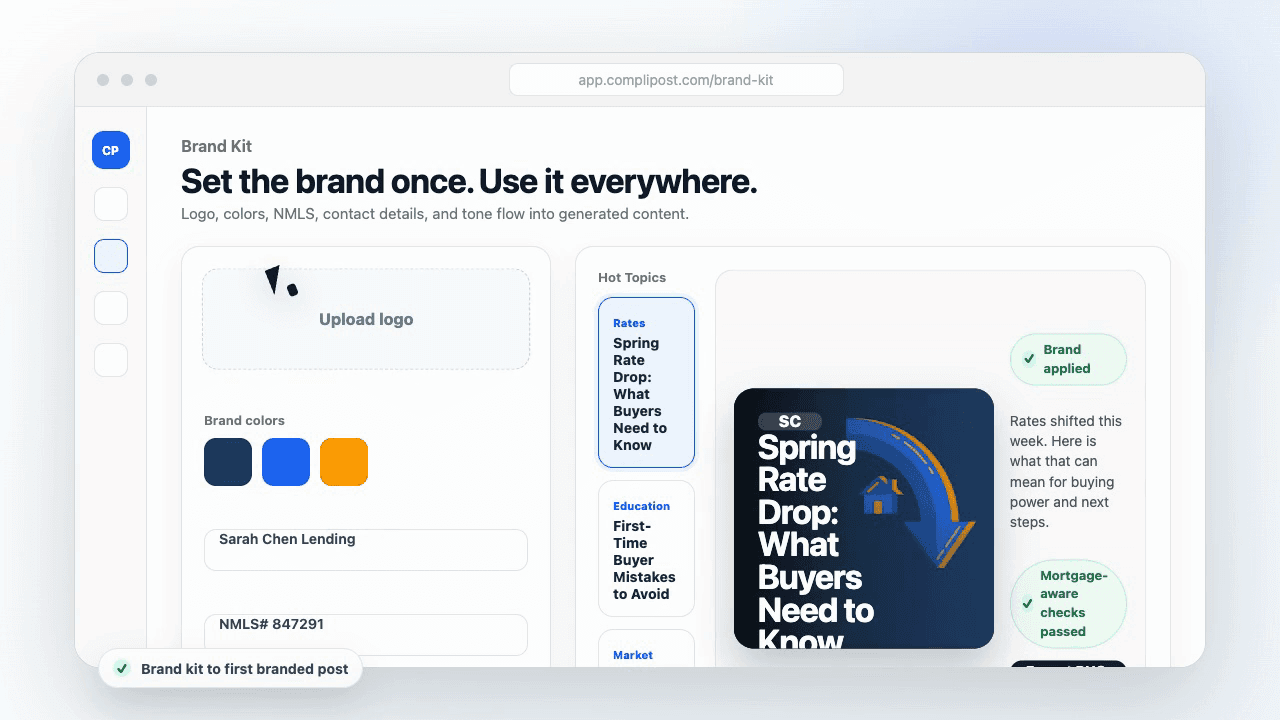
Product workflow
From blank page to export-ready mortgage content
- Start with a borrower topic
- Generate copy and a visual direction
- Review, save, and export the finished asset
These previews reflect the core CompliPost workflow: create, review, save, and export assets for use in your own channels.
Workflow comparison
| Content approach | What happens | Why it matters |
|---|---|---|
| Random posting | One-off ideas created when there is spare time | Inconsistent visibility and weak reuse |
| Template-only posting | Faster design but still requires rewriting and review | Helpful starting point, but not a full system |
| CompliPost workflow | Plan, generate, review, save, and export from one place | Better consistency with mortgage-aware review context |
| Done-for-you service | Someone else creates much of the content | Useful for some teams, but less control and less immediate reuse |
Who this guide helps
This guide is for loan officers working on solo loan officers who need a repeatable mortgage content workflow. The goal is to turn a broad mortgage topic into one borrower question, one useful takeaway, and one asset that can be reviewed before it is shared.
- You need content that sounds like a loan officer, not a generic brand account
- You want examples that can become captions, graphics, GIFs, or PDFs
- You need a clear place to review claims before export
- You want finished work saved for reuse, not lost in a chat thread
A practical workflow for this use case
Start with a narrow scenario, then move through planning, drafting, visual creation, review, and export. For down payment options preapproval, that means the topic should be specific enough that a borrower or referral partner can immediately understand what decision the content helps with.
- Choose the borrower type, loan topic, or platform before generating copy
- Draft the caption and visual together so the asset feels cohesive
- Use the federal baseline review aid to flag claims and disclosure gaps
- Export the finished asset and save the post as a reusable starting point
What makes the content stronger
Strong mortgage content is usually specific, plain-spoken, and calm. It explains tradeoffs without pretending one answer fits every borrower. That is especially important on public social channels, where a short post can be interpreted without the full context of a loan conversation.
- Name the borrower question in the first line
- Explain one decision or tradeoff instead of covering everything
- Use examples without implying approval, savings, or rate outcomes
- End with a soft next step, checklist, or guide rather than pressure
Compliance-aware review notes
CompliPost should be treated as a review aid, not a compliance approval system. The public page, generated draft, graphic, and exported asset should all stay honest about that boundary.
- Review specific payment, APR, rate, savings, and qualification language
- Avoid “best,” “lowest,” “guaranteed,” “free,” and urgency claims unless approved
- Check NMLS, Equal Housing, company, and state-specific requirements
- Use company or legal review for anything outside the federal baseline
How this connects to the rest of CompliPost
A focused guide should leave you with a usable next step. After you understand the topic, you can turn it into a calendar slot, a reviewed social post, a downloadable guide, or a platform-specific version for the channel where your audience already spends time.
- Use the content calendar to turn the idea into a weekly plan
- Use the compliance page when claims or disclosures need a slower pass
- Use lead magnets when the topic deserves a deeper PDF guide
- Use platform pages to adapt the same idea for LinkedIn, Facebook, or Instagram
Recommended next steps
First-time buyer content hub
Build clear education for first-time buyers.
Down Payment Strategies
Comprehensive guide to down payment planning and optimization.
Gift Funds and Down Payment Rules
Detailed explanation of gift fund rules and documentation requirements.
Down Payment Assistance Programs
Resource for finding state and local down payment help programs.
Examples
FAQ
Can my parents gift my entire down payment?+
Yes. Parents can gift the full down payment. They just need to provide a gift letter stating the funds are a gift (not a loan) and your loan program requires it. They'll also provide a bank statement proving they have the funds. Full family gifts are common and accepted.
What if I have a gift and have saved money—can I combine them?+
Yes. You can combine gift funds and savings. Provide a gift letter from the donor and bank statements from both the donor and yourself showing the respective amounts. Lenders accept combined sources as long as each is documented.
Does a gift of equity count as the full down payment?+
It can, depending on the percentage. If a home is worth $300k and you're buying for $250k, the $50k difference is a gift of equity. If that covers your required down payment (say 10%), you're done. If you need 20% down and the gift covers only part, you'll need additional funds.
Are down payment assistance programs really free?+
Some are grants (truly free), but many are soft-second mortgages (low-interest loans). Read program terms carefully. Some have income limits or occupancy requirements. Research local and state programs to find grants vs. loans that fit your situation.
If I gift down payment to a friend, does it affect my preapproval?+
Yes. If you're gifting funds to someone else's down payment, those funds won't be available for your own down payment. This reduces your resources and may affect your preapproval. Discuss major fund transfers with your lender before they happen.
Create mortgage content with a calmer workflow
CompliPost helps you plan, generate, review, save, and export useful mortgage content without pretending compliance or social distribution is automatic.
Start free