PHYSICIAN AUDIENCE
Help Physician Couples and Families Build Home Equity Together
Many physicians are married to other high-income professionals (lawyers, engineers, business owners, other physicians), creating powerful dual-income scenarios. Your content should show how to leverage both incomes for purchasing power, address spousal income documentation, and frame homeownership as a couple's wealth-building opportunity. Additionally, address multi-generational scenarios (parent co-signer, family investment) and show how family financial structures can support physician home purchases.
Dual-Physician or Physician + Professional Couples
When both partners earn professional income, mortgage qualification is powerful—combined income can support premium properties and investment strategies. Your content should show how to document both incomes correctly, when to be joint borrowers vs. individual borrowers, and the long-term wealth implications of dual-income homeownership.
- Combined income advantage: physician + spouse (professional or another physician) = higher buying power
- Joint vs. individual borrowing: discuss when each makes sense (refinancing, future separation concerns)
- Joint applications: both incomes documented, both credit scores factor in, strongest qualification
- Income stability: two professional incomes make mortgage lenders very comfortable
- Investment property advantage: dual income supports multiple property purchases earlier
Spousal Income Documentation and Qualification
When a spouse's income is included in the mortgage application, it must be properly documented. Your content should explain what documentation is needed for different spouse employment situations (W-2, 1099, business owner), and show that lenders handle diverse income combinations well.
- W-2 spouse: paystubs, W2s, employment verification—straightforward documentation
- Self-employed spouse: tax returns, business financials, potentially bank statement qualification
- Stay-at-home with past income: recent work history can sometimes be used, but usually time-out is required
- Non-traditional income (rental, investment income): documented with tax returns, bank statements
- Spouse in different country: special documentation for immigrant spouses or dual-country professionals
Family Financial Structures: Gifts, Co-Signers, and Multi-Generational Planning
Some physician families receive down payment gifts from parents or have co-signers. Your content should explain how gifts are documented, when co-signers help (and when they don't), and how to structure family financial support for maximum benefit.
- Down payment gifts: documented with gift letter, no repayment required, counts as down payment
- Parental co-signer: if parents are concerned about son/daughter's credit, co-sign the mortgage
- Parent co-borrower: different from co-signer, parent income is counted, parent is liable
- Family loans: can be documented as gift or as private loan (impacts DTI differently)
- Multi-generational real estate: family trusts, inherited property leverage, investment strategies
Building Authority in Dual-Income and Family Scenarios
Your content should show sophistication in handling complex family financial situations. Mention tax optimization (married filing jointly vs. separately for mortgage purposes), estate planning (who's on title), and long-term family wealth strategy.
- Tax filing status: MFJ vs. MFS affects income documentation, choose to maximize qualification
- Title and ownership: how to structure ownership (joint, tenants in common, trust) for legal/tax purposes
- Spousal liability: if spouse isn't on mortgage, they're not liable, but also don't build credit for it
- Refinancing as family status changes: divorce, remarriage, kids—mortgage can be restructured
- Wealth planning: home is anchor asset, structure it as part of broader financial/estate plan
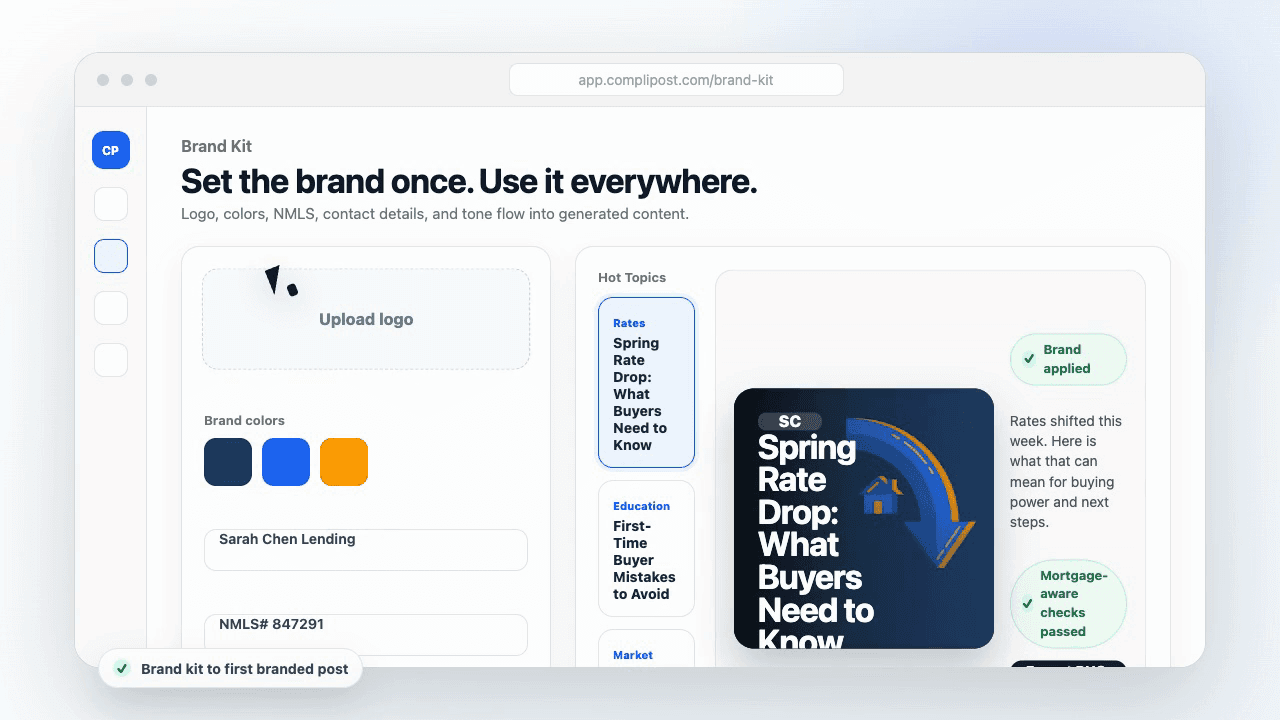
Product workflow
From blank page to export-ready mortgage content
- Start with a borrower topic
- Generate copy and a visual direction
- Review, save, and export the finished asset
These previews reflect the core CompliPost workflow: create, review, save, and export assets for use in your own channels.
Workflow comparison
| Content approach | What happens | Why it matters |
|---|---|---|
| Random posting | One-off ideas created when there is spare time | Inconsistent visibility and weak reuse |
| Template-only posting | Faster design but still requires rewriting and review | Helpful starting point, but not a full system |
| CompliPost workflow | Plan, generate, review, save, and export from one place | Better consistency with mortgage-aware review context |
| Done-for-you service | Someone else creates much of the content | Useful for some teams, but less control and less immediate reuse |
Who this guide helps
This guide is for loan officers working on solo loan officers who need a repeatable mortgage content workflow. The goal is to turn a broad mortgage topic into one borrower question, one useful takeaway, and one asset that can be reviewed before it is shared.
- You need content that sounds like a loan officer, not a generic brand account
- You want examples that can become captions, graphics, GIFs, or PDFs
- You need a clear place to review claims before export
- You want finished work saved for reuse, not lost in a chat thread
A practical workflow for this use case
Start with a narrow scenario, then move through planning, drafting, visual creation, review, and export. For physician homebuyer spouse family income, that means the topic should be specific enough that a borrower or referral partner can immediately understand what decision the content helps with.
- Choose the borrower type, loan topic, or platform before generating copy
- Draft the caption and visual together so the asset feels cohesive
- Use the federal baseline review aid to flag claims and disclosure gaps
- Export the finished asset and save the post as a reusable starting point
What makes the content stronger
Strong mortgage content is usually specific, plain-spoken, and calm. It explains tradeoffs without pretending one answer fits every borrower. That is especially important on public social channels, where a short post can be interpreted without the full context of a loan conversation.
- Name the borrower question in the first line
- Explain one decision or tradeoff instead of covering everything
- Use examples without implying approval, savings, or rate outcomes
- End with a soft next step, checklist, or guide rather than pressure
Compliance-aware review notes
CompliPost should be treated as a review aid, not a compliance approval system. The public page, generated draft, graphic, and exported asset should all stay honest about that boundary.
- Review specific payment, APR, rate, savings, and qualification language
- Avoid “best,” “lowest,” “guaranteed,” “free,” and urgency claims unless approved
- Check NMLS, Equal Housing, company, and state-specific requirements
- Use company or legal review for anything outside the federal baseline
How this connects to the rest of CompliPost
A focused guide should leave you with a usable next step. After you understand the topic, you can turn it into a calendar slot, a reviewed social post, a downloadable guide, or a platform-specific version for the channel where your audience already spends time.
- Use the content calendar to turn the idea into a weekly plan
- Use the compliance page when claims or disclosures need a slower pass
- Use lead magnets when the topic deserves a deeper PDF guide
- Use platform pages to adapt the same idea for LinkedIn, Facebook, or Instagram
Recommended next steps
Self-employed borrower hub
Create income-documentation education for self-employed borrowers.
Physician Mortgage Specialist Content for Loan Officers
General physician lending strategies applicable to family-based scenarios.
Co-Borrower Co-Signer Mortgage Guide
Detailed explanation of co-borrower vs. co-signer, useful for family structures.
Physician Investment Property DSCR Loans
Show dual-income couples the power of investment property scaling with combined income.
Examples
FAQ
Should we apply for the mortgage jointly or separate applications?+
A joint application is almost always better. Your combined income provides higher qualification, and if one partner has slightly lower credit, the other's strong credit helps. The mortgage amount you can qualify for is the same regardless, but a joint application is simpler and faster. The only exception: if you're concerned about future legal separation, consult a family lawyer. Financially, joint is optimal.
How does my spouse's income affect our mortgage qualification if they're self-employed?+
Self-employed spouse income is documented similarly to your own physician income—using 2 years of tax returns, business financials, and potentially bank statements. If your spouse's business is new (less than 2 years), the income may not qualify yet. If it's established, it's treated the same as your income. The advantage: combined physician + business owner income can be very strong for jumbo mortgages.
Can my parents gift me a down payment without it affecting my mortgage?+
Yes. Down payment gifts don't need to be repaid and don't affect your mortgage qualification. You'll provide a gift letter from your parents stating the amount is a gift (not a loan), and show proof the funds were transferred to your account. Make sure the gift funds have been in your bank account for at least 2 months (seasoning requirement) before closing. The gift actually strengthens your application because it increases your down payment percentage.
What if my spouse's income is lower or they work part-time—do I include them?+
Yes, include spousal income even if it's part-time or lower. Every dollar counts toward your buying power. Document it with paystubs, W-2s, or self-employment records as appropriate. If your spouse will be leaving their job to pursue medical training or raise children, mention this to the lender—recent income history is usually required for qualification, but future job loss impacts future refinancing, not current qualification.
How do we structure ownership if we want to protect assets or have different financial situations?+
This is a legal/tax question best answered by an estate attorney, but here are options: (1) Both on title as joint tenants (both own 100%, passes to surviving spouse if one dies), (2) Tenants in common (each owns a percentage, can pass to heirs), (3) Trust ownership (useful for estate planning), (4) One spouse on title only (unusual, limits that spouse's credit benefit). For mortgage purposes, both spouses are typically on the mortgage if both are on title, or just the borrowing spouse if only one is on title.
Create mortgage content with a calmer workflow
CompliPost helps you plan, generate, review, save, and export useful mortgage content without pretending compliance or social distribution is automatic.
Start free