PHYSICIAN AUDIENCE
Help Established Physicians Build Wealth Through Strategic Home Decisions
Established physicians (15–30+ years in practice) have built substantial equity and income. Your content should address home decisions at this stage: upgrading to a dream home, consolidating multiple properties, or leveraging equity for retirement planning. Frame home refinancing as a wealth-building tool for physicians in peak-earning years, and show that later-career physicians can access aggressive financing for goals (vacation home, investment property, legacy property).
Consolidation and Upgrade Strategy for Established Physicians
After 15+ years, many physicians own multiple properties (primary home, rental, vacation home) or are ready to upgrade from early-career homes. Your content should show consolidation strategies—selling smaller properties to fund a single dream home—and upgrade paths that make financial sense.
- Portfolio consolidation: sell 2–3 rental properties to fund luxury primary home
- Trading up: sell modest primary residence, upgrade to home matching current lifestyle
- 1031 exchange: swap investment properties tax-free, redirect equity to preferred locations
- Vacation home addition: sufficient equity and income support second home purchase
- Legacy planning: purchase primary home that can be family estate, held for decades
Aggressive Refinancing and Cash-Out Strategies at Peak Income
Peak-earning physicians can strategically refinance to extract equity while income is highest, using cash for investments or business ventures. Your content should frame refinancing not as debt, but as strategic use of assets to generate wealth during optimal years.
- Cash-out refinance: extract accumulated equity at peak income to fund new goals
- Rate improvement: refinance to lower rates if available, reducing long-term interest costs
- HELOC layering: maintain HELOC alongside mortgage for flexibility in later career
- Investment leveraging: use home equity to fund real estate, stock, or business opportunities
- Retirement strategy: home equity becomes retirement asset, refinanced strategically before retirement
Retirement and Downsize Planning with Home Equity
As physicians approach retirement (55+), some prefer downsizing to simpler homes or moving to lower-cost markets. Your content should address how home equity becomes a retirement income source, and how downsizing can fund travel, grandchildren education, or other retirement goals.
- Downsize timing: sell larger home in expensive market, buy smaller/relocate to lower-cost area
- Home equity release: downsize creates liquid capital for retirement, investments, or legacy gifts
- Reverse mortgage option: for physicians 62+, convert home equity to income stream
- Age-restricted communities: some physicians downsize to amenity-rich communities for lifestyle
- Geographic arbitrage: sell in high-cost market, relocate to lower-cost retirement destination
Multi-Property Portfolio and Tax Strategy for Established Physicians
Physicians with multiple properties benefit from sophisticated tax and financing strategies. Your content should touch on depreciation, cost segregation, and property exchange strategies that maximize wealth for high-income professionals.
- Portfolio depreciation: investment properties generate deductions offsetting high physician income
- Cost segregation studies: accelerate depreciation on high-value properties
- Opportunity zones: new property investments in designated areas offer tax benefits
- Installment sales: sell appreciated property on installment for tax-spread benefits
- Charitable remainder trusts: donate appreciated property to charity, receive income stream
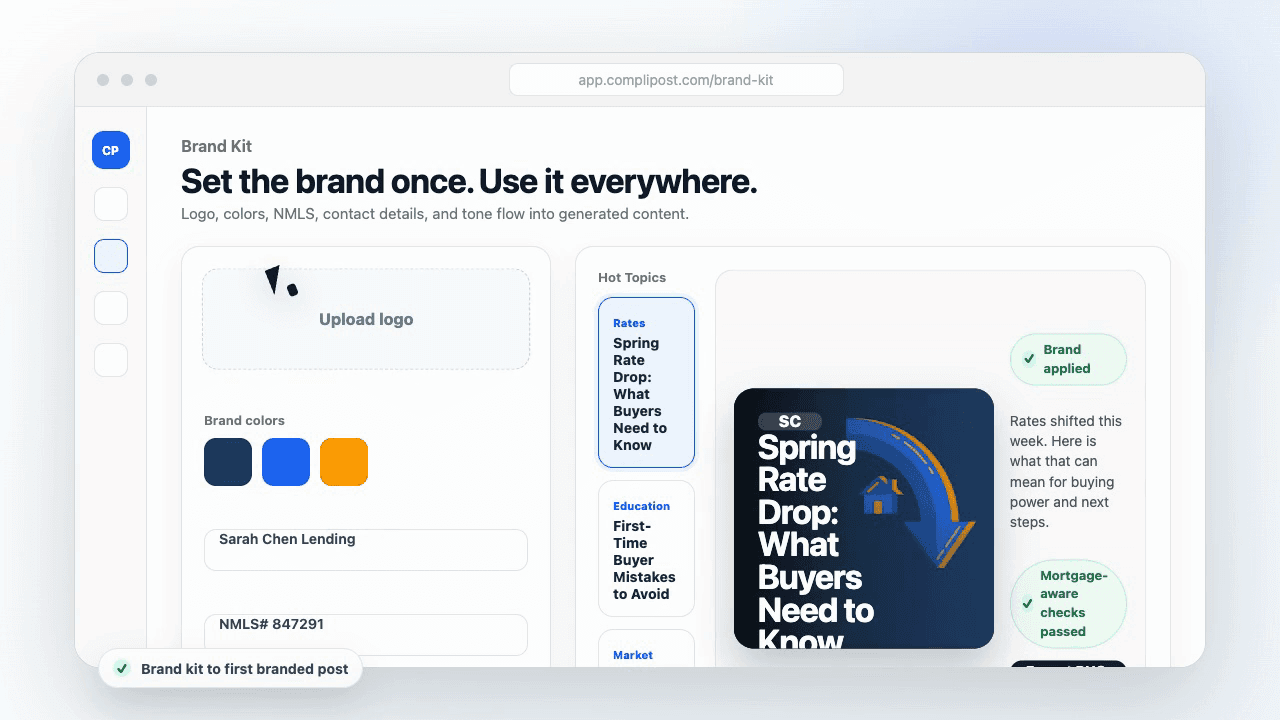
Product workflow
From blank page to export-ready mortgage content
- Start with a borrower topic
- Generate copy and a visual direction
- Review, save, and export the finished asset
These previews reflect the core CompliPost workflow: create, review, save, and export assets for use in your own channels.
Workflow comparison
| Content approach | What happens | Why it matters |
|---|---|---|
| Random posting | One-off ideas created when there is spare time | Inconsistent visibility and weak reuse |
| Template-only posting | Faster design but still requires rewriting and review | Helpful starting point, but not a full system |
| CompliPost workflow | Plan, generate, review, save, and export from one place | Better consistency with mortgage-aware review context |
| Done-for-you service | Someone else creates much of the content | Useful for some teams, but less control and less immediate reuse |
Who this guide helps
This guide is for loan officers working on solo loan officers who need a repeatable mortgage content workflow. The goal is to turn a broad mortgage topic into one borrower question, one useful takeaway, and one asset that can be reviewed before it is shared.
- You need content that sounds like a loan officer, not a generic brand account
- You want examples that can become captions, graphics, GIFs, or PDFs
- You need a clear place to review claims before export
- You want finished work saved for reuse, not lost in a chat thread
A practical workflow for this use case
Start with a narrow scenario, then move through planning, drafting, visual creation, review, and export. For physician homebuyer established career refinancing, that means the topic should be specific enough that a borrower or referral partner can immediately understand what decision the content helps with.
- Choose the borrower type, loan topic, or platform before generating copy
- Draft the caption and visual together so the asset feels cohesive
- Use the federal baseline review aid to flag claims and disclosure gaps
- Export the finished asset and save the post as a reusable starting point
What makes the content stronger
Strong mortgage content is usually specific, plain-spoken, and calm. It explains tradeoffs without pretending one answer fits every borrower. That is especially important on public social channels, where a short post can be interpreted without the full context of a loan conversation.
- Name the borrower question in the first line
- Explain one decision or tradeoff instead of covering everything
- Use examples without implying approval, savings, or rate outcomes
- End with a soft next step, checklist, or guide rather than pressure
Compliance-aware review notes
CompliPost should be treated as a review aid, not a compliance approval system. The public page, generated draft, graphic, and exported asset should all stay honest about that boundary.
- Review specific payment, APR, rate, savings, and qualification language
- Avoid “best,” “lowest,” “guaranteed,” “free,” and urgency claims unless approved
- Check NMLS, Equal Housing, company, and state-specific requirements
- Use company or legal review for anything outside the federal baseline
How this connects to the rest of CompliPost
A focused guide should leave you with a usable next step. After you understand the topic, you can turn it into a calendar slot, a reviewed social post, a downloadable guide, or a platform-specific version for the channel where your audience already spends time.
- Use the content calendar to turn the idea into a weekly plan
- Use the compliance page when claims or disclosures need a slower pass
- Use lead magnets when the topic deserves a deeper PDF guide
- Use platform pages to adapt the same idea for LinkedIn, Facebook, or Instagram
Recommended next steps
Self-employed borrower hub
Create income-documentation education for self-employed borrowers.
Physician Investment Property DSCR Loans
Understand investment property financing for established physicians with multi-property portfolios.
Physician Cash Out Refinance Wealth Extraction
Master cash-out refinancing strategies to leverage accumulated home equity at peak earning years.
Reverse Mortgage Retirement Planning Content
Deep dive into reverse mortgages for late-career physicians considering retirement strategies.
Examples
FAQ
Should I refinance to upgrade my home or keep my current mortgage?+
If you're in your peak earning years and rates are favorable, upgrading can make sense. Refinancing lets you tap accumulated equity for a down payment on a luxury property. However, calculate the total cost: new appraisal, refinancing fees, potential rate change, and extended mortgage timeline. Many physicians find that upgrading (selling current home, buying larger) rather than refinancing is cleaner. Use a financial advisor to compare options.
Can I sell multiple rental properties and consolidate into one primary home?+
Yes. Selling investment properties and using proceeds for a primary home is common. However, consider: (1) capital gains taxes on appreciated properties (substantial if properties appreciated significantly), (2) potential 1031 exchange if you want to reinvest proceeds into other real estate tax-free, (3) loss of rental income if the properties were cash-flowing. Discuss strategy with a tax professional and real estate advisor before selling.
What's a reverse mortgage, and is it right for me in late career?+
A reverse mortgage (available at age 62+) converts home equity into income. You retain home ownership, but the lender pays you, and the loan is repaid from estate proceeds when you pass or sell. Reverse mortgages can provide retirement income without monthly payments, but fees are high and they reduce your estate. Discuss with a financial advisor to determine if it fits your retirement plan. They're most valuable for physicians who plan to age in place and want to reduce monthly obligations.
How do capital gains taxes affect my home sale if I sell and downsize?+
For primary residences, you get a $500K capital gains exclusion (married filing jointly; $250K single), so property appreciation up to that amount is tax-free. Beyond that, long-term capital gains taxes apply (15–20% federally, plus state taxes). This is still often beneficial: buying for $500K, selling for $2M leaves $750K in gains, but $500K is excluded, so only $250K is taxed. Work with a tax professional to optimize the sale and purchase timing.
Can I use a 1031 exchange to defer taxes on rental property sales?+
Yes, if you're selling investment properties (not primary residence). A 1031 exchange lets you reinvest proceeds into another property tax-free, deferring capital gains indefinitely. The rules are strict: identify replacement property within 45 days, close within 180 days, and property must be 'like-kind' (real estate for real estate). Physician investors often use this to shift from one market to another, or consolidate multiple properties. Work with a qualified intermediary and tax professional to execute correctly.
Create mortgage content with a calmer workflow
CompliPost helps you plan, generate, review, save, and export useful mortgage content without pretending compliance or social distribution is automatic.
Start free