PHYSICIAN AUDIENCE
Help Physicians Buy Homes While Relocating for Career Moves
Physicians frequently relocate for fellowship completion, attending position, or practice changes, creating unique homebuying scenarios. Your content should address the challenge of timing—buying in a new city when the job offer is recent, managing two homes during transition, and strategies like bridge loans or temporary rentals. Frame relocation as a normal life event, not a barrier to homeownership, and show lenders who specialize in physician relocations make the process smooth.
Timing Home Purchase Around Job Start Date
The biggest challenge in relocation: buying a home before arriving in a new city. Your content should normalize this challenge and show solutions—virtual tours, local real estate agents, bridge loans, and temporary housing during the search. Emphasize that lenders understand physicians need to buy quickly and offer expedited processes.
- Job offer letter is sufficient for pre-approval, even before start date
- Expedited approval timelines for physicians: 2–3 weeks from application to closing
- Virtual tours and long-distance purchasing are normal for relocating physicians
- Bridge loans: cover gap between home purchase and moving to new city
- Temporary housing strategies: short-term rentals while you search for permanent home
Managing Two Homes During Transition
Some physicians buy in the new city before selling the old home, leading to temporary dual ownership. Your content should explain how lenders handle this (temporary dual DTI, bridge financing), and when it makes sense to buy/sell in which order. Address the financial and emotional reality of managing two properties.
- Buy first (new city), rent out (old city): bridge loan covers overlapping payments
- Sell first (old city), rent (new city): simpler financing but timing risk
- Hold both temporarily: cash-out refinance on old home funds new down payment
- Lender approval: dual ownership is manageable with temporary dual DTI for physicians
- Transition period: typically 3–6 months; plan finances for both mortgage payments
Choosing the Right Home in a New Market Fast
Relocating physicians often have weeks to find a home in an unfamiliar market. Your content should provide framework—neighborhood research, commute considerations, school districts, resale appeal—so they buy strategically, not in panic. Emphasize that local real estate agents and market knowledge are part of good relocation planning.
- Commute distance: research practice location before committing to neighborhood
- Market trajectory: buy in growing neighborhoods, not declining areas
- School quality: matters for family physicians, affects resale appeal
- Proximity to community: medical community hospitals, professional groups
- Rental appeal: if plans change, can the home become investment property?
Lenders Who Specialize in Physician Relocations
Some lenders have streamlined relocation processes specifically for physicians. Your content should explain what to look for—fast underwriting, bridge loan programs, flexible documentation, and lenders who understand that physicians don't have time for traditional slow processes. Position yourself as understanding the relocation crunch.
- Physician lenders: understand relocation timing, offer expedited processes
- Bridge loan programs: cover gap between homes, allow buy-before-sell strategy
- Flexible underwriting: job offer letter acceptable, don't require W2s or tax returns yet
- Local market knowledge: lenders with national networks can connect you to local expertise
- Relocation benefits: some employers offer relocation loan discounts or assistance programs
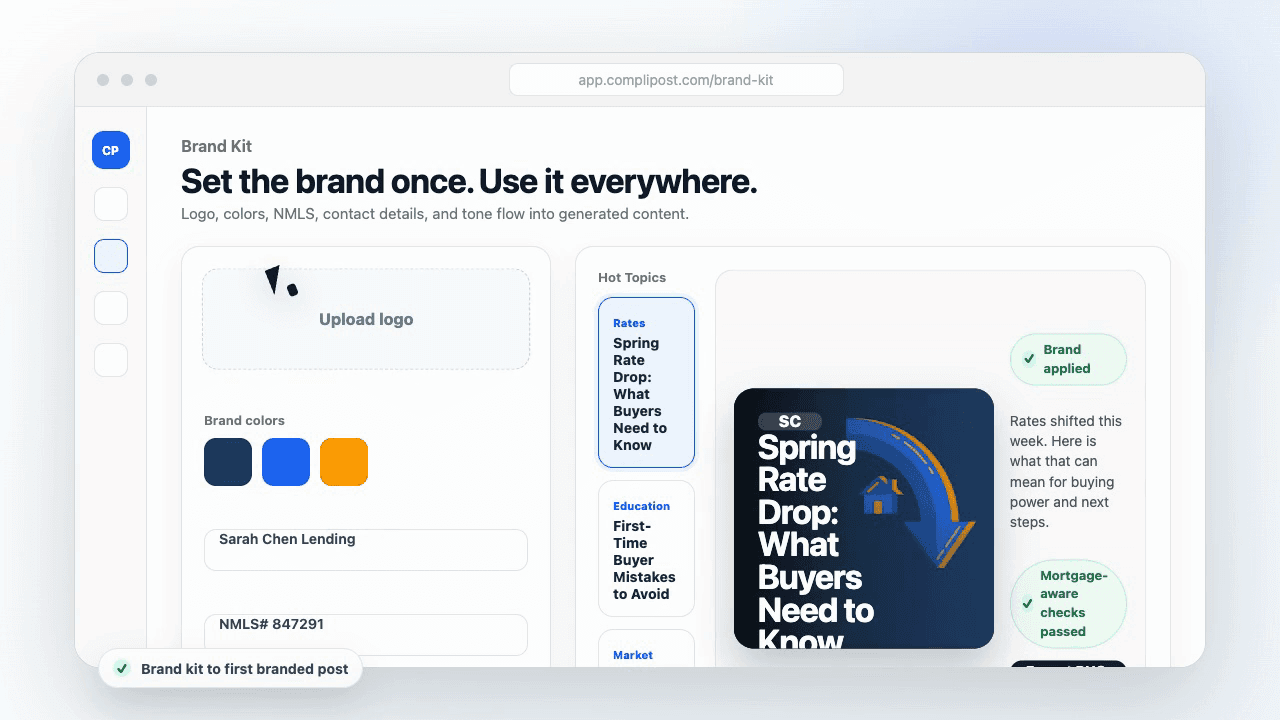
Product workflow
From blank page to export-ready mortgage content
- Start with a borrower topic
- Generate copy and a visual direction
- Review, save, and export the finished asset
These previews reflect the core CompliPost workflow: create, review, save, and export assets for use in your own channels.
Workflow comparison
| Content approach | What happens | Why it matters |
|---|---|---|
| Random posting | One-off ideas created when there is spare time | Inconsistent visibility and weak reuse |
| Template-only posting | Faster design but still requires rewriting and review | Helpful starting point, but not a full system |
| CompliPost workflow | Plan, generate, review, save, and export from one place | Better consistency with mortgage-aware review context |
| Done-for-you service | Someone else creates much of the content | Useful for some teams, but less control and less immediate reuse |
Who this guide helps
This guide is for loan officers working on solo loan officers who need a repeatable mortgage content workflow. The goal is to turn a broad mortgage topic into one borrower question, one useful takeaway, and one asset that can be reviewed before it is shared.
- You need content that sounds like a loan officer, not a generic brand account
- You want examples that can become captions, graphics, GIFs, or PDFs
- You need a clear place to review claims before export
- You want finished work saved for reuse, not lost in a chat thread
A practical workflow for this use case
Start with a narrow scenario, then move through planning, drafting, visual creation, review, and export. For physician homebuyer relocation job move, that means the topic should be specific enough that a borrower or referral partner can immediately understand what decision the content helps with.
- Choose the borrower type, loan topic, or platform before generating copy
- Draft the caption and visual together so the asset feels cohesive
- Use the federal baseline review aid to flag claims and disclosure gaps
- Export the finished asset and save the post as a reusable starting point
What makes the content stronger
Strong mortgage content is usually specific, plain-spoken, and calm. It explains tradeoffs without pretending one answer fits every borrower. That is especially important on public social channels, where a short post can be interpreted without the full context of a loan conversation.
- Name the borrower question in the first line
- Explain one decision or tradeoff instead of covering everything
- Use examples without implying approval, savings, or rate outcomes
- End with a soft next step, checklist, or guide rather than pressure
Compliance-aware review notes
CompliPost should be treated as a review aid, not a compliance approval system. The public page, generated draft, graphic, and exported asset should all stay honest about that boundary.
- Review specific payment, APR, rate, savings, and qualification language
- Avoid “best,” “lowest,” “guaranteed,” “free,” and urgency claims unless approved
- Check NMLS, Equal Housing, company, and state-specific requirements
- Use company or legal review for anything outside the federal baseline
How this connects to the rest of CompliPost
A focused guide should leave you with a usable next step. After you understand the topic, you can turn it into a calendar slot, a reviewed social post, a downloadable guide, or a platform-specific version for the channel where your audience already spends time.
- Use the content calendar to turn the idea into a weekly plan
- Use the compliance page when claims or disclosures need a slower pass
- Use lead magnets when the topic deserves a deeper PDF guide
- Use platform pages to adapt the same idea for LinkedIn, Facebook, or Instagram
Recommended next steps
Self-employed borrower hub
Create income-documentation education for self-employed borrowers.
Relocation Loan Officer Content Strategy
Broad strategies for marketing to relocating professionals across industries and specialties.
Physician Mortgage Specialist Content for Loan Officers
Position yourself as a relocation specialist within the broader physician lending niche.
First Time Homebuyer Specialist Content
Many relocating physicians are buying their first home; use strategies to address first-time buyer concerns.
Examples
FAQ
Can I get approved for a mortgage based on a job offer letter instead of existing employment history?+
Yes. For physicians, lenders will approve mortgages based on an offer letter for a new position, even if you haven't started yet. You'll typically need to provide the offer letter (signed), a copy of your medical license, and basic income documentation. Some lenders require you to be licensed in the new state or have a start date within 60 days, so verify these details with your lender. Physician-focused lenders have streamlined this process and can issue pre-approvals quickly.
What's a bridge loan, and should I use one for my relocation?+
A bridge loan is a short-term loan that lets you buy a home in your new city before selling your old home. You then repay the bridge loan when the old home sells. This strategy avoids timing risk (waiting for the old home to sell before buying the new one) but comes with carrying two mortgages temporarily. Bridge loans are expensive (higher interest rates, fees), so they're best used for relocations where you need to buy immediately. Calculate whether the cost justifies the benefit.
Should I buy or rent when I first relocate?+
This depends on how long you plan to stay and the local real estate market. If you're committed to the city for at least 3–5 years, buying usually makes financial sense, even if you're not sure about the exact neighborhood yet. Buying locks in a housing cost and starts building equity. Renting for 3–6 months while you explore the market is another valid strategy, then buying once you know the area. Discuss your timeline and plans with a local real estate agent and lender to evaluate both options.
How do I choose a home in a city I've never lived in?+
Start by researching the practice location and planning a reasonable commute (15–30 minutes is typical). Then identify 2–3 neighborhoods that fit your budget and lifestyle, and hire a local real estate agent to guide you. Virtual tours and FaceTime walkthroughs are increasingly common. If possible, plan a scouting trip to the city before making an offer. Connect with your medical community (hospital, colleagues) for neighborhood recommendations. Don't feel pressured to buy the first home—you have time to explore, even on a tight relocation timeline.
What if I decide to stay in my old city and commute to the new job?+
This is a personal decision, but keep in mind that long commutes (1+ hours) can impact quality of life, especially for physicians with demanding schedules. Some physicians prefer this temporarily while they transition, then relocate after a year. If you choose to commute, your mortgage application isn't affected—you simply don't purchase a home in the new city. Revisit the relocation decision annually based on commute feasibility and job satisfaction.
Create mortgage content with a calmer workflow
CompliPost helps you plan, generate, review, save, and export useful mortgage content without pretending compliance or social distribution is automatic.
Start free