PHYSICIAN AUDIENCE
Help Physicians Buy Homes That Align With Their Values and Lifestyle
Some physicians prioritize homes reflecting their values—sustainable/green homes, cohousing communities, heritage homes needing restoration, or off-grid properties. These homes may require specialized financing (construction loans, green mortgages, renovation-specific programs). Your content should validate these choices, explain available financing, and show that physicians can build wealth while living intentionally.
Green and Sustainable Home Financing Options
Energy-efficient and sustainable homes can qualify for specialized mortgages or incentives. Your content should explain green mortgage programs, ENERGY STAR ratings, and tax credits.
- Green mortgages: some lenders offer lower rates for energy-efficient homes, offsetting premium construction costs
- ENERGY STAR certified: homes meeting efficiency standards may qualify for favorable rates or down payment assistance
- Solar financing: some programs help finance solar panels as part of mortgage or separate clean energy loans
- State incentives: many states offer tax credits or rebates for green home purchases; research your state
- Long-term savings: efficiency upgrades save money on utilities, offsetting higher initial cost over time
Renovation and Heritage Home Financing
Physicians interested in restoring older or historic homes have specialized loan programs. Your content should explain renovation mortgages and how they work.
- Construction/renovation mortgages: finance purchase + renovation in one loan; funds released as work completes
- FHA 203(k) loans: federal program for renovation financing, available to physicians with modest requirements
- Historic property tax credits: federal and state credits for restoring historic homes; significant tax savings
- Builder partnerships: some renovation projects work with established contractors; improve lender confidence
- Temporary construction financing: short-term loans to bridge renovation period, then convert to permanent mortgage
Cohousing and Intentional Community Properties
Some physicians buy into cohousing developments or intentional communities. These require community financing or investor approval. Your content should address how mortgages work in these settings.
- Shared equity cooperatives: own portion of building/land; mortgage finances personal unit + share of commons
- HOA or community assessments: fees are documented in DTI; affect mortgage qualification calculation
- Developer financing: some intentional communities offer preferred lending partnerships; ask about programs
- Underwriting complexity: some lenders avoid cohousing; shop specifically for community-friendly lenders
- Community values alignment: intentional community choice signals personal values; may appeal to socially conscious lenders
Off-Grid and Alternative Properties
Off-grid or unusual properties (tiny homes, container homes, alternative construction) are harder to finance. Your content should address challenges and workarounds.
- Appraisal challenges: unusual properties are hard to appraise (few comparables); affects financing
- Construction documentation: non-standard builds need engineering approval, inspector sign-off for lender confidence
- HELOC/portfolio loans: some lenders bypass standard appraisal with portfolio products if you have strong income
- Cash purchase: some off-grid buyers finance primarily with cash, smaller mortgage reduces appraisal concerns
- Personal brand advantage: physician credibility helps; lenders more comfortable with credentialed off-grid buyers
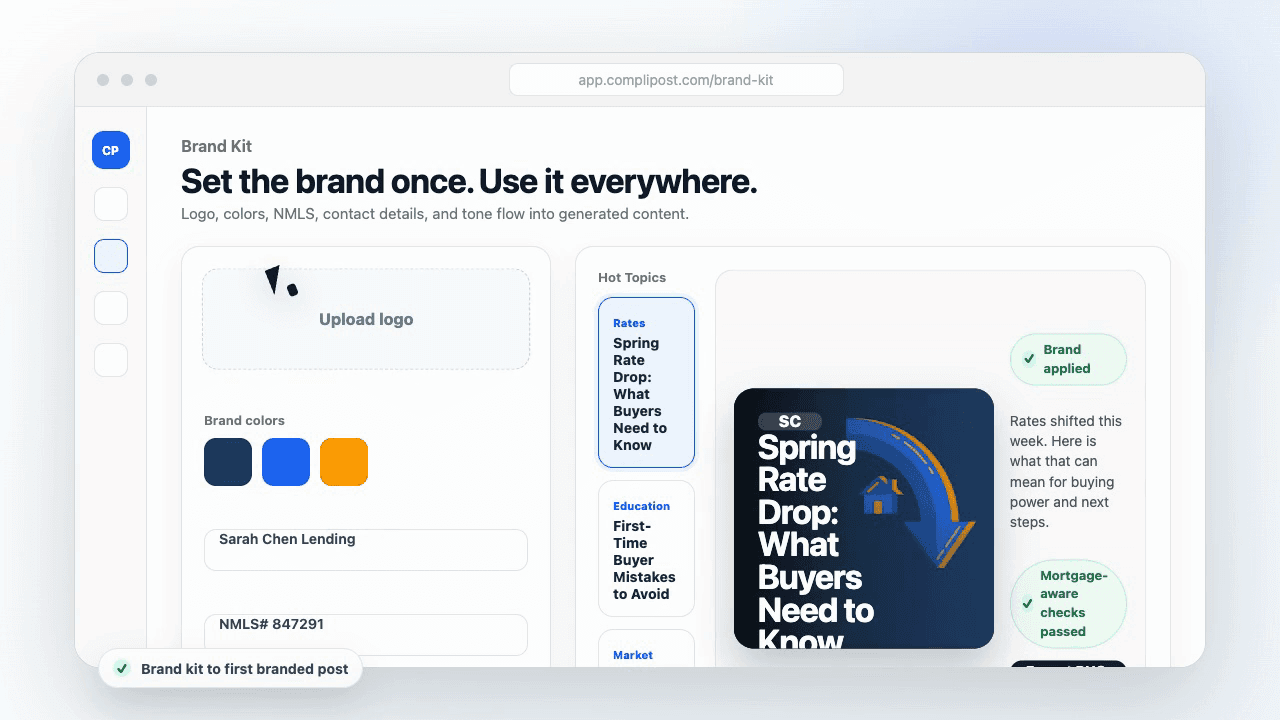
Product workflow
From blank page to export-ready mortgage content
- Start with a borrower topic
- Generate copy and a visual direction
- Review, save, and export the finished asset
These previews reflect the core CompliPost workflow: create, review, save, and export assets for use in your own channels.
Workflow comparison
| Content approach | What happens | Why it matters |
|---|---|---|
| Random posting | One-off ideas created when there is spare time | Inconsistent visibility and weak reuse |
| Template-only posting | Faster design but still requires rewriting and review | Helpful starting point, but not a full system |
| CompliPost workflow | Plan, generate, review, save, and export from one place | Better consistency with mortgage-aware review context |
| Done-for-you service | Someone else creates much of the content | Useful for some teams, but less control and less immediate reuse |
Who this guide helps
This guide is for loan officers working on solo loan officers who need a repeatable mortgage content workflow. The goal is to turn a broad mortgage topic into one borrower question, one useful takeaway, and one asset that can be reviewed before it is shared.
- You need content that sounds like a loan officer, not a generic brand account
- You want examples that can become captions, graphics, GIFs, or PDFs
- You need a clear place to review claims before export
- You want finished work saved for reuse, not lost in a chat thread
A practical workflow for this use case
Start with a narrow scenario, then move through planning, drafting, visual creation, review, and export. For physician homebuyer lifestyle values sustainable, that means the topic should be specific enough that a borrower or referral partner can immediately understand what decision the content helps with.
- Choose the borrower type, loan topic, or platform before generating copy
- Draft the caption and visual together so the asset feels cohesive
- Use the federal baseline review aid to flag claims and disclosure gaps
- Export the finished asset and save the post as a reusable starting point
What makes the content stronger
Strong mortgage content is usually specific, plain-spoken, and calm. It explains tradeoffs without pretending one answer fits every borrower. That is especially important on public social channels, where a short post can be interpreted without the full context of a loan conversation.
- Name the borrower question in the first line
- Explain one decision or tradeoff instead of covering everything
- Use examples without implying approval, savings, or rate outcomes
- End with a soft next step, checklist, or guide rather than pressure
Compliance-aware review notes
CompliPost should be treated as a review aid, not a compliance approval system. The public page, generated draft, graphic, and exported asset should all stay honest about that boundary.
- Review specific payment, APR, rate, savings, and qualification language
- Avoid “best,” “lowest,” “guaranteed,” “free,” and urgency claims unless approved
- Check NMLS, Equal Housing, company, and state-specific requirements
- Use company or legal review for anything outside the federal baseline
How this connects to the rest of CompliPost
A focused guide should leave you with a usable next step. After you understand the topic, you can turn it into a calendar slot, a reviewed social post, a downloadable guide, or a platform-specific version for the channel where your audience already spends time.
- Use the content calendar to turn the idea into a weekly plan
- Use the compliance page when claims or disclosures need a slower pass
- Use lead magnets when the topic deserves a deeper PDF guide
- Use platform pages to adapt the same idea for LinkedIn, Facebook, or Instagram
Recommended next steps
Self-employed borrower hub
Create income-documentation education for self-employed borrowers.
New Construction Loan Financing Strategy
For physicians building homes from scratch with specific vision or off-grid specifications.
Renovation Mortgage FHA 203k Guide
Deep dive into FHA renovation programs for historic home or significant restoration projects.
Physician Jumbo Loan Wealth Strategy
For high-earning physicians buying luxury sustainable homes, jumbo programs may offer better terms.
Examples
FAQ
Can I get a mortgage for an off-grid or non-traditional home?+
Yes, but with limitations. Standard mortgages require standard appraisals, and off-grid properties are hard to appraise (few comparable sales). Options: (1) HELOC or portfolio products (if strong income), (2) Cash purchase with small mortgage, (3) Construction loan if building from scratch, (4) Shop lenders experienced with alternative properties. Your physician income and credentials help; lenders are more comfortable lending to credentialed professionals with unconventional preferences.
What's an FHA 203(k) renovation mortgage?+
A FHA 203(k) is a federal program for purchase + renovation financing. You finance both the home purchase and renovation costs in one loan. Funds are disbursed as work is completed and inspected. Down payment is lower (3.5%) and rates competitive. Renovation must be substantial and documented. Physicians qualify easily; work with a 203(k)-experienced lender to manage timelines and inspections.
Do green mortgages actually offer better rates?+
Some lenders offer 0.25–0.5% rate reductions for certified energy-efficient homes, which can offset the premium you paid for green features. Over 30 years, this saves significant money. However, not all lenders offer green mortgages; you'll need to shop. Also factor in energy savings: an efficient home may cost $100K more but save $100–$200/month in utilities (30-year payback). Green upgrades are investments in long-term savings.
How do cohousing or community assessments affect my mortgage qualification?+
Community fees or HOA assessments count as a monthly obligation in your debt-to-income ratio, reducing your mortgage qualification by the amount of the fee. For example, a $500/month community fee reduces your qualification similarly to a $500 loan payment. Some lenders are unfamiliar with cohousing and over-penalize; shop with lenders experienced in communities. Make sure the community is established and financially stable to avoid lender concerns.
Can I get a mortgage for a tiny home or unconventional construction?+
Tiny homes and alternative construction (container homes, straw bale, etc.) are challenging to finance because they're hard to appraise and some lenders see them as niche/risky. Options: (1) Primarily cash, small mortgage, (2) Portfolio lenders that don't rely on standard appraisal, (3) Construction loan if building from scratch, (4) Build equity first (owner-financing or cash), then refinance once established. Your physician income strengthens the application; lenders more comfortable with credentialed professionals making intentional choices.
Create mortgage content with a calmer workflow
CompliPost helps you plan, generate, review, save, and export useful mortgage content without pretending compliance or social distribution is automatic.
Start free