PHYSICIAN AUDIENCE
Help Physicians Rebuild Home Ownership After Divorce
Physicians divorcing face complex financial situations: alimony/spousal support obligations affect DTI, property division impacts down payment capital and debt, custody arrangements affect home size/location decisions. Your content should normalize post-divorce homebuying, address how alimony counts in qualification, and show that physicians can rebuild and own homes individually or with new partners.
Spousal Support and Alimony Impact on Mortgage Qualification
Court-ordered spousal support or alimony is a monthly obligation that counts against DTI. Your content should explain how it's calculated in qualification and strategies to maximize buying power despite this obligation.
- Alimony obligation: monthly payment counts fully in DTI, reducing mortgage qualification proportionally
- Calculation impact: $5,000/month alimony reduces qualification by amount similar to $5K mortgage payment
- Documentation: divorce decree must clearly state alimony amount and duration for lender verification
- Temporary vs. permanent: temporary alimony (ends when youngest child turns 18) can affect qualification timing
- Income growth strategy: if physician income is growing, waiting a year may improve qualification after alimony obligation
Property Division, Down Payment, and Debt Impact
Divorces result in property division and debt allocation. Your content should address how this affects down payment capital and new home purchase planning.
- Equity division: family home often divided; physician may receive percentage of equity or must buy out ex
- Down payment capital: use equity from property settlement as down payment on new home
- Debt allocation: ex-spouse may be responsible for mortgage or debt; confirm with decree
- Refinancing old home: if ex stays in family home, physician may need to refinance to remove name
- Child support impact: separate from alimony; affects household finances and DTI if physician pays
Custody Arrangements and Home Decisions
Child custody affects home buying decisions—physicians with primary or joint custody need homes with appropriate space. Your content should address how custody influences location, size, and financial planning.
- Primary custody: need larger home with bedrooms for children; location matters (schools, ex-location)
- Joint custody: home should accommodate children during custody time; flexibility in size possible
- Custody stability: home purchase timing should wait for finalized custody arrangement
- School districts: primary or joint custody parents care about quality schools; affects location cost
- Child support alignment: monthly child support payment also counts in DTI, alongside alimony
New Partnerships and Co-Borrowing Post-Divorce
Some physicians remarry or partner after divorce. Your content should address co-borrowing with new spouse/partner, combining incomes, and blended family financial planning.
- New marriage/partnership: can co-borrow with new spouse; combined income strengthens qualification
- Prior debt separation: ensure no commingling of pre-divorce debt with new couple's obligations
- Blended families: home purchase may involve step-children; custody and financial dynamics shift
- Prenuptial/postnuptial: some physicians prefer legal clarity on property/debt ownership post-divorce
- Credit recovery: rebuilding credit after divorce; positive new purchase can help credit score recovery
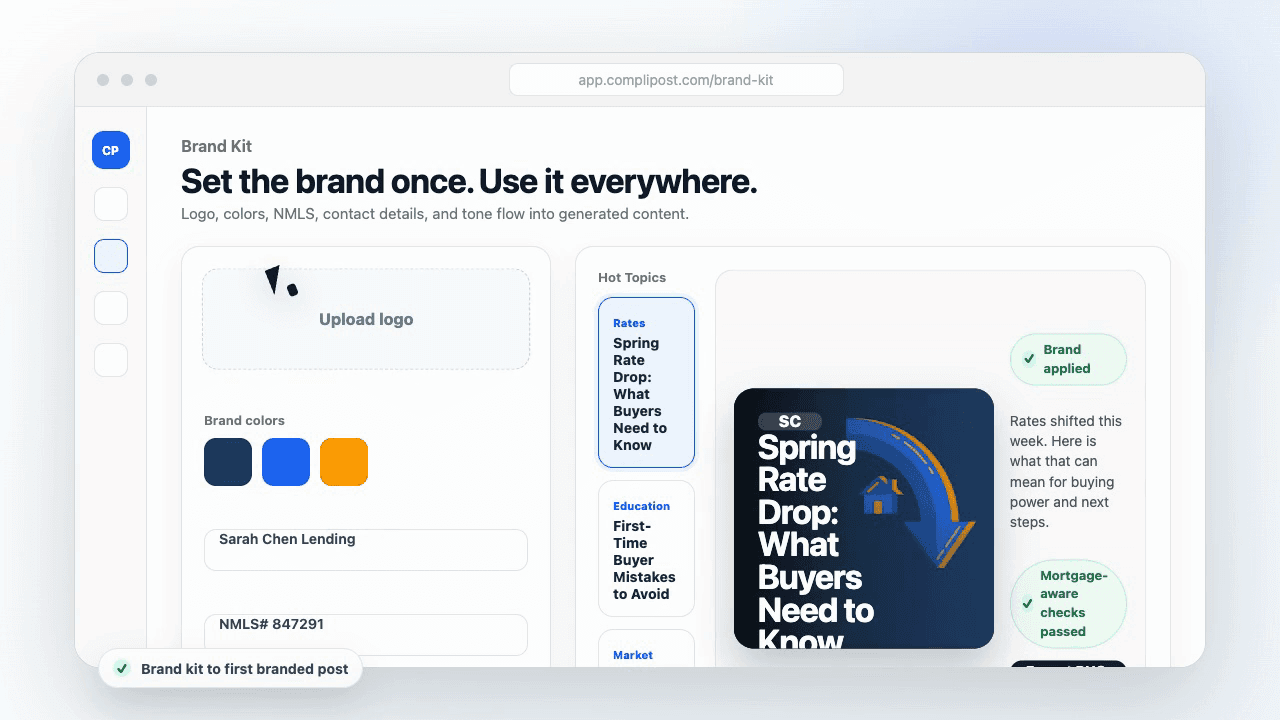
Product workflow
From blank page to export-ready mortgage content
- Start with a borrower topic
- Generate copy and a visual direction
- Review, save, and export the finished asset
These previews reflect the core CompliPost workflow: create, review, save, and export assets for use in your own channels.
Workflow comparison
| Content approach | What happens | Why it matters |
|---|---|---|
| Random posting | One-off ideas created when there is spare time | Inconsistent visibility and weak reuse |
| Template-only posting | Faster design but still requires rewriting and review | Helpful starting point, but not a full system |
| CompliPost workflow | Plan, generate, review, save, and export from one place | Better consistency with mortgage-aware review context |
| Done-for-you service | Someone else creates much of the content | Useful for some teams, but less control and less immediate reuse |
Who this guide helps
This guide is for loan officers working on solo loan officers who need a repeatable mortgage content workflow. The goal is to turn a broad mortgage topic into one borrower question, one useful takeaway, and one asset that can be reviewed before it is shared.
- You need content that sounds like a loan officer, not a generic brand account
- You want examples that can become captions, graphics, GIFs, or PDFs
- You need a clear place to review claims before export
- You want finished work saved for reuse, not lost in a chat thread
A practical workflow for this use case
Start with a narrow scenario, then move through planning, drafting, visual creation, review, and export. For physician homebuyer divorce post-divorce mortgage, that means the topic should be specific enough that a borrower or referral partner can immediately understand what decision the content helps with.
- Choose the borrower type, loan topic, or platform before generating copy
- Draft the caption and visual together so the asset feels cohesive
- Use the federal baseline review aid to flag claims and disclosure gaps
- Export the finished asset and save the post as a reusable starting point
What makes the content stronger
Strong mortgage content is usually specific, plain-spoken, and calm. It explains tradeoffs without pretending one answer fits every borrower. That is especially important on public social channels, where a short post can be interpreted without the full context of a loan conversation.
- Name the borrower question in the first line
- Explain one decision or tradeoff instead of covering everything
- Use examples without implying approval, savings, or rate outcomes
- End with a soft next step, checklist, or guide rather than pressure
Compliance-aware review notes
CompliPost should be treated as a review aid, not a compliance approval system. The public page, generated draft, graphic, and exported asset should all stay honest about that boundary.
- Review specific payment, APR, rate, savings, and qualification language
- Avoid “best,” “lowest,” “guaranteed,” “free,” and urgency claims unless approved
- Check NMLS, Equal Housing, company, and state-specific requirements
- Use company or legal review for anything outside the federal baseline
How this connects to the rest of CompliPost
A focused guide should leave you with a usable next step. After you understand the topic, you can turn it into a calendar slot, a reviewed social post, a downloadable guide, or a platform-specific version for the channel where your audience already spends time.
- Use the content calendar to turn the idea into a weekly plan
- Use the compliance page when claims or disclosures need a slower pass
- Use lead magnets when the topic deserves a deeper PDF guide
- Use platform pages to adapt the same idea for LinkedIn, Facebook, or Instagram
Recommended next steps
Self-employed borrower hub
Create income-documentation education for self-employed borrowers.
Divorce Recovery Mortgage Content
Broader divorce and financial recovery strategies for homebuyers post-separation.
Co-Borrower Co-Signer Mortgage Guide
Understanding co-borrowing when entering new partnerships post-divorce.
Single Parent and Family Home Buying Strategy
Strategies for single parent physicians buying homes with custody and financial obligations.
Examples
FAQ
How does alimony affect my mortgage qualification?+
Alimony (spousal support) is a monthly obligation that counts fully against your debt-to-income ratio, just like a loan payment. For example, $5,000/month alimony reduces your mortgage qualification by the equivalent of a $5,000 mortgage payment. The divorce decree must clearly specify the alimony amount, start date, and duration. This documentation is provided to your lender during application. If alimony is temporary (ends when youngest turns 18), some lenders will factor this in, but plan conservatively.
Can I use the equity from my divorce settlement as a down payment?+
Yes. If your divorce settlement includes a portion of the family home equity, or if you receive a cash settlement, this can be used for down payment on a new home. Provide documentation of the settlement (divorce decree) showing you're entitled to the funds. The funds must be in your account for a minimum period (usually 2 months, called 'seasoning') before closing. This is a common and straightforward source of down payment for post-divorce homebuyers.
Does child support count the same as alimony in my DTI?+
Yes, child support counts the same as alimony in debt-to-income calculations. Both are monthly obligations that reduce your mortgage qualification. If you pay both alimony and child support, both count. If you receive child support (ex pays you), this can potentially offset other DTI or count as income if documented, but lenders treat it conservatively. Disclose all support obligations and receipts clearly to your lender.
What if my ex-spouse is on the mortgage of the family home—does that affect my new mortgage?+
Yes. If your ex-spouse is still on the family home mortgage, that debt appears in your credit report and counts against your DTI (or your ex's, depending on who is responsible). Ideally, the decree specifies who is responsible for the family mortgage. If you're responsible but ex remains on title, you may need to refinance to remove their name before getting a new mortgage. Consult your divorce attorney and lender about this situation.
Can I buy a home with a new spouse after divorce?+
Yes. If you've remarried or entered a new partnership, you can apply for a joint mortgage with your new spouse. Their income helps your qualification, assuming both credit profiles are solid. Discuss any blended family or prior debt considerations with your lender. Make sure the new home arrangement is clearly separate from prior divorce settlements and doesn't complicate custody or financial arrangements from the previous marriage.
Create mortgage content with a calmer workflow
CompliPost helps you plan, generate, review, save, and export useful mortgage content without pretending compliance or social distribution is automatic.
Start free