PHYSICIAN AUDIENCE
Help First-Year Attendings Leverage Income Jump to Build Primary Home Wealth
The transition from resident/fellow to attending is the biggest income jump in a physician's career—often 40–100% increase. This is the critical moment for major home purchases. Your content should position first-attending-year home buying as strategic (lock in mortgage before further income growth), explain how attending offer letters support mortgages, and show that attendings can finally afford the homes they've admired during training years.
Attending Offer Letter and Mortgage Pre-Approval
Attending offer letters are powerful documentation—they show multi-year income commitment, often with year 1 guarantee or salary schedule. Your content should explain how lenders use offer letters, the difference between guaranteed vs. potential income, and how to extract maximum mortgage qualification from attending compensation.
- Offer letter strength: lenders treat offer letter as binding commitment for 30-year mortgage
- Guaranteed base: even if attending contract is 1–3 years, guaranteed base counts fully
- Production bonus: some programs count bonus potential, others require 2 years history first
- RVU-based compensation: if part of contract, lenders may use historical RVU data from group
- Pre-approval timing: apply before starting attending role for smooth process
The Attending Income Jump: Opportunity for Lifestyle Upgrade
Many attendings have been renting during residency/fellowship, viewing homeownership as 'someday.' First attending year is 'now.' Your content should address the psychology of suddenly being able to afford nice things, normalize the desire to upgrade lifestyle, and position home purchase as celebrating achieved goals.
- Renting-to-owning transition: attendings often buy their first home in first attending year
- Lifestyle upgrade: finally affording neighborhoods, schools, homes dreamed about during training
- Wealth building: home equity acceleration once owning vs. renting (decades of rent payments avoided)
- Family timing: many attendings also plan families in first attending year, home priority increases
- Market leverage: high attending income supports competitive offers in desirable neighborhoods
Negotiating Mortgage-Friendly Compensation Structures
Some attendings negotiate contracts with mortgage qualification in mind—requesting base salary over RVU or bonus, signing multi-year contracts, or requesting written production guarantees. Your content should show that lenders care about income predictability, and savvy attendings use this knowledge in negotiation.
- Guaranteed base vs. variable: higher guaranteed base improves mortgage qualification
- Contract length: 3+ year contracts are stronger than year-to-year, preferred by lenders
- Production guarantees: written guarantee of minimum income improves loan qualification
- Relocation bonus: some offers include housing/relocation assistance, may not affect mortgage
- Partnership track: clear partnership timeline can be factored into long-term income projections
Home Purchase as Career Anchor and Wealth Foundation
Buying a home in the first attending year creates emotional and financial anchoring—roots in the community, commitment to the practice location, and start of serious wealth building. Your content should frame it as healthy and important life decision, not frivolous spending.
- Career stability: buying signals commitment to practice location, improves professional relationships
- Community integration: homeownership makes physicians more invested in local community
- Family foundation: many attendings buy to establish family home before kids arrive
- Wealth acceleration: equity building in first attending year compounds over 30-year career
- Tax advantages: mortgage interest, property tax deductions at high tax-bracket attending income
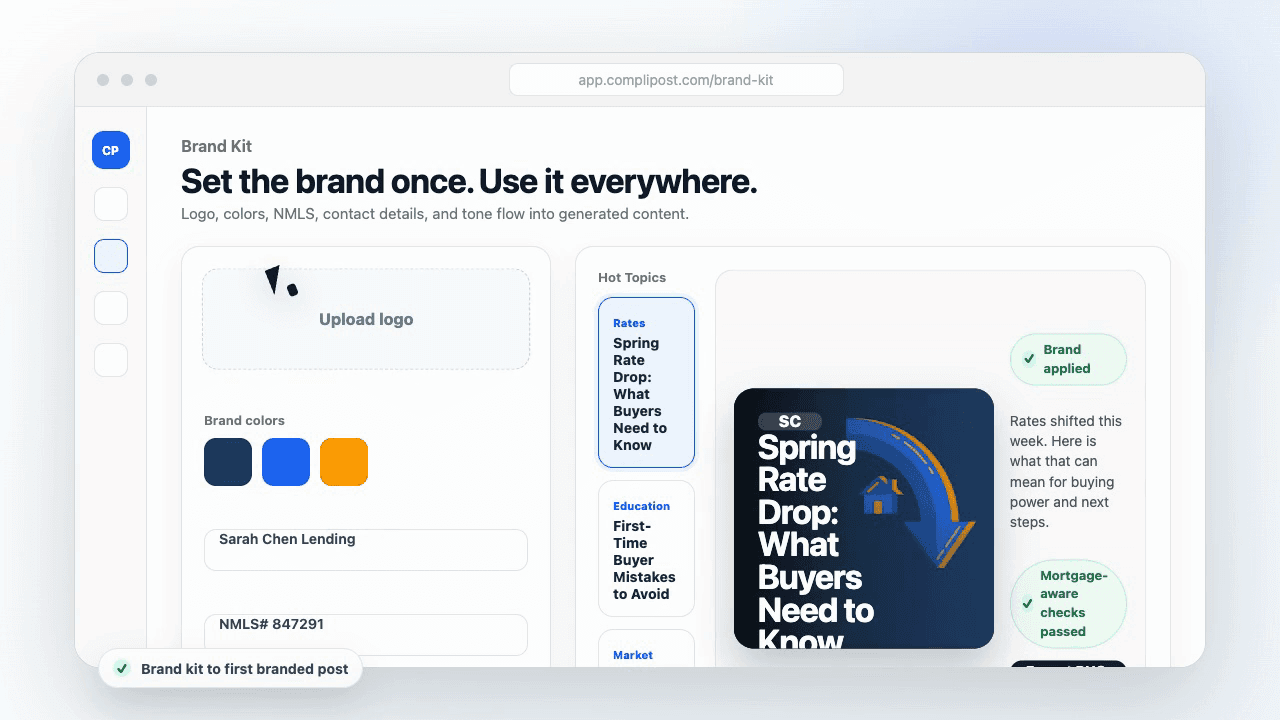
Product workflow
From blank page to export-ready mortgage content
- Start with a borrower topic
- Generate copy and a visual direction
- Review, save, and export the finished asset
These previews reflect the core CompliPost workflow: create, review, save, and export assets for use in your own channels.
Workflow comparison
| Content approach | What happens | Why it matters |
|---|---|---|
| Random posting | One-off ideas created when there is spare time | Inconsistent visibility and weak reuse |
| Template-only posting | Faster design but still requires rewriting and review | Helpful starting point, but not a full system |
| CompliPost workflow | Plan, generate, review, save, and export from one place | Better consistency with mortgage-aware review context |
| Done-for-you service | Someone else creates much of the content | Useful for some teams, but less control and less immediate reuse |
Who this guide helps
This guide is for loan officers working on solo loan officers who need a repeatable mortgage content workflow. The goal is to turn a broad mortgage topic into one borrower question, one useful takeaway, and one asset that can be reviewed before it is shared.
- You need content that sounds like a loan officer, not a generic brand account
- You want examples that can become captions, graphics, GIFs, or PDFs
- You need a clear place to review claims before export
- You want finished work saved for reuse, not lost in a chat thread
A practical workflow for this use case
Start with a narrow scenario, then move through planning, drafting, visual creation, review, and export. For physician attending first year homebuyer, that means the topic should be specific enough that a borrower or referral partner can immediately understand what decision the content helps with.
- Choose the borrower type, loan topic, or platform before generating copy
- Draft the caption and visual together so the asset feels cohesive
- Use the federal baseline review aid to flag claims and disclosure gaps
- Export the finished asset and save the post as a reusable starting point
What makes the content stronger
Strong mortgage content is usually specific, plain-spoken, and calm. It explains tradeoffs without pretending one answer fits every borrower. That is especially important on public social channels, where a short post can be interpreted without the full context of a loan conversation.
- Name the borrower question in the first line
- Explain one decision or tradeoff instead of covering everything
- Use examples without implying approval, savings, or rate outcomes
- End with a soft next step, checklist, or guide rather than pressure
Compliance-aware review notes
CompliPost should be treated as a review aid, not a compliance approval system. The public page, generated draft, graphic, and exported asset should all stay honest about that boundary.
- Review specific payment, APR, rate, savings, and qualification language
- Avoid “best,” “lowest,” “guaranteed,” “free,” and urgency claims unless approved
- Check NMLS, Equal Housing, company, and state-specific requirements
- Use company or legal review for anything outside the federal baseline
How this connects to the rest of CompliPost
A focused guide should leave you with a usable next step. After you understand the topic, you can turn it into a calendar slot, a reviewed social post, a downloadable guide, or a platform-specific version for the channel where your audience already spends time.
- Use the content calendar to turn the idea into a weekly plan
- Use the compliance page when claims or disclosures need a slower pass
- Use lead magnets when the topic deserves a deeper PDF guide
- Use platform pages to adapt the same idea for LinkedIn, Facebook, or Instagram
Recommended next steps
Self-employed borrower hub
Create income-documentation education for self-employed borrowers.
Physician Jumbo Loan Wealth Strategy
For high-earning specialties, show how attending income can support jumbo mortgages and premium properties.
Physician Mortgage Specialist Content for Loan Officers
Position yourself as understanding the attending life stage and its financial implications.
Physician Investment Property DSCR Loans
Once primary home is secured, attendings often turn to investment properties—introduce this next step.
Examples
FAQ
Can I use my attending offer letter to get pre-approved for a mortgage before I start the job?+
Yes. Most lenders accept signed offer letters for attending positions, even if your official start date is months away. You'll provide the offer letter, proof of medical board certification, and standard financial documentation. Many lenders have expedited physician attending processes. Applying before your official start date can actually speed the closing timeline—you can close before moving to the new city.
How much home can I actually afford on attending income?+
This depends on your specialty, location, and attending salary. General estimate: you can afford a home price of 3–4x your annual attending income (if you have low other debt). For example, a cardiologist earning $350K could afford a $1M–$1.4M home purchase. Use an online mortgage calculator with your attending salary to get a personalized estimate, then get pre-approved by a lender for an exact number. Remember: just because you qualify doesn't mean you should spend the maximum—consider student debt payoff, savings, investments.
Should I wait to buy until I have attending track record, or buy right away?+
Buying in the first attending year is often smart—you lock in a mortgage rate at your current (lower) rate level, and your salary is documented clearly with the offer letter. Waiting a year doesn't significantly improve your qualification, and you miss a year of equity building. The exception: if you're changing practices or unsure about the location/job, rent first year to confirm. Otherwise, buying year 1 is financially optimal.
Can I negotiate my attending contract to be mortgage-friendly?+
Absolutely. Some attendings request higher guaranteed base (vs. bonus or RVU-dependent compensation) because it improves mortgage qualification. Some negotiate for 3+ year contract terms (more stable than 1-year) or written production guarantees. Relocation bonuses or housing assistance should be clarified—they may not improve mortgage qualification but are valuable financial support. Discuss contract structure with a mortgage lender before finalizing your attending deal if maximizing home buying power is important to you.
What happens to my mortgage if I leave the attending role or change jobs?+
Once your mortgage is closed and funded, your employment situation doesn't change the loan. You keep the same rate and terms regardless of job changes. However, if you want to refinance or take out a second mortgage, lenders will evaluate your new employment at that time. Some attending contracts include early termination clauses (with penalties), but these don't directly affect an existing mortgage.
Create mortgage content with a calmer workflow
CompliPost helps you plan, generate, review, save, and export useful mortgage content without pretending compliance or social distribution is automatic.
Start free