PHYSICIAN AUDIENCE
Help Medical Fellows Buy During Advanced Training with Specialty Income Proof
Medical fellows earn significantly more than residents and are typically near the end of their training, making them prime mortgage candidates. Your content should emphasize that fellowship income is recognized and stable, that fellows often buy before attending status to lock in rates early, and that specialty-specific lender programs exist to streamline fellowship approvals. Frame the fellow phase as the perfect timing window—higher income than resident, proven medical track record, but still pre-attending rates.
Why Fellows Are in the Sweet Spot for Buying
Fellows have three advantages: higher income than residents (often 40–60% more), clear career trajectory (specialty already chosen), and proximity to attending status (1–3 years away). Your content should position fellowship as the ideal moment to buy before attending income kicks in, which means locking in a mortgage at a lower rate than what will be offered once attending status pushes them into a higher rate bracket. This is a money-saving pitch, not a rush pitch.
- Fellowship income qualifies for home purchases that resident income couldn't support
- Buying as a fellow means lower mortgage rates than buying as an attending
- Multiple years of medical training prove stability—lenders have confidence in fellows
- Specialty choice is finalized, so income projections are predictable
- Moving from renting during residency/fellowship to owning is natural life-stage content
Specialty-Specific Lender Programs for Fellows
Some lenders have dedicated fellowship programs that recognize specialty-specific income levels and career trajectories. Your content should highlight that these programs exist, what they offer (faster approval, better rates, lower down payments), and how to identify a lender knowledgeable about your fellow's specific specialty (some pay more than others). Demystify the process so fellows feel they're not being treated as generic borrowers.
- Fellowship income documentation is different from resident income—specialists understand this
- Some programs offer lower down payments or better rates specifically for fellows
- High-income specialties (surgery, ortho, cards) may qualify for jumbo loan programs with better terms
- Approval timelines for fellows can be shorter once fellowship status and specialty are verified
- Rate locks may be available that allow for refinancing once attending status is confirmed
Leveraging Specialty Income for Better Properties
Fellows often want to buy homes that reflect their achieved status but may feel they can't afford them yet. Your content should show that specialty income can support premium properties and that jumbo programs for high-earning specialties can open up homes normally out of reach. Frame it as investing in a home that grows with their career.
- High-income specialties can qualify for jumbo mortgages with competitive rates
- Geographic preferences (expensive markets) become possible once specialty income is documented
- Buying in desirable neighborhoods during fellowship sets up for long-term appreciation
- Premium properties provide room for family growth before attending moves
- Specialty income validation opens doors to investment property purchases later
Timing the Purchase Around Attending Transition
Fellows often complete training within 1–3 years of purchase. Your content should address the strategy of buying during fellowship vs. waiting for attending status. Show that buying early locks in lower rates, that the mortgage doesn't change even after promotion, and that attendings often buy again later (second home, primary home upgrade). Position fellowship buying as stage one of a wealth-building journey.
- Attending status won't change a locked mortgage rate—buy before the promotion to maximize savings
- Many attendings buy a primary residence as fellow, then investment properties as attending
- Income jump from fellow to attending is dramatic—mortgage locks in before the increase
- Relocation for fellowship vs. attending position is normal and manageable with the right property
- Building home equity during fellowship accelerates wealth before attending high-income years begin
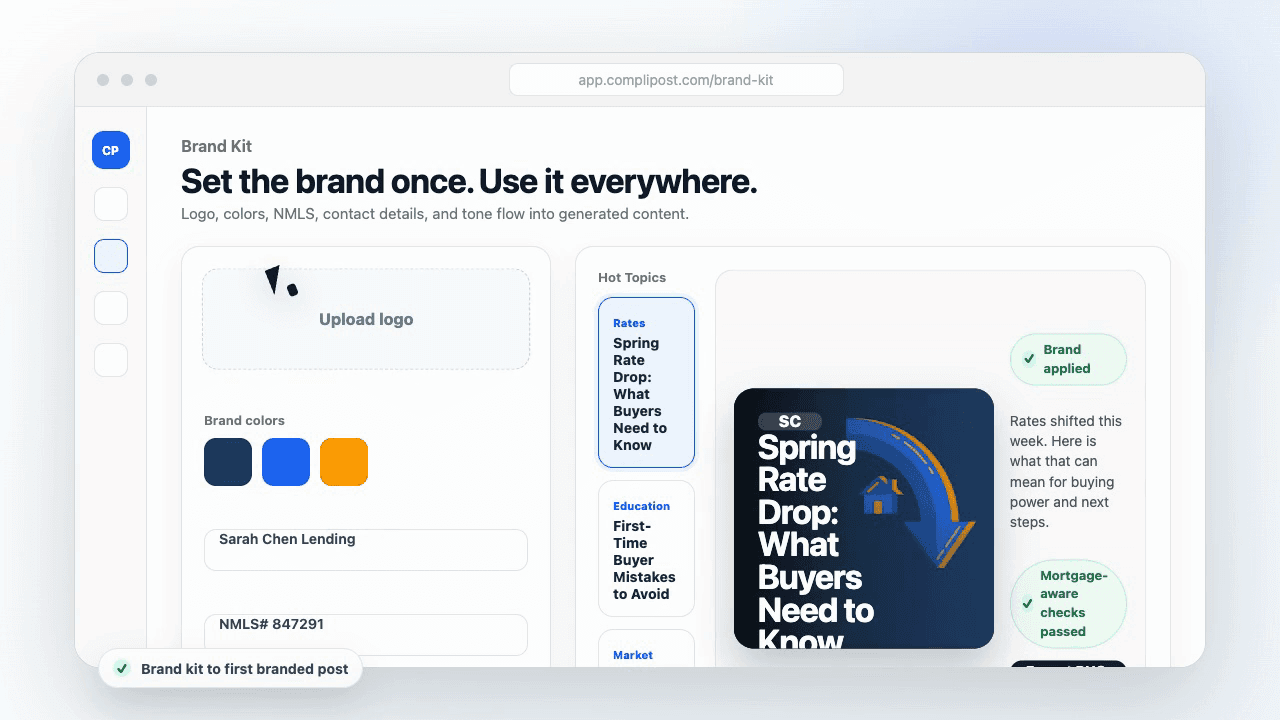
Product workflow
From blank page to export-ready mortgage content
- Start with a borrower topic
- Generate copy and a visual direction
- Review, save, and export the finished asset
These previews reflect the core CompliPost workflow: create, review, save, and export assets for use in your own channels.
Workflow comparison
| Content approach | What happens | Why it matters |
|---|---|---|
| Random posting | One-off ideas created when there is spare time | Inconsistent visibility and weak reuse |
| Template-only posting | Faster design but still requires rewriting and review | Helpful starting point, but not a full system |
| CompliPost workflow | Plan, generate, review, save, and export from one place | Better consistency with mortgage-aware review context |
| Done-for-you service | Someone else creates much of the content | Useful for some teams, but less control and less immediate reuse |
Who this guide helps
This guide is for loan officers working on solo loan officers who need a repeatable mortgage content workflow. The goal is to turn a broad mortgage topic into one borrower question, one useful takeaway, and one asset that can be reviewed before it is shared.
- You need content that sounds like a loan officer, not a generic brand account
- You want examples that can become captions, graphics, GIFs, or PDFs
- You need a clear place to review claims before export
- You want finished work saved for reuse, not lost in a chat thread
A practical workflow for this use case
Start with a narrow scenario, then move through planning, drafting, visual creation, review, and export. For physician homebuyer fellowship mortgage, that means the topic should be specific enough that a borrower or referral partner can immediately understand what decision the content helps with.
- Choose the borrower type, loan topic, or platform before generating copy
- Draft the caption and visual together so the asset feels cohesive
- Use the federal baseline review aid to flag claims and disclosure gaps
- Export the finished asset and save the post as a reusable starting point
What makes the content stronger
Strong mortgage content is usually specific, plain-spoken, and calm. It explains tradeoffs without pretending one answer fits every borrower. That is especially important on public social channels, where a short post can be interpreted without the full context of a loan conversation.
- Name the borrower question in the first line
- Explain one decision or tradeoff instead of covering everything
- Use examples without implying approval, savings, or rate outcomes
- End with a soft next step, checklist, or guide rather than pressure
Compliance-aware review notes
CompliPost should be treated as a review aid, not a compliance approval system. The public page, generated draft, graphic, and exported asset should all stay honest about that boundary.
- Review specific payment, APR, rate, savings, and qualification language
- Avoid “best,” “lowest,” “guaranteed,” “free,” and urgency claims unless approved
- Check NMLS, Equal Housing, company, and state-specific requirements
- Use company or legal review for anything outside the federal baseline
How this connects to the rest of CompliPost
A focused guide should leave you with a usable next step. After you understand the topic, you can turn it into a calendar slot, a reviewed social post, a downloadable guide, or a platform-specific version for the channel where your audience already spends time.
- Use the content calendar to turn the idea into a weekly plan
- Use the compliance page when claims or disclosures need a slower pass
- Use lead magnets when the topic deserves a deeper PDF guide
- Use platform pages to adapt the same idea for LinkedIn, Facebook, or Instagram
Recommended next steps
Self-employed borrower hub
Create income-documentation education for self-employed borrowers.
Physician Mortgage Specialist Content for Loan Officers
Position yourself as the go-to lender for physicians at all career stages by mastering specialty-specific financing.
Physician Jumbo Loan Wealth Strategy
Teach high-earning physicians how jumbo mortgages enable premium property purchases and multi-property portfolios.
Physician Cash Out Refinance Wealth Extraction
Show attendings how to leverage home equity built during residency and fellowship for investment opportunities.
Examples
FAQ
Does fellowship income count the same as attending income for mortgage qualification?+
Fellowship income is recognized and fundable by specialized lenders, though it's documented slightly differently than resident or attending income. Lenders will verify your fellowship offer letter, contract, and tax returns (if you've been in the position for at least two years) to confirm income stability. Some programs have specific fellowship programs that streamline this process. The amount of income you can qualify for may be lower than if you were attending, but it's still substantial and often sufficient for significant home purchases in most markets.
Should I wait until I'm an attending to buy a home?+
This is a strategic question. Buying as a fellow locks you into a mortgage rate at a lower rate bracket than attending, and that rate stays the same even after your promotion. You're building equity during fellowship, and your increased attending income can then be directed toward investments or other goals. That said, some fellows prefer to wait for the higher income and flexibility. Model both scenarios with a mortgage professional to see which makes sense for your timeline and market.
Will my mortgage rate improve when I become an attending?+
Your mortgage rate does not automatically change when you're promoted to attending status—the rate you lock in at application is fixed for the life of the loan (if you have a fixed-rate mortgage). However, some lenders offer 'rate improvement' programs where you can refinance to a lower rate if you transition to attending status within a certain timeframe. Always ask your lender about these options during the initial application process.
What down payment percentage is typical for fellows?+
Down payment options for fellows typically range from 5% to 20%, depending on the lender and loan program. Fellowship-specific programs may allow down payments as low as 5% without PMI, while conventional programs usually require PMI below 20%. Your specialty and income level can affect down payment requirements, so shop multiple lenders to understand your options. Some specialty programs offer incentives for higher down payments with rate discounts.
How does relocation for attending position affect my mortgage?+
Relocation for your attending position doesn't affect your mortgage—you keep the same loan and terms regardless of where you move. If you're relocating to a significantly higher cost-of-living area, you may want to sell the fellowship home and purchase in the new market. Alternatively, if your fellowship home appreciates and is in a desirable market, you can convert it to a rental property and purchase a new primary residence in your attending location. Discuss relocation strategies with your lender and a tax professional.
Create mortgage content with a calmer workflow
CompliPost helps you plan, generate, review, save, and export useful mortgage content without pretending compliance or social distribution is automatic.
Start free