PHYSICIAN AUDIENCE
Help Dentists and Dental Specialists Buy Homes with Business-Owner Income
Dentists and dental specialists face unique financing challenges: variable practice income, business ownership complexity, and income documentation that differs from MD lenders' standard procedures. Your content should position dentists as fundable using specialized programs that account for practice income, explain how to document business owner income for mortgage qualification, and show that dental specialty income is stable enough for premium mortgages. Address the fear that business-owner status complicates things, and show it doesn't have to.
Financing Options for Dentist Business Owners
Dentists who own practices face different underwriting than employed physicians. Your content should explain bank statement programs, which qualify based on business bank deposits (averaging 2 years of statements) rather than tax returns, and traditional self-employed programs. Show that dentists can buy with lower down payments than standard self-employed borrowers if they use dental-specific lender programs.
- Bank statement programs: average 24 months of business deposits, bypass tax return scrutiny
- Asset programs: use cash reserves, investments, and equipment value as qualification basis
- Dental-specific lenders: understand practice valuations, associate vs. owner complexity
- Average income method: 2–3 years of tax returns averaged for self-employed dentists
- Down payment flexibility: 5–15% for established practices, dependent on lender and doc requirements
Associate vs. Owner Dentists: Different Financing Paths
Associate dentists are employees (simpler underwriting), while dentist owners are self-employed (more complex). Your content should explain both paths, and address the transition from associate to owner. Show that buying as an associate is straightforward, and buying as an owner opens more expensive properties and investment opportunities.
- Associate dentists: standard employee income documentation, similar to employed physicians
- Dentist owners: business owner qualification, requires 2 years of practice history
- Transition timing: buying as associate, then refinancing as owner after practice purchase
- Practice partnerships: multiple owners may need partner guarantee letters, accountant statements
- Income stability: long-term practice ownership is viewed as stable, better than new practices
Specialty Income and Pricing for Ortho, Oral Surgery, Periodontists
Dental specialties have higher incomes than general dentistry and different income patterns. Your content should position specialties as premium financing candidates and explain how specialty income is documented. Address variable income (some months high, some low) and show it's manageable.
- Orthodontists: consistent monthly income, often higher than general dentistry
- Oral surgeons: fee-for-service variable income, but high annual totals
- Periodontists: specialty procedures, stable insurance-based income stream
- Average specialty income: higher than physician residents, competitive with physician fellows
- Specialty lenders: some programs specifically for orthodontists, oral surgeons, etc.
Building Authority with Dentist Content
Dentists value lenders who understand their unique financial picture and business complexity. Your content should prove this understanding—mention practice transitions, associate-to-owner financing, the impact of DSOs (Dental Service Organizations), and competitive market pressures that affect income stability.
- DSO ownership vs. independent practices: different income stability profiles, different financing
- Insurance reimbursement changes: impact on dentist income, important context for lenders
- Practice buy-in costs: how dentist-owner debt affects mortgage qualification
- Referral networks: orthodontists and specialists depend on general dentist referrals, income volatility
- Practice competition: understand regional market saturation and its impact on dentist income
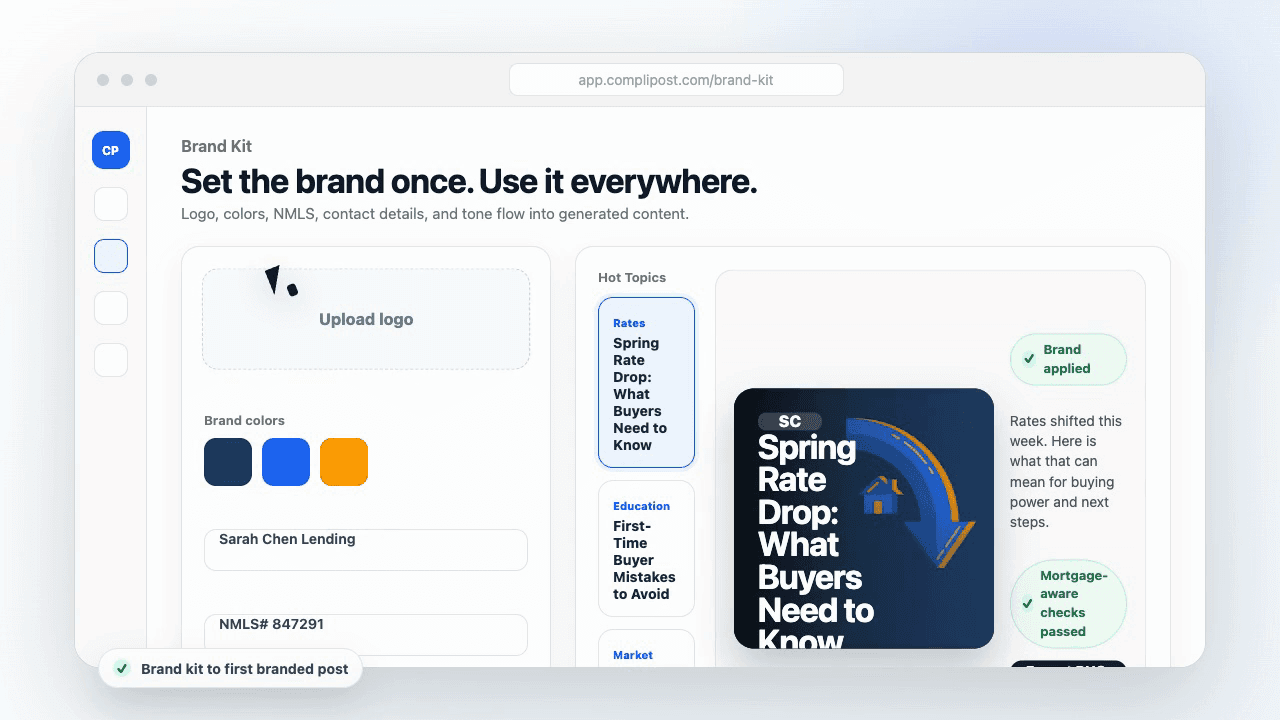
Product workflow
From blank page to export-ready mortgage content
- Start with a borrower topic
- Generate copy and a visual direction
- Review, save, and export the finished asset
These previews reflect the core CompliPost workflow: create, review, save, and export assets for use in your own channels.
Workflow comparison
| Content approach | What happens | Why it matters |
|---|---|---|
| Random posting | One-off ideas created when there is spare time | Inconsistent visibility and weak reuse |
| Template-only posting | Faster design but still requires rewriting and review | Helpful starting point, but not a full system |
| CompliPost workflow | Plan, generate, review, save, and export from one place | Better consistency with mortgage-aware review context |
| Done-for-you service | Someone else creates much of the content | Useful for some teams, but less control and less immediate reuse |
Who this guide helps
This guide is for loan officers working on solo loan officers who need a repeatable mortgage content workflow. The goal is to turn a broad mortgage topic into one borrower question, one useful takeaway, and one asset that can be reviewed before it is shared.
- You need content that sounds like a loan officer, not a generic brand account
- You want examples that can become captions, graphics, GIFs, or PDFs
- You need a clear place to review claims before export
- You want finished work saved for reuse, not lost in a chat thread
A practical workflow for this use case
Start with a narrow scenario, then move through planning, drafting, visual creation, review, and export. For dentist dental specialist homebuyer mortgage, that means the topic should be specific enough that a borrower or referral partner can immediately understand what decision the content helps with.
- Choose the borrower type, loan topic, or platform before generating copy
- Draft the caption and visual together so the asset feels cohesive
- Use the federal baseline review aid to flag claims and disclosure gaps
- Export the finished asset and save the post as a reusable starting point
What makes the content stronger
Strong mortgage content is usually specific, plain-spoken, and calm. It explains tradeoffs without pretending one answer fits every borrower. That is especially important on public social channels, where a short post can be interpreted without the full context of a loan conversation.
- Name the borrower question in the first line
- Explain one decision or tradeoff instead of covering everything
- Use examples without implying approval, savings, or rate outcomes
- End with a soft next step, checklist, or guide rather than pressure
Compliance-aware review notes
CompliPost should be treated as a review aid, not a compliance approval system. The public page, generated draft, graphic, and exported asset should all stay honest about that boundary.
- Review specific payment, APR, rate, savings, and qualification language
- Avoid “best,” “lowest,” “guaranteed,” “free,” and urgency claims unless approved
- Check NMLS, Equal Housing, company, and state-specific requirements
- Use company or legal review for anything outside the federal baseline
How this connects to the rest of CompliPost
A focused guide should leave you with a usable next step. After you understand the topic, you can turn it into a calendar slot, a reviewed social post, a downloadable guide, or a platform-specific version for the channel where your audience already spends time.
- Use the content calendar to turn the idea into a weekly plan
- Use the compliance page when claims or disclosures need a slower pass
- Use lead magnets when the topic deserves a deeper PDF guide
- Use platform pages to adapt the same idea for LinkedIn, Facebook, or Instagram
Recommended next steps
Self-employed borrower hub
Create income-documentation education for self-employed borrowers.
Self-Employed Business Owner Mortgage Guide
General business owner mortgage strategies applicable to dentist practice owners.
Healthcare Professional Mortgage Guide
Broader healthcare context positioning dentists alongside other medical professionals.
Self-Employed Bank Statement Mortgage Qualification
Deep dive into bank statement programs that dentist owners can leverage for better qualification.
Examples
FAQ
How do lenders determine my income if I own a dental practice?+
Lenders typically use one of two methods: (1) Average your net business income from 2–3 years of tax returns, or (2) Use a bank statement program that averages 24 months of business deposits. Bank statement programs are often more favorable for practice owners because they don't penalize you for specific deductions (like reinvested profit or business equipment purchases) that might lower your taxable income. Choose the method that shows the highest qualifying income.
Can I qualify for a mortgage while transitioning from associate to practice owner?+
Yes, but timing matters. If you're planning to buy a practice, buy the home first (while you have clear associate income documentation), then transition to ownership. If you've already purchased the practice, lenders will use the business income documentation above. If you're buying both a home and a practice simultaneously, you'll need to show clear financing for both. Work with a lender experienced in dental practice transitions to structure this correctly.
Does variable income as a specialty dentist affect my mortgage qualification?+
Variable income is expected for specialty dentists, particularly oral surgeons and those paid on a fee-for-service basis. Lenders average your income over 2 years to account for this variation. As long as your 2-year average is consistent and shows an upward trend (or stability), you'll qualify. Avoid big income drops right before applying; if your income dipped temporarily due to illness, closure, or market conditions, explain it to your lender.
What's different about financing for associate dentists vs. owners?+
Associate dentists have straightforward employment income (W-2), similar to employed physicians, and face standard mortgage underwriting. Dentist owners are self-employed and need business income documentation (tax returns, profit & loss statements, or bank statements). Owners also need to disclose practice debt (loans for equipment, practice acquisition, etc.), which counts against their personal DTI. The good news: established practices are viewed as stable and often support larger mortgages than the owner's personal W-2 income alone would allow.
How do DSO-affiliated dentists document income?+
If you work for a Dental Service Organization (DSO), you're an employee, even if you feel entrepreneurial. Document income using W-2s and paystubs, similar to any employed physician. If you own the practice but operate within a DSO model, you'll document business income as above. Be clear on your exact relationship with the DSO (employee, independent contractor, owner, partner) because it affects how lenders treat your income.
Create mortgage content with a calmer workflow
CompliPost helps you plan, generate, review, save, and export useful mortgage content without pretending compliance or social distribution is automatic.
Start free