PHYSICIAN AUDIENCE
Help Attending Physicians Build Multi-Property Wealth with High-Income Strategy
Attending physicians have reached peak income and predictable earnings, making them ideal for aggressive wealth-building strategies. Your content should position attendings as candidates for jumbo mortgages on premium primary residences, investment property purchases, and portfolio expansion. Emphasize tax-efficient financing, the ability to hold multiple properties, and strategic refinancing to open up equity for future investments.
Beyond the Primary Home: Multi-Property Strategy
Attendings often focus only on their primary residence, missing the wealth-building opportunity of investment properties. Your content should introduce the concept of strategic home purchases followed by investment property financing, using equity to scale. Frame it as normal for high-earning professionals and show the financial advantage of starting property portfolios while still young and earning at peak.
- Primary residence as attending: jumbo programs enable premium homes in competitive markets
- Investment property financing: DSCR loans and portfolio programs allow 2nd, 3rd, 4th properties
- Holding residential rentals: shift from occupied to rental generates passive income stream
- Rate arbitrage: refinancing primary home to extract equity for investment down payments
- Depreciation and deductions: real estate investment provides significant tax advantages for high earners
Jumbo Mortgage Programs for Premium Homes
Attending physicians in high-cost markets face jumbo mortgages, but specialized lender programs make these competitive. Your content should explain that jumbo programs for physicians often have better rates than standard jumbo programs, with lower down payment requirements and faster approvals. Demystify the jumbo process so attendings see premium homes as achievable, not unrealistic.
- Physician jumbo programs: lower down payments, better rates, faster closings
- Portfolio/bank statement programs for self-employed and business-owner physicians
- Jumbo loans up to $3M+ available for high-income specialties in competitive markets
- Rate comparisons: physician jumbo often beats conventional jumbo significantly
- Second homes and vacation properties: jumbo programs enable geographic flexibility
Tax-Efficient Financing and Refinancing Strategy
Attendings are in high tax brackets and benefit from strategic financing decisions. Your content should touch on mortgage interest deductions, real estate investment tax breaks, and the timing of refinances to optimize tax outcomes. Work with tax professionals but position yourself as understanding the bigger picture of physician wealth.
- Mortgage interest deductions: significant for jumbo loans on high-value properties
- Investment property depreciation: creates paper losses that offset high attending income
- 1031 exchanges: swap investment properties tax-free to scale portfolio
- Refinancing timing: pull equity right before income year ends, deduct interest efficiently
- Loan structure: some physicians benefit from HELOC or portfolio loans vs. traditional mortgages
Leveraging Attending Income for Career-Life Balance
Attendings earn peak income for decades, allowing them to prioritize lifestyle alongside wealth-building. Your content should show that high income enables buying in desired locations, closer to family or practice, and properties that support the life they've earned. This is aspirational and emotionally resonant—not just financial, but about lifestyle and family.
- Location choice: buy in the market you want to practice in, not the cheapest option
- Second home: mountain or beach home becomes financially feasible for attendings
- Upgrade strategy: move from starter home to dream home as income and equity grow
- Family-focused: properties near parents, grandparents, or extended family networks
- Career stability: 20+ years of potential at same practice justify larger mortgage commitment
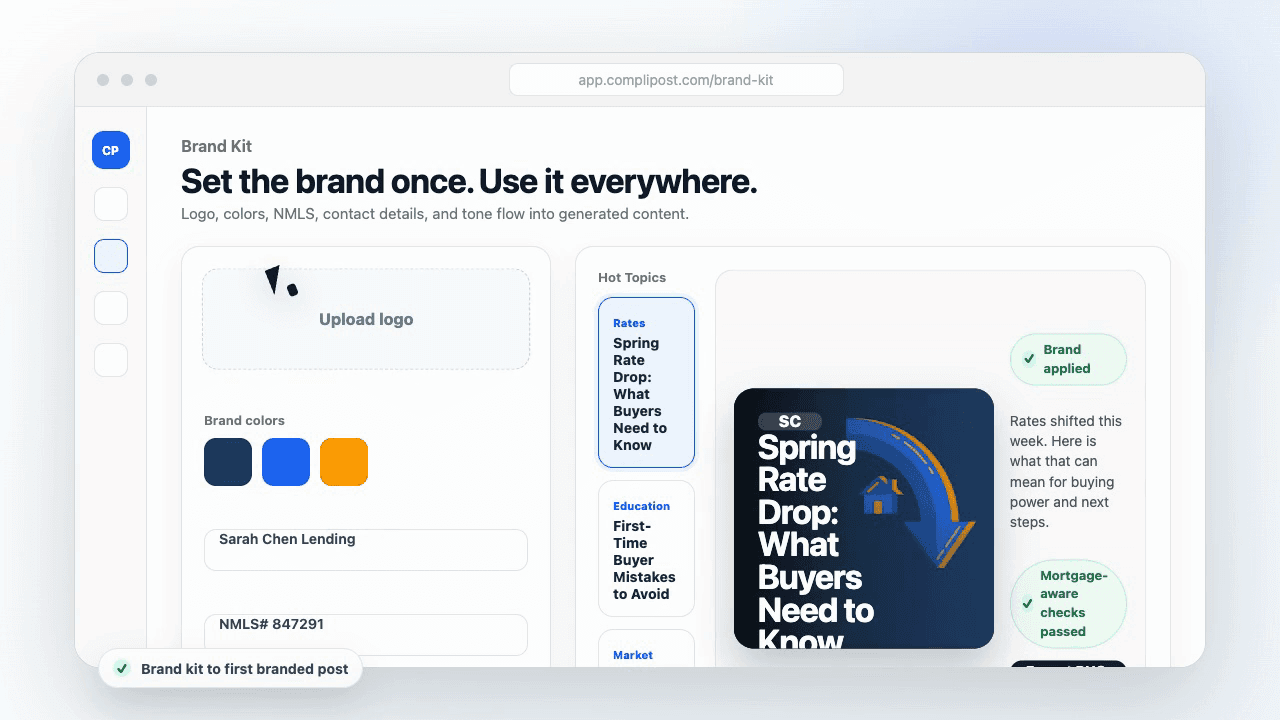
Product workflow
From blank page to export-ready mortgage content
- Start with a borrower topic
- Generate copy and a visual direction
- Review, save, and export the finished asset
These previews reflect the core CompliPost workflow: create, review, save, and export assets for use in your own channels.
Workflow comparison
| Content approach | What happens | Why it matters |
|---|---|---|
| Random posting | One-off ideas created when there is spare time | Inconsistent visibility and weak reuse |
| Template-only posting | Faster design but still requires rewriting and review | Helpful starting point, but not a full system |
| CompliPost workflow | Plan, generate, review, save, and export from one place | Better consistency with mortgage-aware review context |
| Done-for-you service | Someone else creates much of the content | Useful for some teams, but less control and less immediate reuse |
Who this guide helps
This guide is for loan officers working on solo loan officers who need a repeatable mortgage content workflow. The goal is to turn a broad mortgage topic into one borrower question, one useful takeaway, and one asset that can be reviewed before it is shared.
- You need content that sounds like a loan officer, not a generic brand account
- You want examples that can become captions, graphics, GIFs, or PDFs
- You need a clear place to review claims before export
- You want finished work saved for reuse, not lost in a chat thread
A practical workflow for this use case
Start with a narrow scenario, then move through planning, drafting, visual creation, review, and export. For physician homebuyer attending wealth strategy, that means the topic should be specific enough that a borrower or referral partner can immediately understand what decision the content helps with.
- Choose the borrower type, loan topic, or platform before generating copy
- Draft the caption and visual together so the asset feels cohesive
- Use the federal baseline review aid to flag claims and disclosure gaps
- Export the finished asset and save the post as a reusable starting point
What makes the content stronger
Strong mortgage content is usually specific, plain-spoken, and calm. It explains tradeoffs without pretending one answer fits every borrower. That is especially important on public social channels, where a short post can be interpreted without the full context of a loan conversation.
- Name the borrower question in the first line
- Explain one decision or tradeoff instead of covering everything
- Use examples without implying approval, savings, or rate outcomes
- End with a soft next step, checklist, or guide rather than pressure
Compliance-aware review notes
CompliPost should be treated as a review aid, not a compliance approval system. The public page, generated draft, graphic, and exported asset should all stay honest about that boundary.
- Review specific payment, APR, rate, savings, and qualification language
- Avoid “best,” “lowest,” “guaranteed,” “free,” and urgency claims unless approved
- Check NMLS, Equal Housing, company, and state-specific requirements
- Use company or legal review for anything outside the federal baseline
How this connects to the rest of CompliPost
A focused guide should leave you with a usable next step. After you understand the topic, you can turn it into a calendar slot, a reviewed social post, a downloadable guide, or a platform-specific version for the channel where your audience already spends time.
- Use the content calendar to turn the idea into a weekly plan
- Use the compliance page when claims or disclosures need a slower pass
- Use lead magnets when the topic deserves a deeper PDF guide
- Use platform pages to adapt the same idea for LinkedIn, Facebook, or Instagram
Recommended next steps
Self-employed borrower hub
Create income-documentation education for self-employed borrowers.
Physician Jumbo Loan Wealth Strategy
Master jumbo financing specifically designed for high-earning physicians to access premium properties and multi-property strategies.
Physician Investment Property DSCR Loans
Scale investment properties using debt service coverage ratio loans tailored for physician investors.
Physician Cash Out Refinance Wealth Extraction
Use cash-out refinancing to open up home equity and fund additional investments or financial goals.
Examples
FAQ
Can I qualify for a jumbo mortgage as an attending physician?+
Yes, and often with better terms than you'd expect. Physician-focused lenders have specialized jumbo programs that recognize attending income stability and offer competitive rates, lower down payments, and faster approvals compared to standard jumbo products. Down payments for physician jumbos can be as low as 10–15%, and rates may be comparable to conventional mortgages. Work with a lender experienced in physician jumbos to understand your full buying power.
Should I buy one expensive home or start an investment property portfolio?+
Both are possible, and many attendings do both over time. A common strategy is to purchase a primary residence that aligns with your lifestyle and location preferences, then leverage the home equity and income to purchase investment properties. This diversifies your wealth-building approach—your primary home is about lifestyle, while investment properties focus on cash flow and long-term appreciation. Your personal goals, local real estate market, and risk tolerance should guide this decision.
How do investment property loans (DSCR) work for physicians?+
DSCR stands for Debt Service Coverage Ratio, and these loans are designed for investment properties where the rental income is expected to cover the mortgage payment. As an attending physician, you can qualify for DSCR loans based on the projected rental income of the property, not your personal physician income. This allows you to scale multiple properties without having to show enough personal income to cover all the mortgages, which is especially valuable if you're purchasing multiple properties simultaneously.
What's the best strategy for buying a second home or investment property?+
Strategy depends on your goals. For a second home, standard mortgages work fine; lenders expect high-income professionals to own vacation homes. For investment properties, DSCR loans are popular because they base qualification on rental income rather than your personal income, allowing you to scale faster. Consider the market fundamentals (appreciation potential, rental demand) and your cash flow needs (passive income vs. appreciation). A hybrid approach—primary home in one market, investment properties in another—is common among attending physicians.
How does refinancing work to access equity for new investments?+
Cash-out refinancing lets you refinance your primary residence (or investment property) at the current interest rate and take out the accumulated equity in cash. For example, if your primary home is worth $800K and you owe $500K, you could refinance for $600K, pocketing $100K in cash to use for an investment property down payment or other goal. The new loan amount becomes your mortgage balance, and your monthly payment may increase depending on rates and terms. This is a strategic move to open up capital without selling the property.
Create mortgage content with a calmer workflow
CompliPost helps you plan, generate, review, save, and export useful mortgage content without pretending compliance or social distribution is automatic.
Start free