State-specific
Navigating Mortgage Compliance and Attorney Practices in New York
For loan officers working in New York, understanding the unique mortgage compliance landscape is crucial. This includes the mandatory involvement of real estate attorneys in closings, as well as state-specific disclosure requirements and compliance rules. By mastering these elements, loan officers can position themselves as knowledgeable and reliable resources for New York borrowers. Gain insights into how these requirements shape the lending process and what it means for your client interactions and service delivery. This gives you a reusable way to teach the topic, write captions, choose a soft call to action, and keep the message inside a safer mortgage marketing lane before you export it.
Mandatory Attorney Participation in New York Closings
New York stands out from many states by mandating the presence of a real estate attorney during real estate closings. This requirement is designed to ensure that all legal aspects of the transaction are thoroughly reviewed, protecting both the borrower and the integrity of the process. Loan officers must be adept at coordinating with attorneys to facilitate smooth and timely closings. Understanding the impact of attorney involvement on the timeline is essential, as it can add several days to the process. Being proactive in communication with both attorneys and borrowers will help manage expectations and prevent delays.
Understanding New York's Unique Disclosure and Compliance Requirements
Navigating New York's mortgage landscape involves adhering to a series of state-specific disclosure and compliance mandates. These include unique requirements for radon testing disclosures, as well as compliance with homeowner association regulations. Loan officers can distinguish themselves by becoming well-versed in these requirements, positioning themselves as experts in the New York market. Providing clear, concise explanations to borrowers about these differences not only enhances client trust but also ensures compliance with state regulations. Familiarity with these rules is crucial for maintaining a high standard of service and avoiding potential compliance pitfalls.
Opportunities in High-Value Markets: Jumbo and Investment Lending
The real estate markets in New York City, Westchester, and Long Island are characterized by high property values, leading to a greater prevalence of jumbo loans and investment property financing. Loan officers looking to expand their market share in these areas should focus on developing expertise in these specific loan types. Understanding the nuances of jumbo loan requirements can provide a competitive edge. Additionally, being knowledgeable about financing options for investment properties can attract a broader client base. This expertise enables loan officers to offer tailored solutions that meet the distinct needs of clients investing in these high-value markets.
Compliance Considerations: Ensuring Adherence to State and Federal Regulations
Compliance with both state and federal regulations is a non-negotiable aspect of mortgage lending in New York. Loan officers must be vigilant in adhering to laws like the Truth in Lending Act (TILA) and the Real Estate Settlement Procedures Act (RESPA), among others. These regulations govern everything from disclosure standards to fair lending practices. Staying informed about compliance requirements helps avoid legal complications and reinforces trust with clients. Regularly updating your knowledge and utilizing compliance tools can streamline your processes and ensure that your lending practices meet all necessary legal standards.
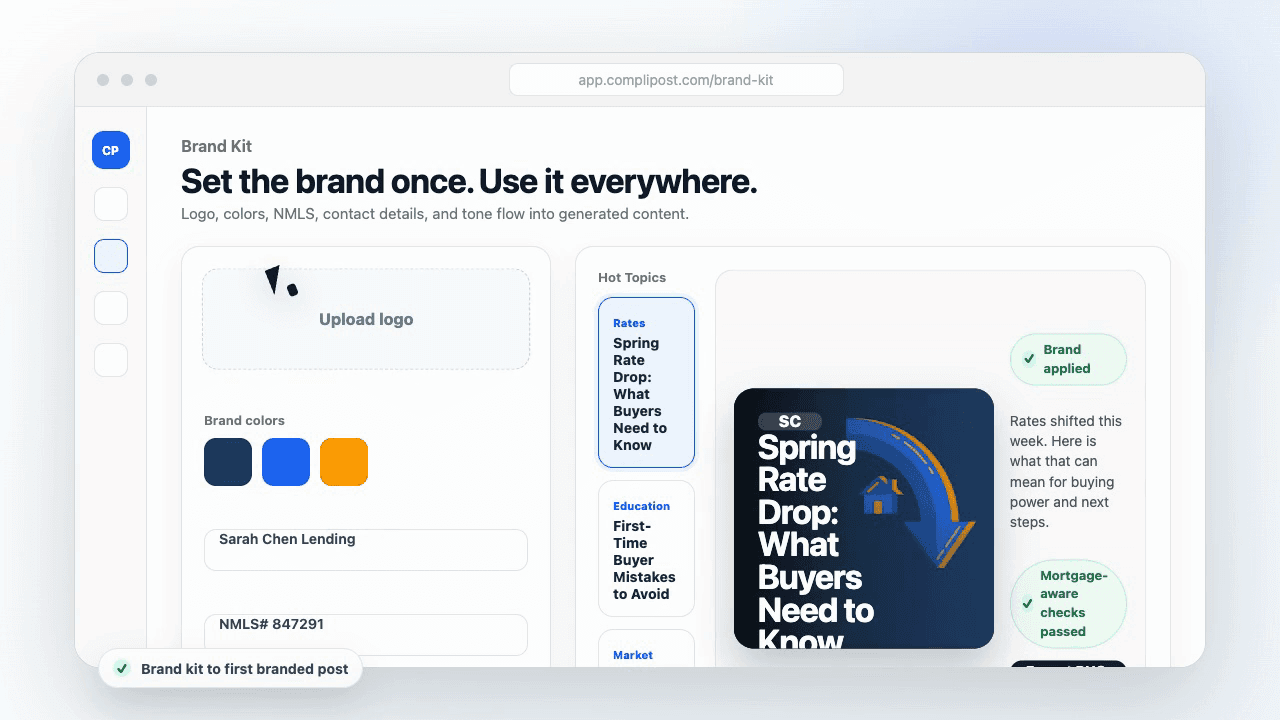
Product workflow
From blank page to export-ready mortgage content
- Start with a borrower topic
- Generate copy and a visual direction
- Review, save, and export the finished asset
These previews reflect the core CompliPost workflow: create, review, save, and export assets for use in your own channels.
Risky copy vs safer review direction
| Draft pattern | Why it needs review | Safer direction |
|---|---|---|
| Guaranteed lowest rate | Guarantee and superlative claim | Compare options carefully with a licensed professional |
| Save $500/month | Unsupported savings claim | Review refinance goals, costs, and break-even timing |
| No-cost loan | Potential fee and disclosure issue | Explain tradeoffs and confirm company-approved language |
| Act now before rates explode | Pressure and urgency language | Use calm market context and invite questions |
Who this guide helps
This guide is for loan officers working on solo loan officers who need a repeatable mortgage content workflow. The goal is to turn a broad mortgage topic into one borrower question, one useful takeaway, and one asset that can be reviewed before it is shared.
- You need content that sounds like a loan officer, not a generic brand account
- You want examples that can become captions, graphics, GIFs, or PDFs
- You need a clear place to review claims before export
- You want finished work saved for reuse, not lost in a chat thread
A practical workflow for this use case
Start with a narrow scenario, then move through planning, drafting, visual creation, review, and export. For New York mortgage attorney compliance, that means the topic should be specific enough that a borrower or referral partner can immediately understand what decision the content helps with.
- Choose the borrower type, loan topic, or platform before generating copy
- Draft the caption and visual together so the asset feels cohesive
- Use the federal baseline review aid to flag claims and disclosure gaps
- Export the finished asset and save the post as a reusable starting point
What makes the content stronger
Strong mortgage content is usually specific, plain-spoken, and calm. It explains tradeoffs without pretending one answer fits every borrower. That is especially important on public social channels, where a short post can be interpreted without the full context of a loan conversation.
- Name the borrower question in the first line
- Explain one decision or tradeoff instead of covering everything
- Use examples without implying approval, savings, or rate outcomes
- End with a soft next step, checklist, or guide rather than pressure
Compliance-aware review notes
CompliPost should be treated as a review aid, not a compliance approval system. The public page, generated draft, graphic, and exported asset should all stay honest about that boundary.
- Review specific payment, APR, rate, savings, and qualification language
- Avoid “best,” “lowest,” “guaranteed,” “free,” and urgency claims unless approved
- Check NMLS, Equal Housing, company, and state-specific requirements
- Use company or legal review for anything outside the federal baseline
How this connects to the rest of CompliPost
A focused guide should leave you with a usable next step. After you understand the topic, you can turn it into a calendar slot, a reviewed social post, a downloadable guide, or a platform-specific version for the channel where your audience already spends time.
- Use the content calendar to turn the idea into a weekly plan
- Use the compliance page when claims or disclosures need a slower pass
- Use lead magnets when the topic deserves a deeper PDF guide
- Use platform pages to adapt the same idea for LinkedIn, Facebook, or Instagram
Recommended next steps
Self-employed borrower hub
Create income-documentation education for self-employed borrowers.
Mortgage content calendar
Plan a weekly rhythm of useful borrower and referral-partner posts.
Jumbo loan guide
High-balance lending in NY.
Compliance checklist tool
Check common mortgage marketing risk signals before export.
Examples
FAQ
Why do New York mortgages require an attorney?+
In New York, an attorney is required in real estate transactions to ensure all legal documentation is thoroughly reviewed and compliant with state laws. This involvement safeguards the interests of all parties and contributes to a smooth transaction process. The practical move is to keep the answer educational, mention that details vary by borrower profile and lender guidelines, and invite the reader to ask for a personal review instead of implying a certain result.
How does attorney involvement affect closing timelines?+
Attorney involvement in New York real estate transactions can extend closing timelines by several days. Loan officers should coordinate early with attorneys and borrowers to manage expectations and ensure all necessary documentation is prepared in advance. The practical move is to keep the answer educational, mention that details vary by borrower profile and lender guidelines, and invite the reader to ask for a personal review instead of implying a certain result.
What are some New York-specific disclosure requirements?+
New York mandates specific disclosures such as radon testing and compliance with homeowner association rules. Loan officers must familiarize themselves with these requirements to provide accurate information and avoid compliance issues. The practical move is to keep the answer educational, mention that details vary by borrower profile and lender guidelines, and invite the reader to ask for a personal review instead of implying a certain result.
How can loan officers ensure compliance with New York lending laws?+
Loan officers can ensure compliance by staying informed about state and federal regulations, utilizing compliance tools, and engaging in regular training. Adhering to laws like TILA and RESPA is crucial for maintaining integrity and avoiding legal issues. The practical move is to keep the answer educational, mention that details vary by borrower profile and lender guidelines, and invite the reader to ask for a personal review instead of implying a certain result.
Create mortgage content with a calmer workflow
CompliPost helps you plan, generate, review, save, and export useful mortgage content without pretending compliance or social distribution is automatic.
Start free