Content Ideas
Mortgage Holiday Content Ideas: How Loan Officers Stay Visible Around Every Holiday
Holiday content is one of the most underused tools in a loan officer's content strategy. Done well, it humanizes your brand, anchors your posting calendar to dates your audience already notices, and builds the kind of relationship that makes a borrower think of you when they're finally ready to move. Done poorly, it's a generic "Happy Thanksgiving" post that earns no engagement and teaches your audience nothing.
Why holiday content works — and where most loan officers go wrong
Holidays solve the blank-calendar problem that most loan officers identify as their single biggest content barrier. A national holiday gives you a natural reason to post — and your audience gives you attention because the date is already on their radar. The mistake is treating holiday content as purely ceremonial: a stock-photo graphic that says "Happy Fourth of July" teaches nothing and earns a like from three people who already follow you. The stronger approach anchors the holiday to something genuinely useful for a borrower. A Memorial Day post that connects the date to VA loan benefits earns engagement from people who actually need the information. The holiday is the hook; the education is the value.
- Use the holiday as a hook to a genuinely useful piece of information
- Connect national observances to loan types where relevant (Memorial Day → VA benefits, Tax Day → self-employment income)
- Personal posts around major holidays humanize your brand without requiring a mortgage angle
- Avoid hollow ceremony: generic graphics with no educational value teach your audience to scroll past your holiday posts
A holiday-by-holiday content calendar for loan officers
The following calendar is a starting framework — adapt the angles to your specialty, geography, and audience. New Year's (January): "Is this the year you buy a home? Here are the three things I'd check before deciding." Education-first; connects annual goal-setting to a specific action. MLK Day (January): Fair Housing awareness is directly relevant to mortgage lending. An educational post about Fair Housing Act history earns authority and demonstrates values. Tax Day (April 15): "Tax season just ended — if you're self-employed and thinking about buying, here's what your lender will actually look at." Timely and highly specific. Memorial Day (late May): VA loan benefit education. "This weekend honors those who served. If you're a veteran who hasn't explored the VA home loan benefit, here's what the benefit actually covers and who qualifies." National Homeownership Month (June): The calendar anchor every loan officer should use. An entire month of education posts and first-time-buyer content. Labor Day: "The fall market is starting to shape up — here's what I'm watching for buyers who want to move before year-end." Thanksgiving: Personal appreciation post — a moment from a closing this year, something you're grateful for professionally. No mortgage pitch.
Holiday content that connects to specific loan types
The strongest holiday content for a specialist loan officer connects the occasion to the borrower type they serve. A VA specialist has a natural, genuine reason to post on Memorial Day, Veterans Day, and Independence Day — and those posts will reach and resonate with the exact audience they want. An FHA or first-time-buyer specialist can use Tax Day, New Year's, and National Homeownership Month as natural moments to educate their audience. A self-employed borrower specialist has a natural Tax Day post that no generalist LO can replicate with the same specificity. This is the niche-beats-generalist principle applied to the holiday calendar.
Compliance notes for holiday content
Holiday content carries a specific set of compliance risks because it's often written quickly and casually. The most common holiday-content violations are urgency frames: "buy before the spring market heats up," "lock your rate before the new year." A market-outlook statement attached to a holiday is unauthorized advice regardless of whether it's decorated with a holiday graphic. The compliance-safe approach is to use the holiday as a human hook, keep any market context to framing rather than prediction, and avoid any language that implies a personal recommendation. CompliPost's federal-baseline review aid flags urgency-framing language before export — useful for holiday copy that gets written in a hurry.
- Do not attach market predictions to holiday posts ("buy before spring" is an unauthorized recommendation)
- Do not use holiday urgency frames ("lock your rate before the New Year")
- Personal appreciation posts require no compliance review — they contain no financial content
- Educational posts connecting a holiday to a loan type should explain, not advise
Creating holiday content in advance with CompliPost
Holiday content is one of the easiest categories to batch in advance — the dates are fixed, the angles are predictable, and creating a full year of holiday posts in one sitting is entirely feasible. CompliPost generates branded copy, captions, and graphics for holiday occasions that a loan officer can review, adjust, and export to their own platforms. Batching holiday content in January for the full year means you never miss a holiday because you were too busy closing loans — the blank-calendar problem solved before the calendar even opens.
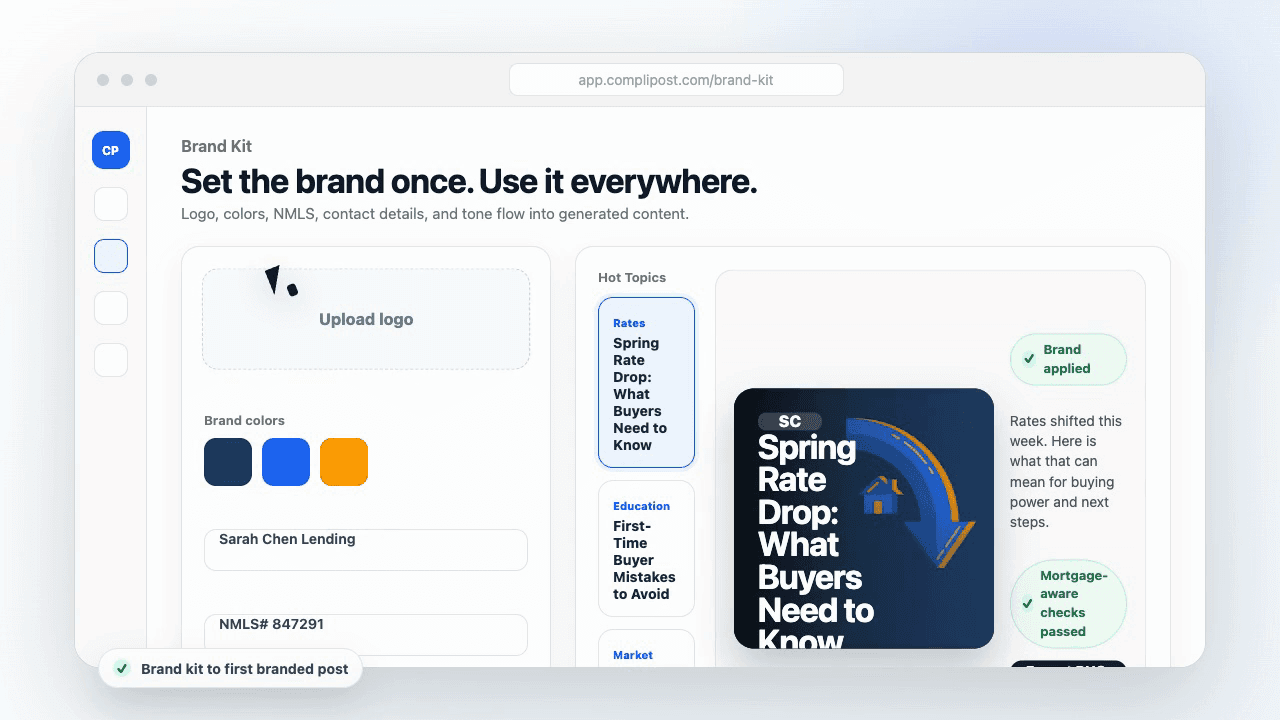
Product workflow
From blank page to export-ready mortgage content
- Start with a borrower topic
- Generate copy and a visual direction
- Review, save, and export the finished asset
These previews reflect the core CompliPost workflow: create, review, save, and export assets for use in your own channels.
Workflow comparison
| Content approach | What happens | Why it matters |
|---|---|---|
| Random posting | One-off ideas created when there is spare time | Inconsistent visibility and weak reuse |
| Template-only posting | Faster design but still requires rewriting and review | Helpful starting point, but not a full system |
| CompliPost workflow | Plan, generate, review, save, and export from one place | Better consistency with mortgage-aware review context |
| Done-for-you service | Someone else creates much of the content | Useful for some teams, but less control and less immediate reuse |
Who this guide helps
This guide is for loan officers working on solo loan officers who need a repeatable mortgage content workflow. The goal is to turn a broad mortgage topic into one borrower question, one useful takeaway, and one asset that can be reviewed before it is shared.
- You need content that sounds like a loan officer, not a generic brand account
- You want examples that can become captions, graphics, GIFs, or PDFs
- You need a clear place to review claims before export
- You want finished work saved for reuse, not lost in a chat thread
A practical workflow for this use case
Start with a narrow scenario, then move through planning, drafting, visual creation, review, and export. For mortgage holiday content ideas, that means the topic should be specific enough that a borrower or referral partner can immediately understand what decision the content helps with.
- Choose the borrower type, loan topic, or platform before generating copy
- Draft the caption and visual together so the asset feels cohesive
- Use the federal baseline review aid to flag claims and disclosure gaps
- Export the finished asset and save the post as a reusable starting point
What makes the content stronger
Strong mortgage content is usually specific, plain-spoken, and calm. It explains tradeoffs without pretending one answer fits every borrower. That is especially important on public social channels, where a short post can be interpreted without the full context of a loan conversation.
- Name the borrower question in the first line
- Explain one decision or tradeoff instead of covering everything
- Use examples without implying approval, savings, or rate outcomes
- End with a soft next step, checklist, or guide rather than pressure
Compliance-aware review notes
CompliPost should be treated as a review aid, not a compliance approval system. The public page, generated draft, graphic, and exported asset should all stay honest about that boundary.
- Review specific payment, APR, rate, savings, and qualification language
- Avoid “best,” “lowest,” “guaranteed,” “free,” and urgency claims unless approved
- Check NMLS, Equal Housing, company, and state-specific requirements
- Use company or legal review for anything outside the federal baseline
How this connects to the rest of CompliPost
A focused guide should leave you with a usable next step. After you understand the topic, you can turn it into a calendar slot, a reviewed social post, a downloadable guide, or a platform-specific version for the channel where your audience already spends time.
- Use the content calendar to turn the idea into a weekly plan
- Use the compliance page when claims or disclosures need a slower pass
- Use lead magnets when the topic deserves a deeper PDF guide
- Use platform pages to adapt the same idea for LinkedIn, Facebook, or Instagram
Recommended next steps
Mortgage content calendar
Plan a steady mortgage social content rhythm.
Mortgage seasonal content ideas
Seasonal content strategy for spring, summer, fall, and winter mortgage market cycles.
VA loan specialist marketing
Holiday content strategy for VA specialists — Memorial Day, Veterans Day, and more.
First-time buyer specialist content
Content for first-time buyer specialists — including New Year's and National Homeownership Month angles.
Examples
FAQ
What holidays should a loan officer post about?+
Every major national holiday is fair game, but the strongest opportunities connect to your specialty: Memorial Day and Veterans Day for VA specialists, Tax Day for self-employed borrower specialists, National Homeownership Month (June) for all loan officers, and New Year's for first-time buyer content. Personal appreciation posts on Thanksgiving and Christmas require no mortgage angle.
Is holiday content effective for mortgage marketing?+
Yes, when the holiday is used as a hook to something genuinely useful. Generic "Happy [Holiday]" graphics teach your audience to scroll past your holiday posts. The strongest holiday content earns engagement because it contains information the borrower couldn't get from anyone else posting that day.
Are there compliance risks in holiday content for loan officers?+
Yes. The most common risk is urgency-framing attached to a holiday: "buy before the spring market heats up" or "lock your rate before the New Year" can be read as unauthorized financial advice. Personal appreciation posts with no financial content carry no compliance risk.
How far in advance should a loan officer plan holiday content?+
Batching a full year of holiday content in January is entirely feasible and eliminates the problem of missing a holiday because you were too busy. The dates are fixed and the angles are predictable — you can create Memorial Day, Tax Day, July Fourth, and National Homeownership Month content in a single session.
What is National Homeownership Month and why does it matter for loan officers?+
National Homeownership Month is recognized every June by HUD and trade organizations as a time to promote education about homeownership. For loan officers, it's the strongest content anchor of the year — an entire month of borrower education, first-time buyer content, and awareness posts that carry built-in cultural relevance and search interest.
Create mortgage content with a calmer workflow
CompliPost helps you plan, generate, review, save, and export useful mortgage content without pretending compliance or social distribution is automatic.
Start free