Content craft
Loan officer video hooks: the five seconds that determine whether anyone watches
Short-form video platforms serve new content to a non-follower audience for approximately five seconds before abandoning it or continuing. The hook — the first line a loan officer speaks on camera — determines whether a video builds visibility or disappears. Mortgage video hooks that work name a specific person, fear, or insight immediately.
The five hook structures that work for mortgage video
Every effective short-form video hook for loan officers follows one of five patterns: the audience call-out, the myth setup, the answer promise, the contradiction, or the fear named. Each one earns the watch by immediately signaling that the video has something specific and useful for the viewer.
- Audience call-out: "If you are a first-time buyer who thinks you need 20% down, this is for you"
- Myth setup: "The VA loan funding fee — almost everything most veterans believe about it is wrong"
- Answer promise: "I will explain what preapproval actually means in the next 60 seconds"
- Contradiction: "The lowest rate is not always the best rate — here is why"
- Fear named: "The credit score concern that stops most buyers before they even start"
The worst mortgage video hooks
The hooks that kill videos: greetings, general topic announcements, and slow setups. "Hey guys, today I want to talk about down payments" is a three-second warning that nothing urgent is coming. "Happy Monday! Let's talk mortgages!" tells the algorithm this is low-engagement content before a single second of value is delivered. The viewer scrolled before the third word. Start with the point.
- ✗ "Hey everyone, today we're going to talk about..."
- ✗ "Happy Monday! I have a great tip for you today"
- ✗ "So I wanted to share something important..."
- ✗ "As a loan officer, I often get asked about..."
- ✓ Lead with the viewer's problem, the myth you're correcting, or the answer you're giving
Writing hooks in advance, not on camera
Loan officers who write their hook line before filming — exactly, word for word — deliver it more confidently and more directly than those who improvise the opening. A written hook is a promise to the viewer; an improvised opener is a warm-up for the speaker. Write five hooks for five different video topics in one sitting. The act of writing them reveals which ones are strong enough to film.
Compliance in the hook
The hook is often where compliance risk hides because it is designed to be provocative. "Stop paying rent and start building equity" is a strong hook — and a compliance concern. "The rate prediction that changes everything" implies what CompliPost's review aid would flag. Write hooks that create curiosity and name the viewer's situation without implying guaranteed outcomes or financial predictions.
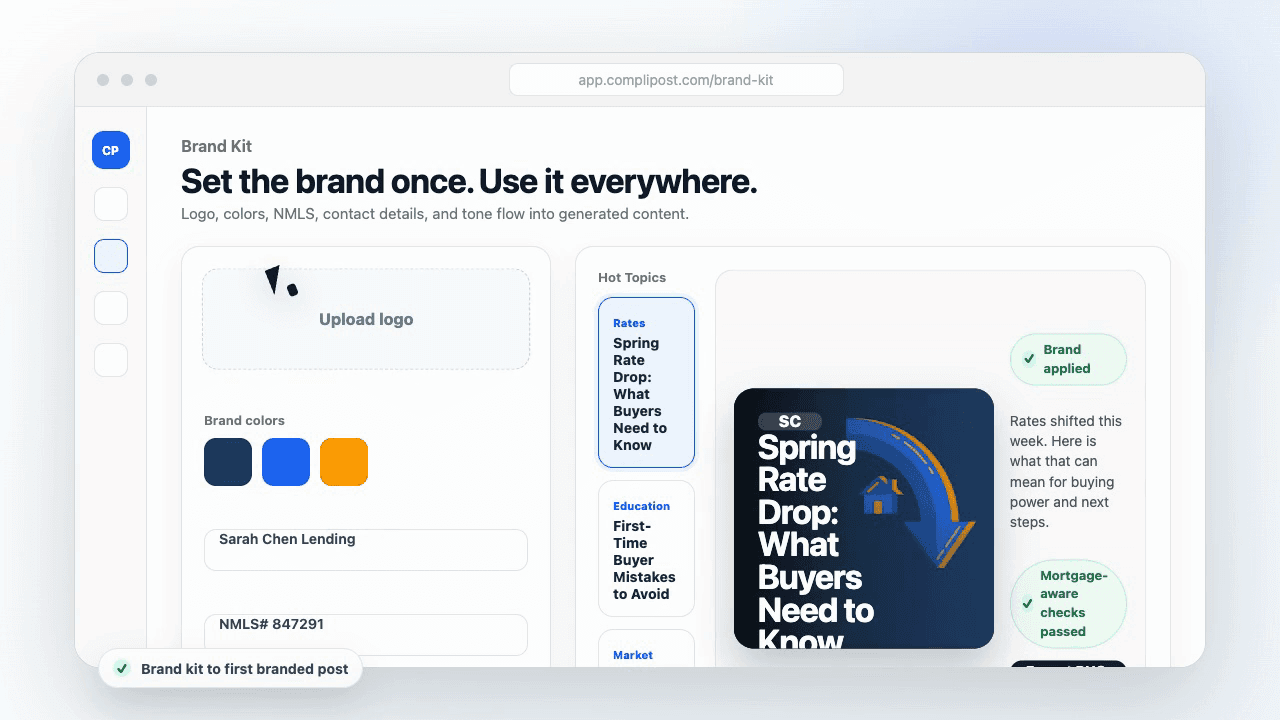
Product workflow
From blank page to export-ready mortgage content
- Start with a borrower topic
- Generate copy and a visual direction
- Review, save, and export the finished asset
These previews reflect the core CompliPost workflow: create, review, save, and export assets for use in your own channels.
Workflow comparison
| Content approach | What happens | Why it matters |
|---|---|---|
| Random posting | One-off ideas created when there is spare time | Inconsistent visibility and weak reuse |
| Template-only posting | Faster design but still requires rewriting and review | Helpful starting point, but not a full system |
| CompliPost workflow | Plan, generate, review, save, and export from one place | Better consistency with mortgage-aware review context |
| Done-for-you service | Someone else creates much of the content | Useful for some teams, but less control and less immediate reuse |
Who this guide helps
This guide is for loan officers working on solo loan officers who need a repeatable mortgage content workflow. The goal is to turn a broad mortgage topic into one borrower question, one useful takeaway, and one asset that can be reviewed before it is shared.
- You need content that sounds like a loan officer, not a generic brand account
- You want examples that can become captions, graphics, GIFs, or PDFs
- You need a clear place to review claims before export
- You want finished work saved for reuse, not lost in a chat thread
A practical workflow for this use case
Start with a narrow scenario, then move through planning, drafting, visual creation, review, and export. For loan officer video hooks, that means the topic should be specific enough that a borrower or referral partner can immediately understand what decision the content helps with.
- Choose the borrower type, loan topic, or platform before generating copy
- Draft the caption and visual together so the asset feels cohesive
- Use the federal baseline review aid to flag claims and disclosure gaps
- Export the finished asset and save the post as a reusable starting point
What makes the content stronger
Strong mortgage content is usually specific, plain-spoken, and calm. It explains tradeoffs without pretending one answer fits every borrower. That is especially important on public social channels, where a short post can be interpreted without the full context of a loan conversation.
- Name the borrower question in the first line
- Explain one decision or tradeoff instead of covering everything
- Use examples without implying approval, savings, or rate outcomes
- End with a soft next step, checklist, or guide rather than pressure
Compliance-aware review notes
CompliPost should be treated as a review aid, not a compliance approval system. The public page, generated draft, graphic, and exported asset should all stay honest about that boundary.
- Review specific payment, APR, rate, savings, and qualification language
- Avoid “best,” “lowest,” “guaranteed,” “free,” and urgency claims unless approved
- Check NMLS, Equal Housing, company, and state-specific requirements
- Use company or legal review for anything outside the federal baseline
How this connects to the rest of CompliPost
A focused guide should leave you with a usable next step. After you understand the topic, you can turn it into a calendar slot, a reviewed social post, a downloadable guide, or a platform-specific version for the channel where your audience already spends time.
- Use the content calendar to turn the idea into a weekly plan
- Use the compliance page when claims or disclosures need a slower pass
- Use lead magnets when the topic deserves a deeper PDF guide
- Use platform pages to adapt the same idea for LinkedIn, Facebook, or Instagram
Recommended next steps
Mortgage social media content
See the cross-platform content workflow for loan officers.
Loan officer video scripts
Full script structure beyond the hook: the middle and close.
Mortgage reel ideas
Reel topics that pair naturally with each hook structure.
TikTok content calendar for loan officers
Plan which hooks to film each week in a sustainable batching system.
Examples
FAQ
How long should a loan officer video hook be?+
Five to eight seconds — one to two sentences. The hook should be complete: it names the audience or the problem, signals what the video delivers, and creates enough curiosity to keep the viewer watching. A hook that runs past ten seconds loses viewers before it has earned their attention.
Should I write hooks before or during filming?+
Before. Write the hook exactly — word for word — before you film. The first sentence is too important to improvise. Once the hook is written, the rest of the script can follow from an outline rather than a full script.
What makes a loan officer video hook compliant?+
A compliant hook names the viewer's situation without implying guaranteed outcomes. "This is for VA buyers who think the funding fee makes the loan not worth it" is compliant — it names the viewer and the concern. "This VA loan eliminates your down payment and saves you thousands" implies a specific outcome and creates compliance exposure.
Do the same hook structures work on TikTok, Reels, and YouTube Shorts?+
Yes. The five hook structures work across all short-form platforms because the viewer behavior is the same — a fast scroll-or-stay decision in the first three to five seconds. The tone can vary slightly by platform (TikTok benefits from a slightly faster, more casual delivery), but the structure is platform-agnostic.
Create mortgage content with a calmer workflow
CompliPost helps you plan, generate, review, save, and export useful mortgage content without pretending compliance or social distribution is automatic.
Start free