Content strategy
Loan officer content creation: DIY from scratch vs. a system built for the workflow
Most loan officers do not have a content problem — they have a structure problem. Creating mortgage content from scratch every week is the approach that leads to "I'll post when I have time," which means rarely posting. A content system built around the lending workflow changes the equation: it does not replace the loan officer's voice, it removes the blank-page barrier that kills cadence.
The real cost of DIY content for loan officers
A 30-day scan of loan-officer social content identified the dominant bottleneck clearly: it is not strategy, and it is not ideas. It is cadence and structure. The loan officers who post inconsistently — or who abandoned their content effort — almost uniformly describe the same pattern: good intentions, a few posts during a slow week, then a closing rush, then silence, then starting over. The "post when I have time" approach is not a scheduling problem; it is a structural one. DIY from scratch means that every post requires a creative decision, a production decision, a compliance check, and a brand decision — all before hitting save. That cognitive load compounds quickly. When the production cycle is expensive enough, the brain defers it. The result is a loan officer who knows what good content looks like but never builds the consistency to make it matter.
What a content system actually changes
A structured content workflow separates the creative decision from the production execution. The loan officer who has a system for converting topic ideas into branded, reviewed, export-ready posts is not doing less creative work — they are doing it more efficiently. The weekly content rhythm that strong-performing loan officers follow (market context Monday, authority post Tuesday, borrower education Wednesday, lead magnet Thursday, relationship post Friday) is not difficult to understand. The difficulty is maintaining it against the competing demands of a closing pipeline. A system that queues content by format type, generates copy and graphics together, and applies a compliance review check before export removes the production friction that breaks cadence.
- Topic-to-asset in one workflow: caption, graphic, and compliance check without switching between tools
- Brand kit applied consistently: colors, fonts, logo, NMLS number on every export
- Federal-baseline compliance review before export: flags risk signals so the loan officer catches them, not the compliance department
- Reusable post library: save the closing story post and repurpose it for a different audience six weeks later
The DIY approach works — under specific conditions
The DIY approach is not wrong. It is right for loan officers who have a dedicated content hour built into their week, who have a marketing background or have already developed a consistent posting habit, who have an internal compliance review process they run before posting, and who are not being recruited away from in-house content team access. Those conditions describe some loan officers — probably fewer than the DIY approach is commonly recommended for. A solo loan officer in a middle-production year, managing a pipeline without support staff and competing with lenders who now offer in-house content teams as a recruiting perk, is not in those conditions. Big lenders have begun dangling in-house marketing support as a recruiting perk specifically because they know production loan officers will not consistently execute solo DIY content creation.
Honest questions to ask before choosing an approach
The right framework is an honest self-assessment of which conditions you are actually in. DIY from scratch makes sense if: you already have a posting habit that held through your last two busy months; you have a compliance review step that runs on every post before it goes out; you enjoy the creative production work and it does not feel like a drain. A structured system makes sense if: your content drops off during pipeline peaks; you are starting from a blank calendar more than twice a month; you are not sure your current compliance review is catching the subtle phrase risks that get loan officers cited. Neither answer is a judgment on work ethic. A system does not replace the loan officer — it removes the friction that stops them.
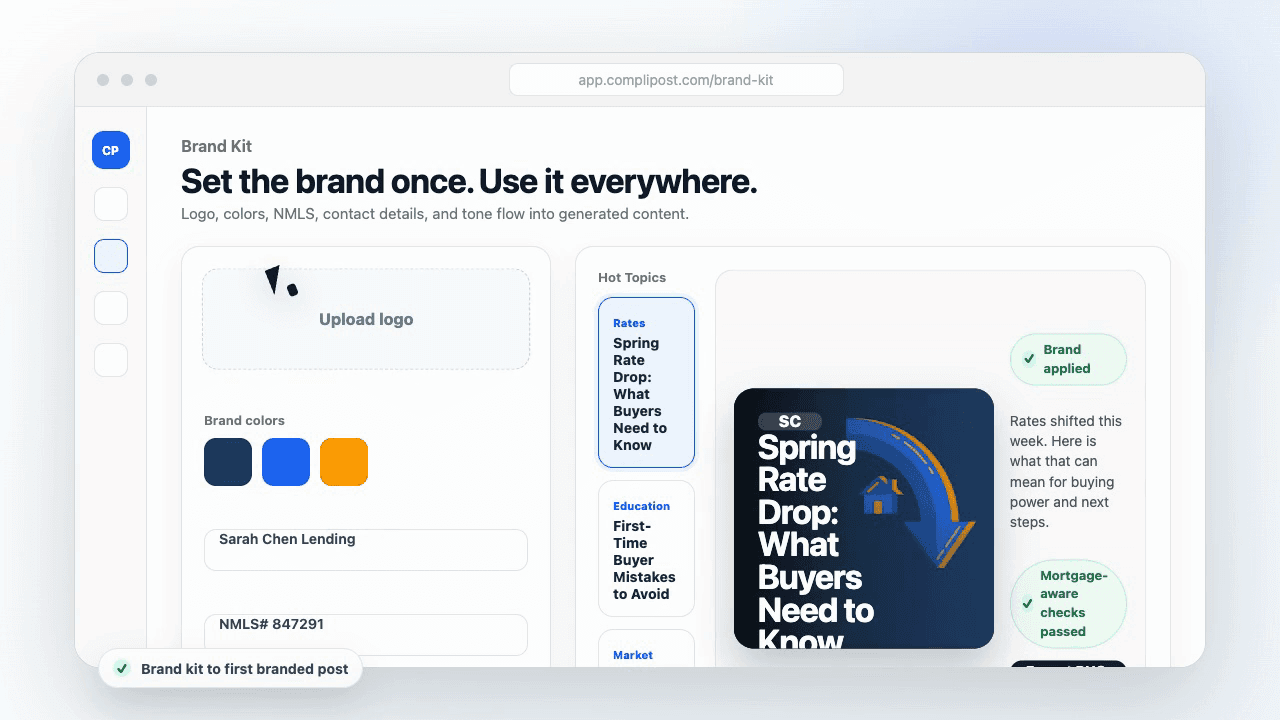
Product workflow
From blank page to export-ready mortgage content
- Start with a borrower topic
- Generate copy and a visual direction
- Review, save, and export the finished asset
These previews reflect the core CompliPost workflow: create, review, save, and export assets for use in your own channels.
Workflow comparison
| Content approach | What happens | Why it matters |
|---|---|---|
| Random posting | One-off ideas created when there is spare time | Inconsistent visibility and weak reuse |
| Template-only posting | Faster design but still requires rewriting and review | Helpful starting point, but not a full system |
| CompliPost workflow | Plan, generate, review, save, and export from one place | Better consistency with mortgage-aware review context |
| Done-for-you service | Someone else creates much of the content | Useful for some teams, but less control and less immediate reuse |
Who this guide helps
This guide is for loan officers working on solo loan officers who need a repeatable mortgage content workflow. The goal is to turn a broad mortgage topic into one borrower question, one useful takeaway, and one asset that can be reviewed before it is shared.
- You need content that sounds like a loan officer, not a generic brand account
- You want examples that can become captions, graphics, GIFs, or PDFs
- You need a clear place to review claims before export
- You want finished work saved for reuse, not lost in a chat thread
A practical workflow for this use case
Start with a narrow scenario, then move through planning, drafting, visual creation, review, and export. For loan officer content creation system, that means the topic should be specific enough that a borrower or referral partner can immediately understand what decision the content helps with.
- Choose the borrower type, loan topic, or platform before generating copy
- Draft the caption and visual together so the asset feels cohesive
- Use the federal baseline review aid to flag claims and disclosure gaps
- Export the finished asset and save the post as a reusable starting point
What makes the content stronger
Strong mortgage content is usually specific, plain-spoken, and calm. It explains tradeoffs without pretending one answer fits every borrower. That is especially important on public social channels, where a short post can be interpreted without the full context of a loan conversation.
- Name the borrower question in the first line
- Explain one decision or tradeoff instead of covering everything
- Use examples without implying approval, savings, or rate outcomes
- End with a soft next step, checklist, or guide rather than pressure
Compliance-aware review notes
CompliPost should be treated as a review aid, not a compliance approval system. The public page, generated draft, graphic, and exported asset should all stay honest about that boundary.
- Review specific payment, APR, rate, savings, and qualification language
- Avoid “best,” “lowest,” “guaranteed,” “free,” and urgency claims unless approved
- Check NMLS, Equal Housing, company, and state-specific requirements
- Use company or legal review for anything outside the federal baseline
How this connects to the rest of CompliPost
A focused guide should leave you with a usable next step. After you understand the topic, you can turn it into a calendar slot, a reviewed social post, a downloadable guide, or a platform-specific version for the channel where your audience already spends time.
- Use the content calendar to turn the idea into a weekly plan
- Use the compliance page when claims or disclosures need a slower pass
- Use lead magnets when the topic deserves a deeper PDF guide
- Use platform pages to adapt the same idea for LinkedIn, Facebook, or Instagram
Recommended next steps
Mortgage social media content
See the cross-platform content workflow for loan officers.
Mortgage content batching
How to create a week of content in one focused session instead of daily scrambling.
Mortgage content strategy
The framework for building a content approach that holds up over time.
Loan officer social media beginners guide
For loan officers starting their content effort without a system in place.
Examples
FAQ
Can loan officers create good social media content on their own?+
Yes — the question is whether they will do it consistently. A 30-day scan of mortgage loan-officer social content found that the dominant bottleneck is cadence and structure, not creative ability. Loan officers who have a good instinct for content often fail to maintain a consistent posting rhythm because the DIY production cycle is expensive enough to defer when the pipeline gets busy.
What does a loan officer content system actually include?+
A content system for loan officers should cover: a workflow that converts topic ideas into branded, review-ready, export-ready posts; consistent brand application (colors, fonts, NMLS, logo); a compliance review check before export that flags common mortgage advertising risk signals; and a library structure for saving and reusing posts. CompliPost is built around this workflow — create, review, save, export — without claiming to handle the posting itself.
Is it a problem if my content is inconsistent during busy months?+
Consistency matters more than volume in mortgage content marketing. Research on LO social content consistently shows the outcome is reputation and trust-building over time — not any single post. An inconsistent pattern that drops off during pipeline peaks creates visible gaps at the exact moment you are most credible. A system that reduces the production load during busy periods is more valuable than extra capacity during slow ones.
How does a content system handle compliance for loan officers?+
CompliPost's federal-baseline review aid runs a check on drafted content and surfaces risk signals — payment claims, certainty language, missing disclosure indicators, fair-lending sensitivity — before you export. It does not replace your company compliance policy or a compliance officer's review. It is an earlier-stage check designed to catch the casual, well-meaning phrase risks that get loan officers cited before the post leaves the draft stage.
Does CompliPost replace a loan officer's voice?+
No. CompliPost generates from the context you provide — your brand kit, your loan type focus, your tone direction — and the output is a starting point you review, edit, and own before exporting. The loan officer's expertise and voice are the input; the system removes the blank-page and production friction, not the human judgment.
What is the honest limitation of a content system?+
A system does not generate relationships, local knowledge, or genuine closing stories — those come from the loan officer. It also does not guarantee compliance; the review aid flags signals, but final responsibility for every post rests with the loan officer and their compliance reviewer. A content system is a production and structure tool, not a substitute for subject matter expertise or a compliance department.
Create mortgage content with a calmer workflow
CompliPost helps you plan, generate, review, save, and export useful mortgage content without pretending compliance or social distribution is automatic.
Start free