Investor Mortgages
Crafting Investor Mortgage Content for Charlotte: DSCR Insights
As a loan officer in Charlotte, you have a unique opportunity to guide real estate investors in navigating the dynamic DSCR landscape. This guide will help you create content that addresses the specific needs and opportunities in the Charlotte market. You'll learn how to highlight neighborhood advantages, portfolio strategies, and the nuances of DSCR lending. By equipping yourself with this knowledge, you can effectively engage with investors looking to optimize their portfolios in Charlotte's diverse real estate market. This gives you a reusable way to teach the topic, write captions, choose a soft call to action, and keep the message inside a safer mortgage marketing lane before you export it.
Key Attractions for Real Estate Investors in Charlotte
Charlotte's real estate market is thriving, offering lucrative opportunities for investors. As a loan officer, you can create content that highlights the city's investor-friendly policies and economic growth. Emphasize the importance of understanding DSCR loan qualifications and how they enable investors to scale their rental portfolios. Discuss neighborhood-specific rental demand and the potential for appreciation, balancing this with cash flow opportunities. By focusing on these elements, you can provide valuable insights that attract and inform potential investors about the benefits of investing in Charlotte. real estate investor mortgage content charlotte caption angle: name.
- Understanding DSCR loan qualifications
- Analyzing neighborhood rental demand
- Opportunities for portfolio scaling
- Balancing appreciation with cash flow
- Investor-friendly economic environment
Neighborhoods in Charlotte: Tailoring Your Content
Different neighborhoods in Charlotte cater to varying investor profiles, making it essential for loan officers to create content that addresses these differences. Urban core neighborhoods may appeal to those seeking high appreciation, while suburban areas might attract investors interested in stable family rentals. Highlight emerging neighborhoods with gentrification potential and those with long-term rental demand. By offering submarket-specific insights, you enable investors to position themselves effectively within the market, ensuring they make informed decisions tailored to their investment strategies. real estate investor mortgage content charlotte borrower.
- Urban core with high appreciation potential
- Suburban areas for family rentals
- Gentrification candidates with growth potential
- Stable neighborhoods with consistent demand
- Balancing value and investment opportunities
Strategies for Building a Strong Investment Portfolio in Charlotte
Loan officers can empower investors by providing content focused on effective portfolio construction strategies in Charlotte. Discuss the importance of diversification and long-term planning, including refinancing strategies and equity extraction. Highlight the advantages of property management at scale and tenant diversification. By offering guidance on these topics, you help investors build robust portfolios that can withstand market fluctuations and maximize returns over time. This positions you as a valuable resource for investors looking to optimize their real estate investments in Charlotte. real estate investor mortgage content charlotte.
- Effective portfolio construction techniques
- Refinancing and leveraging equity
- Managing properties at scale
- Diversifying tenant base
- Planning for long-term portfolio growth
Creating Compelling Mortgage Content for Charlotte Investors
Creating engaging and informative mortgage content for Charlotte investors requires a strategic approach. Loan officers should focus on crafting narratives that resonate with local market conditions and investor goals. Provide insights into DSCR loan processes, timelines, and compliance considerations. Highlight the importance of pre-approval and document preparation in streamlining the loan process. By developing content that addresses these aspects, you not only educate investors but also position yourself as a knowledgeable partner in their investment journey, fostering trust and long-lasting relationships. real estate investor mortgage content charlotte reuse plan: make one caption, one carousel point,.
- Crafting market-relevant narratives
- Understanding DSCR loan processes
- Importance of pre-approval and preparation
- Compliance considerations in lending
- Building trust through informed content
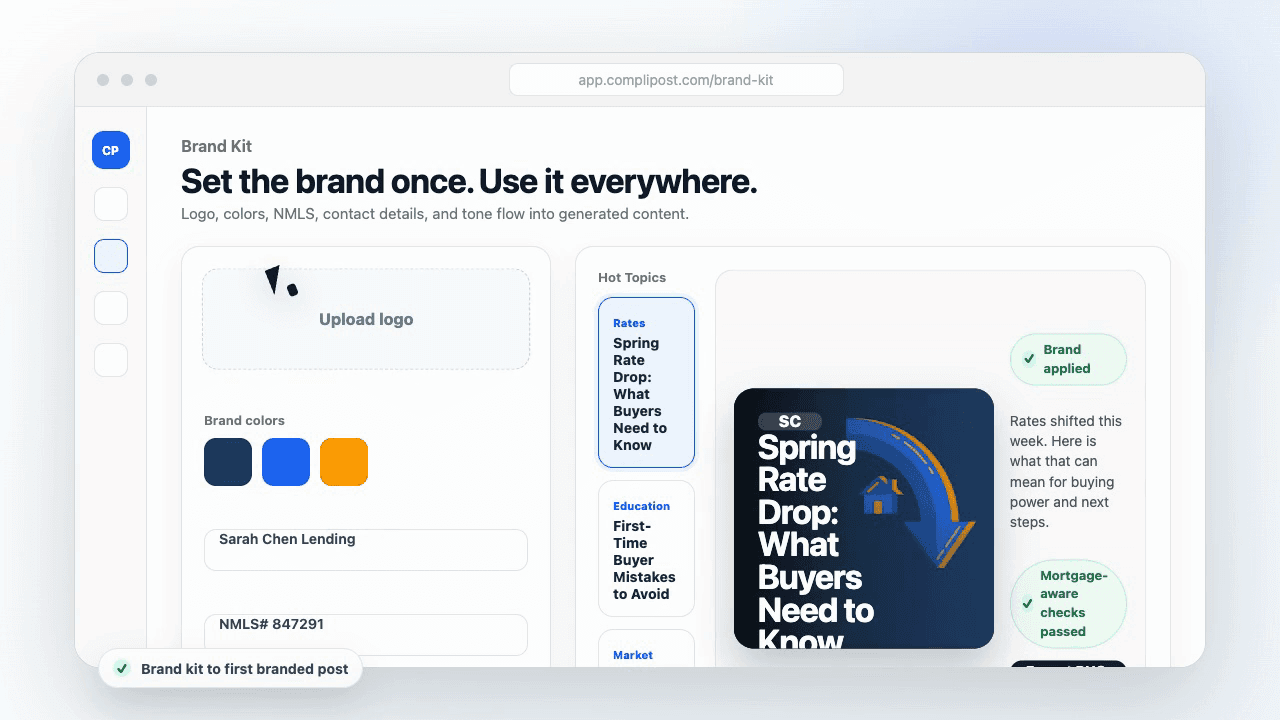
Product workflow
From blank page to export-ready mortgage content
- Start with a borrower topic
- Generate copy and a visual direction
- Review, save, and export the finished asset
These previews reflect the core CompliPost workflow: create, review, save, and export assets for use in your own channels.
Workflow comparison
| Content approach | What happens | Why it matters |
|---|---|---|
| Random posting | One-off ideas created when there is spare time | Inconsistent visibility and weak reuse |
| Template-only posting | Faster design but still requires rewriting and review | Helpful starting point, but not a full system |
| CompliPost workflow | Plan, generate, review, save, and export from one place | Better consistency with mortgage-aware review context |
| Done-for-you service | Someone else creates much of the content | Useful for some teams, but less control and less immediate reuse |
Who this guide helps
This guide is for loan officers working on solo loan officers who need a repeatable mortgage content workflow. The goal is to turn a broad mortgage topic into one borrower question, one useful takeaway, and one asset that can be reviewed before it is shared.
- You need content that sounds like a loan officer, not a generic brand account
- You want examples that can become captions, graphics, GIFs, or PDFs
- You need a clear place to review claims before export
- You want finished work saved for reuse, not lost in a chat thread
A practical workflow for this use case
Start with a narrow scenario, then move through planning, drafting, visual creation, review, and export. For real estate investor mortgage content charlotte, that means the topic should be specific enough that a borrower or referral partner can immediately understand what decision the content helps with.
- Choose the borrower type, loan topic, or platform before generating copy
- Draft the caption and visual together so the asset feels cohesive
- Use the federal baseline review aid to flag claims and disclosure gaps
- Export the finished asset and save the post as a reusable starting point
What makes the content stronger
Strong mortgage content is usually specific, plain-spoken, and calm. It explains tradeoffs without pretending one answer fits every borrower. That is especially important on public social channels, where a short post can be interpreted without the full context of a loan conversation.
- Name the borrower question in the first line
- Explain one decision or tradeoff instead of covering everything
- Use examples without implying approval, savings, or rate outcomes
- End with a soft next step, checklist, or guide rather than pressure
Compliance-aware review notes
CompliPost should be treated as a review aid, not a compliance approval system. The public page, generated draft, graphic, and exported asset should all stay honest about that boundary.
- Review specific payment, APR, rate, savings, and qualification language
- Avoid “best,” “lowest,” “guaranteed,” “free,” and urgency claims unless approved
- Check NMLS, Equal Housing, company, and state-specific requirements
- Use company or legal review for anything outside the federal baseline
How this connects to the rest of CompliPost
A focused guide should leave you with a usable next step. After you understand the topic, you can turn it into a calendar slot, a reviewed social post, a downloadable guide, or a platform-specific version for the channel where your audience already spends time.
- Use the content calendar to turn the idea into a weekly plan
- Use the compliance page when claims or disclosures need a slower pass
- Use lead magnets when the topic deserves a deeper PDF guide
- Use platform pages to adapt the same idea for LinkedIn, Facebook, or Instagram
Recommended next steps
DSCR loan content hub
Create investor-friendly education for DSCR and rental-property financing.
Mortgage content calendar
Plan a weekly rhythm of useful borrower and referral-partner posts.
DSCR Loan New Investor Guide
Foundational DSCR content.
Calendar generator
Turn one mortgage topic into a practical weekly content plan.
Examples
FAQ
What cap rates does this market offer?+
Cap rates in Charlotte vary based on neighborhood conditions and property types. Loan officers should guide investors to research local rental rates and property prices to calculate expected returns. Investors typically aim for a combined cash flow and appreciation rate of 5-7%. The practical move is to keep the answer educational, mention that details vary by borrower profile and lender guidelines, and invite the reader to ask for a personal review instead of implying a certain result.
How much down payment is needed for DSCR loans?+
Down payment requirements for DSCR loans usually range from 20% to 30%. However, some lenders may offer lower requirements with strong financial reserves. The exact amount depends on the property type and the borrower's credit profile and liquidity. The practical move is to keep the answer educational, mention that details vary by borrower profile and lender guidelines, and invite the reader to ask for a personal review instead of implying a certain result.
Can refinancing fund the next property purchase?+
Yes, refinancing can be a strategic tool for investors. After 12-24 months of seasoning, a cash-out refinance can release equity to fund future purchases. This approach allows investors to grow their portfolios without relying heavily on personal income. The practical move is to keep the answer educational, mention that details vary by borrower profile and lender guidelines, and invite the reader to ask for a personal review instead of implying a certain result.
How long does it take to close a DSCR loan?+
Closing a DSCR loan typically takes 30-45 days, depending on the lender and the borrower's preparedness. Loan officers should advise clients to start the pre-approval process early and gather necessary documents promptly to avoid delays. The practical move is to keep the answer educational, mention that details vary by borrower profile and lender guidelines, and invite the reader to ask for a personal review instead of implying a certain result.
Create mortgage content with a calmer workflow
CompliPost helps you plan, generate, review, save, and export useful mortgage content without pretending compliance or social distribution is automatic.
Start free