International borrower strategy
How international income borrowers can navigate mortgages with ease
Loan officers can effectively cater to international income borrowers by providing comprehensive, clear, and reassuring content. These borrowers often self-disqualify due to perceived complexities in their income structures. By proactively addressing their concerns and demystifying the mortgage process, you position yourself as a knowledgeable expert. This guide will help you create content that not only reassures but also educates international income borrowers on how their unique income can be managed within the mortgage qualification process. By focusing on clarity and step-by-step guidance, your content can become an invaluable resource for borrowers looking to understand how their international earnings can support their homeownership goals.
Addressing Common Fears of International Income Borrowers
International income borrowers often fear rejection due to their complex income types. Your content should begin with reassurance, emphasizing that international income can be part of the mortgage process. Educate borrowers on the necessary documentation and procedural steps, making the path clear and accessible. By focusing on what borrowers can do, you alleviate fears and encourage engagement with the mortgage process. Highlighting successful case studies of international income borrowers can further boost confidence. international income borrowers mortgage caption angle: name one borrower decision, add one document cue, close.
- Reassure that international income is manageable within the mortgage process.
- Provide a clear list of required documentation to guide borrowers.
- Explain how currency conversion works, using a trailing 12-month average.
- Share stories of international income borrowers who have successfully closed mortgages.
Effective Content Formats for Engaging International Income Borrowers
When crafting content for international income borrowers, prioritize clarity and detail over brevity. Consider using a variety of formats to address different learning preferences. Detailed blog posts, FAQs, and visual aids like infographics or videos can help explain complex processes in an accessible way. By utilizing multiple content formats, you can ensure that borrowers receive the information they need in a manner that resonates with them. international income borrowers mortgage borrower concern: explain what a lender may verify, why the step matters, and how a reader can prepare. international.
- Create educational carousels showing a step-by-step documentation checklist.
- Write detailed blog posts: "Understanding International Income in Mortgage Qualification."
- Develop FAQ threads addressing common queries from international borrowers.
- Use videos or animations to simplify concepts like currency conversion.
Crucial Messaging Pillars for International Income Borrowers
Your messaging should focus on reassurance, clarity, and an accessible process. Avoid using gatekeeping language that might deter borrowers. Instead, emphasize that international income is verifiable and can be part of a successful mortgage application. By outlining the steps clearly and providing detailed documentation requirements, you build trust and transparency with your audience. This approach ensures borrowers feel supported and informed throughout their mortgage journey. international income borrowers mortgage compliance note: avoid exact terms, certainty language, and rushed decisions. international income borrowers mortgage works better as education.
- Affirm that international income is verifiable and qualifiable.
- Provide clear steps and documentation requirements.
- Share that many have succeeded with international income.
- Avoid surprises by clearly stating what is needed and when.
Leveraging Stories and Examples to Build Trust
Storytelling can be a powerful tool in building trust with international income borrowers. Share success stories and testimonials from previous clients who have navigated the mortgage process with international income. These narratives can serve as both inspiration and reassurance, showing that others have successfully achieved their homeownership goals despite initial concerns. Use these stories to illustrate the practical application of your guidance and the effectiveness of your process. international income borrowers mortgage reuse plan: make one caption, one carousel point, one email follow-up, and one saved template. international.
- Use client testimonials to showcase successful mortgage experiences.
- Highlight the journey of international income borrowers who achieved their goals.
- Incorporate real-life examples in blog posts and videos.
- Utilize these stories in social media posts to reach a broader audience.
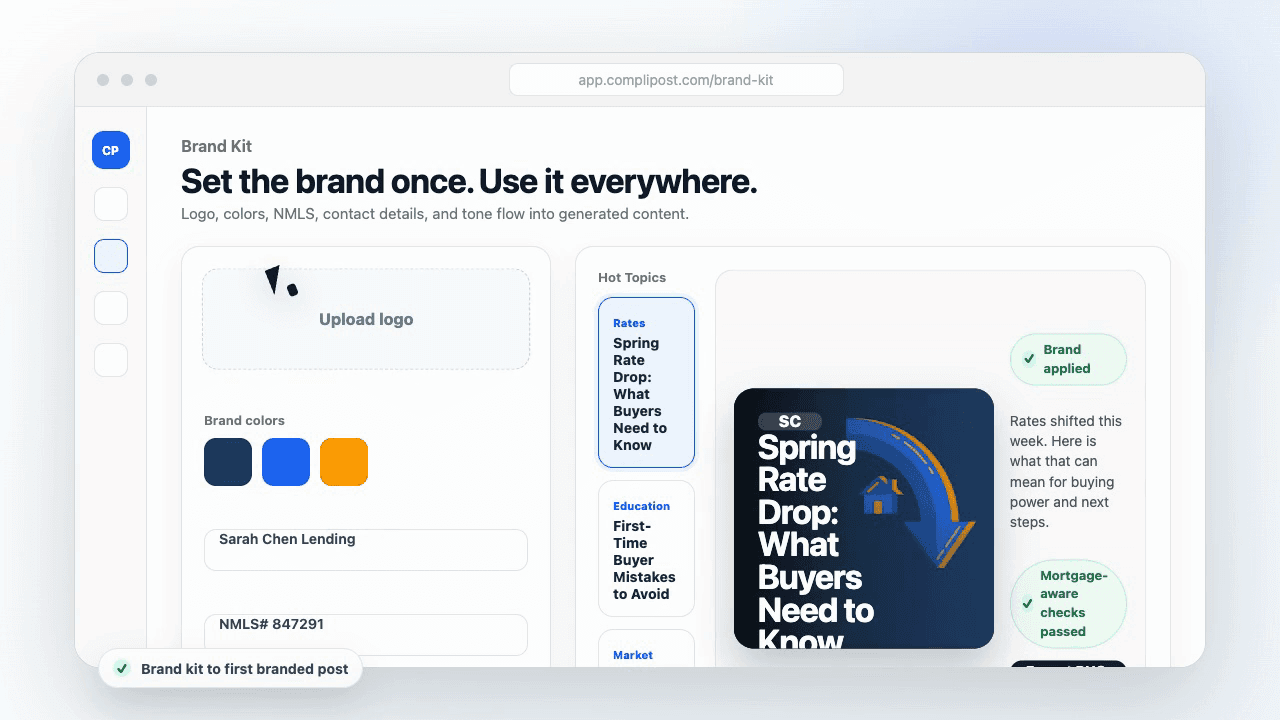
Product workflow
From blank page to export-ready mortgage content
- Start with a borrower topic
- Generate copy and a visual direction
- Review, save, and export the finished asset
These previews reflect the core CompliPost workflow: create, review, save, and export assets for use in your own channels.
Workflow comparison
| Content approach | What happens | Why it matters |
|---|---|---|
| Random posting | One-off ideas created when there is spare time | Inconsistent visibility and weak reuse |
| Template-only posting | Faster design but still requires rewriting and review | Helpful starting point, but not a full system |
| CompliPost workflow | Plan, generate, review, save, and export from one place | Better consistency with mortgage-aware review context |
| Done-for-you service | Someone else creates much of the content | Useful for some teams, but less control and less immediate reuse |
Who this guide helps
This guide is for loan officers working on solo loan officers who need a repeatable mortgage content workflow. The goal is to turn a broad mortgage topic into one borrower question, one useful takeaway, and one asset that can be reviewed before it is shared.
- You need content that sounds like a loan officer, not a generic brand account
- You want examples that can become captions, graphics, GIFs, or PDFs
- You need a clear place to review claims before export
- You want finished work saved for reuse, not lost in a chat thread
A practical workflow for this use case
Start with a narrow scenario, then move through planning, drafting, visual creation, review, and export. For international income borrowers mortgage, that means the topic should be specific enough that a borrower or referral partner can immediately understand what decision the content helps with.
- Choose the borrower type, loan topic, or platform before generating copy
- Draft the caption and visual together so the asset feels cohesive
- Use the federal baseline review aid to flag claims and disclosure gaps
- Export the finished asset and save the post as a reusable starting point
What makes the content stronger
Strong mortgage content is usually specific, plain-spoken, and calm. It explains tradeoffs without pretending one answer fits every borrower. That is especially important on public social channels, where a short post can be interpreted without the full context of a loan conversation.
- Name the borrower question in the first line
- Explain one decision or tradeoff instead of covering everything
- Use examples without implying approval, savings, or rate outcomes
- End with a soft next step, checklist, or guide rather than pressure
Compliance-aware review notes
CompliPost should be treated as a review aid, not a compliance approval system. The public page, generated draft, graphic, and exported asset should all stay honest about that boundary.
- Review specific payment, APR, rate, savings, and qualification language
- Avoid “best,” “lowest,” “guaranteed,” “free,” and urgency claims unless approved
- Check NMLS, Equal Housing, company, and state-specific requirements
- Use company or legal review for anything outside the federal baseline
How this connects to the rest of CompliPost
A focused guide should leave you with a usable next step. After you understand the topic, you can turn it into a calendar slot, a reviewed social post, a downloadable guide, or a platform-specific version for the channel where your audience already spends time.
- Use the content calendar to turn the idea into a weekly plan
- Use the compliance page when claims or disclosures need a slower pass
- Use lead magnets when the topic deserves a deeper PDF guide
- Use platform pages to adapt the same idea for LinkedIn, Facebook, or Instagram
Recommended next steps
Mortgage social media content
See the cross-platform content workflow for loan officers.
Mortgage content calendar
Plan a weekly rhythm of useful borrower and referral-partner posts.
Foreign income mortgage content
Comprehensive strategy for foreign-income borrowers.
Calendar generator
Turn one mortgage topic into a practical weekly content plan.
Examples
FAQ
Do international income borrowers face higher interest rates?+
International income alone doesn't determine rates. Factors like credit score, loan-to-value ratio, and property type are key. Your income source doesn't inherently affect your rate. The practical move is to keep the answer educational, mention that details vary by borrower profile and lender guidelines, and invite the reader to ask for a personal review instead.
What down payment is required for international borrowers?+
Down payment requirements depend on the loan program and credit score. They are similar to domestic borrowers, with some government programs having specific needs. Discuss your options with your loan officer. The practical move is to keep the answer educational, mention that details vary by borrower profile and lender guidelines, and invite the reader to ask.
How do recent arrivals to the US handle mortgage applications?+
Timing impacts documentation. Recent arrivals might need additional papers like visa and work authorization. Certain programs may require US credit history, though alternatives exist. Early discussions with a loan officer are beneficial. The practical move is to keep the answer educational, mention that details vary by borrower profile and lender guidelines, and.
Can a co-signer from outside the US assist in my mortgage application?+
Yes, typically. A non-US citizen co-signer should have a valid visa, work authorization, and an ITIN. Their income and credit can strengthen your application. The practical move is to keep the answer educational, mention that details vary by borrower profile and lender guidelines, and invite the reader to ask for a personal review instead.
Create mortgage content with a calmer workflow
CompliPost helps you plan, generate, review, save, and export useful mortgage content without pretending compliance or social distribution is automatic.
Start free