Investment strategies
House-Hacking: The Path to Multifamily Real Estate Investment
Loan officers can use this topic to create clearer mortgage content without drifting into personal advice. House hacking offers a unique opportunity for real estate investors to enter the market with owner-occupied multifamily properties. By living in one unit and renting out others, investors can benefit from lower interest rates and easier qualification processes typically reserved for primary residences. This content will guide loan officers on how to educate borrowers about the potential returns and strategies involved in house hacking. You'll learn how to communicate the benefits of creative financing options and position house hacking as a valuable entry point into real estate investment. This approach not only assists potential investors in building equity but also helps you establish yourself as a knowledgeable resource in the mortgage industry.
Understanding House Hacking and Its Benefits
House hacking involves purchasing a duplex, triplex, or fourplex as a primary residence. The investor lives in one unit while renting out the remaining units to generate income. This strategy allows for lower down payments and interest rates due to owner-occupied loan terms. By leveraging these benefits, investors can cover a significant portion of their mortgage costs through rental income. This not only makes living expenses more manageable but also accelerates equity building. Loan officers should emphasize the importance of analyzing local rental markets and potential earnings to advise clients effectively. Highlighting these key benefits can make house hacking an appealing option for first-time investors.
Navigating Owner-Occupied Financing
Owner-occupied financing typically offers more favorable terms compared to traditional investment property loans. This is because lenders perceive less risk when the buyer resides in the property. Loan officers should guide potential house hackers through the qualification process, which may include demonstrating the ability to cover the mortgage without relying solely on rental income. It's crucial to educate clients on the implications of temporarily residing in the property and the potential need to comply with occupancy requirements set by lenders. By understanding these nuances, you can better assist clients in taking advantage of owner-occupied financing benefits.
House Hacking as a Real Estate Investment Foundation
For many new investors, house hacking serves as an entry point into real estate. Starting with a smaller multifamily property allows them to gain experience in property management and investment strategies. As equity builds, investors can leverage their initial property to acquire additional investments. Loan officers should position this strategy as a stepping stone towards more extensive real estate portfolios. By providing insights into long-term benefits, such as increased property value and tax advantages, you can help clients see the bigger picture. Emphasizing the educational aspect of house hacking can also attract novice investors eager to learn.
Creative Financing Solutions for House Hackers
Creative financing can enhance the house hacking strategy, offering flexibility and expanded options for investors. Loan officers can introduce clients to various financing solutions such as FHA loans, which require lower down payments for owner-occupied properties. Additionally, discussing conventional loan options and their requirements can provide more tailored solutions. It's important to ensure clients understand compliance with fair lending practices and avoid steering. By offering a comprehensive view of available financing, you empower clients to make informed decisions. This section should also include a compliance note focusing on the Equal Housing and TILA regulations to maintain ethical standards.
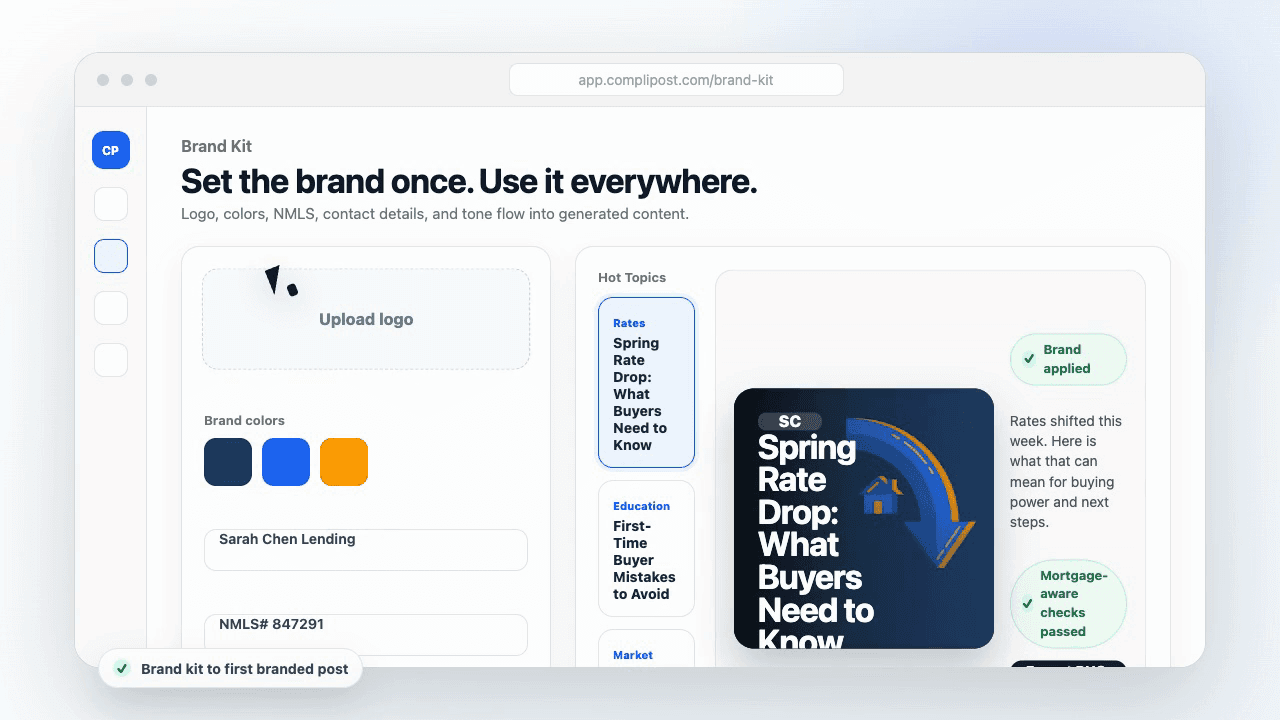
Product workflow
From blank page to export-ready mortgage content
- Start with a borrower topic
- Generate copy and a visual direction
- Review, save, and export the finished asset
These previews reflect the core CompliPost workflow: create, review, save, and export assets for use in your own channels.
Workflow comparison
| Content approach | What happens | Why it matters |
|---|---|---|
| Random posting | One-off ideas created when there is spare time | Inconsistent visibility and weak reuse |
| Template-only posting | Faster design but still requires rewriting and review | Helpful starting point, but not a full system |
| CompliPost workflow | Plan, generate, review, save, and export from one place | Better consistency with mortgage-aware review context |
| Done-for-you service | Someone else creates much of the content | Useful for some teams, but less control and less immediate reuse |
Who this guide helps
This guide is for loan officers working on solo loan officers who need a repeatable mortgage content workflow. The goal is to turn a broad mortgage topic into one borrower question, one useful takeaway, and one asset that can be reviewed before it is shared.
- You need content that sounds like a loan officer, not a generic brand account
- You want examples that can become captions, graphics, GIFs, or PDFs
- You need a clear place to review claims before export
- You want finished work saved for reuse, not lost in a chat thread
A practical workflow for this use case
Start with a narrow scenario, then move through planning, drafting, visual creation, review, and export. For house hacking investor content, that means the topic should be specific enough that a borrower or referral partner can immediately understand what decision the content helps with.
- Choose the borrower type, loan topic, or platform before generating copy
- Draft the caption and visual together so the asset feels cohesive
- Use the federal baseline review aid to flag claims and disclosure gaps
- Export the finished asset and save the post as a reusable starting point
What makes the content stronger
Strong mortgage content is usually specific, plain-spoken, and calm. It explains tradeoffs without pretending one answer fits every borrower. That is especially important on public social channels, where a short post can be interpreted without the full context of a loan conversation.
- Name the borrower question in the first line
- Explain one decision or tradeoff instead of covering everything
- Use examples without implying approval, savings, or rate outcomes
- End with a soft next step, checklist, or guide rather than pressure
Compliance-aware review notes
CompliPost should be treated as a review aid, not a compliance approval system. The public page, generated draft, graphic, and exported asset should all stay honest about that boundary.
- Review specific payment, APR, rate, savings, and qualification language
- Avoid “best,” “lowest,” “guaranteed,” “free,” and urgency claims unless approved
- Check NMLS, Equal Housing, company, and state-specific requirements
- Use company or legal review for anything outside the federal baseline
How this connects to the rest of CompliPost
A focused guide should leave you with a usable next step. After you understand the topic, you can turn it into a calendar slot, a reviewed social post, a downloadable guide, or a platform-specific version for the channel where your audience already spends time.
- Use the content calendar to turn the idea into a weekly plan
- Use the compliance page when claims or disclosures need a slower pass
- Use lead magnets when the topic deserves a deeper PDF guide
- Use platform pages to adapt the same idea for LinkedIn, Facebook, or Instagram
Recommended next steps
DSCR loan content hub
Create investor-friendly education for DSCR and rental-property financing.
Mortgage content calendar
Plan a weekly rhythm of useful borrower and referral-partner posts.
Real estate investing for beginners
Complete first-investment guide.
Calendar generator
Turn one mortgage topic into a practical weekly content plan.
Examples
FAQ
What is house hacking?+
House hacking involves purchasing a multifamily property, such as a duplex or triplex, and living in one unit while renting out others. This strategy allows investors to use rental income to offset mortgage payments, making it a cost-effective entry into real estate investing. By living in the property, investors benefit from lower interest rates and down payment requirements typical of owner-occupied loans.
How does owner-occupied financing work?+
Owner-occupied financing offers more favorable terms than traditional investment property loans. Lenders provide lower interest rates and down payments when the buyer lives in the property. This is because residing in the property is seen as reducing risk. Loan officers should guide clients through the qualification process, ensuring they meet occupancy and income requirements without relying solely on rental income.
What are the benefits of starting with house hacking?+
House hacking provides a practical entry into real estate investment, allowing new investors to gain experience in property management and investment strategies. It builds equity and offers potential tax advantages. As investors become more experienced, they can leverage their initial property to acquire additional assets, ultimately expanding their real estate portfolio.
What creative financing options are available for house hackers?+
Creative financing options for house hackers include FHA loans, which offer lower down payment requirements for owner-occupied properties. Conventional loans may also be used, depending on individual circumstances. Loan officers should ensure clients understand fair lending practices and avoid steering. By exploring various financing avenues, investors can find solutions that strong suit their needs while complying with regulations.
Create mortgage content with a calmer workflow
CompliPost helps you plan, generate, review, save, and export useful mortgage content without pretending compliance or social distribution is automatic.
Start free