Global Borrower Series
Build Mortgage Qualification with Rent History When You Have No Credit Score
Many global borrowers pay rent consistently but have no U.S. credit score. Good news: consistent rent payment history (12+ months) documented by landlord letters counts as credit for mortgage qualification. It's one of the strongest alternative credit sources. Help borrowers gather rent documentation upfront and understand that being a reliable tenant proves mortgage reliability.
What Rent History Documentation Lenders Accept
Lenders need: landlord/property manager letter on official letterhead confirming borrower name, lease dates, monthly rent, and payment record (on-time, late, missed payments). Digital proof also works: cancelled checks with 'rent' memo, bank statements showing regular rent transfers, or lease agreement plus lease compliance statement. More documentation = more confidence in underwriting.
- Landlord letter: confirms tenant name, lease dates, monthly rent, payment history
- Letter should specify 'On-time payments' or list any late/missed payments (transparency helps)
- Cancelled rent checks or transfer records (12+ months) with 'rent' memo
- Bank statements showing regular monthly transfers to landlord (pattern = proof)
- Lease agreement + letter from landlord confirming lease compliance (no evictions/violations)
Timeline and Documentation Gathering
Build rent documentation systematically. If renting month-to-month without a formal lease, ask landlord for a letter. If paying in person, ask for receipts or a payment history document. Start gathering documentation 3–6 months before mortgage application. Lenders prefer 12+ months of consistent rent history; 24 months is ideal.
- Start gathering rent documentation early (3–6 months before mortgage application)
- Request landlord letter even if you have informal arrangement
- Save all rent payment receipts, cancelled checks, or bank transfer records
- If renting, ask landlord in writing for payment history confirmation (creates paper trail)
- 12+ months of documented rent history is standard minimum; 24 months is stronger
Rent History with Other Alternative Credit
Rent history is powerful but often used alongside other alternative credit: utility bills, insurance payments, phone bills, international credit reports. Lenders build a 'full picture' of creditworthiness using multiple sources. Help borrowers gather 2–3 years of utility and phone bills showing consistent, on-time payments alongside rent history.
- Rent history + utility/phone bills = strong alternative credit profile
- Utility payment letters from providers (electric, water, gas) documenting on-time history
- Phone/internet bill statements or letters confirming payment history
- Insurance payment records (auto, renters, life insurance) showing consistency
- International credit reports (translated to English) supplement U.S. rent history
When Rent History Alone May Not Be Sufficient
Rent history alone rarely qualifies without income documentation and some credit history. Lenders need: strong income (documented via W-2s or tax returns), down payment proof, and often some established credit or alternative credit beyond rent. Manual underwriting accepts rent history; it just requires comprehensive documentation overall.
- Rent history + strong income (W-2s, tax returns) = qualification likely
- Rent history + alternative credit (utilities, phone) + income = strongest position
- Down payment (15–20%) compensates for weak credit if rent history is strong
- Debt-to-income ratio matters: even strong rent history doesn't overcome high debt loads
- Manual underwriting: loan officer reviews full picture, not just credit score
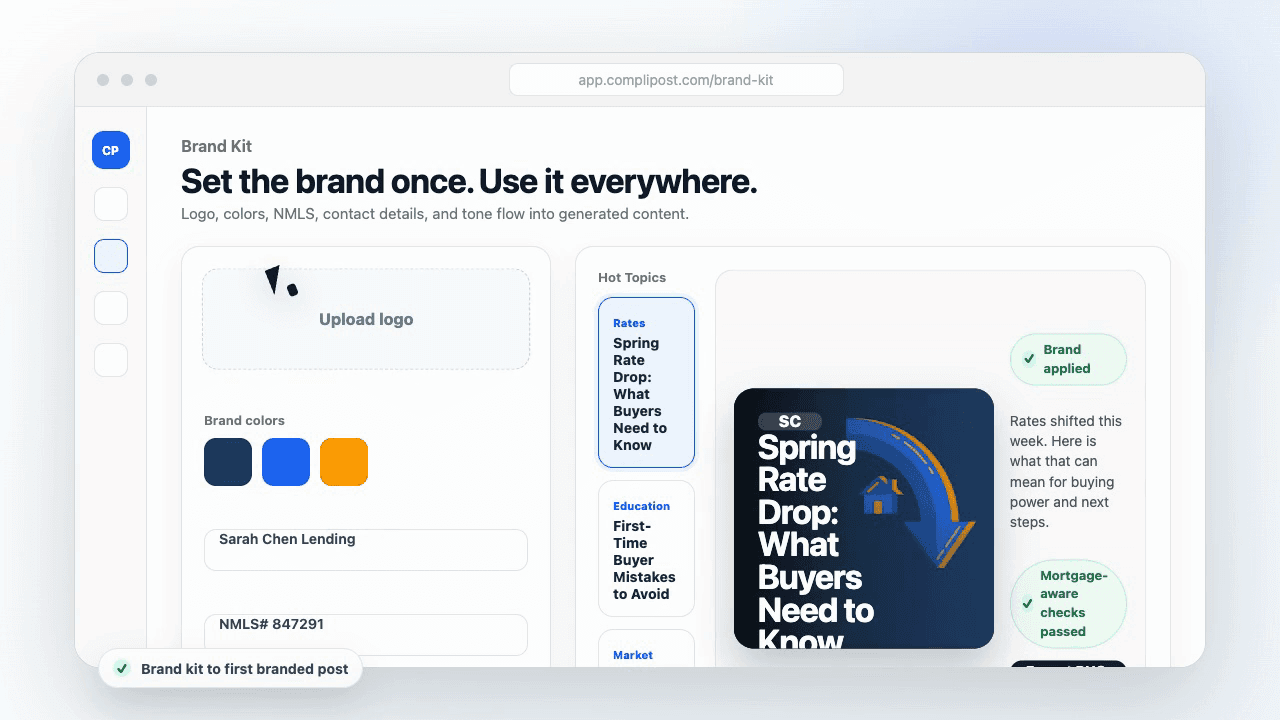
Product workflow
From blank page to export-ready mortgage content
- Start with a borrower topic
- Generate copy and a visual direction
- Review, save, and export the finished asset
These previews reflect the core CompliPost workflow: create, review, save, and export assets for use in your own channels.
Workflow comparison
| Content approach | What happens | Why it matters |
|---|---|---|
| Random posting | One-off ideas created when there is spare time | Inconsistent visibility and weak reuse |
| Template-only posting | Faster design but still requires rewriting and review | Helpful starting point, but not a full system |
| CompliPost workflow | Plan, generate, review, save, and export from one place | Better consistency with mortgage-aware review context |
| Done-for-you service | Someone else creates much of the content | Useful for some teams, but less control and less immediate reuse |
Who this guide helps
This guide is for loan officers working on solo loan officers who need a repeatable mortgage content workflow. The goal is to turn a broad mortgage topic into one borrower question, one useful takeaway, and one asset that can be reviewed before it is shared.
- You need content that sounds like a loan officer, not a generic brand account
- You want examples that can become captions, graphics, GIFs, or PDFs
- You need a clear place to review claims before export
- You want finished work saved for reuse, not lost in a chat thread
A practical workflow for this use case
Start with a narrow scenario, then move through planning, drafting, visual creation, review, and export. For rent history mortgage credit alternative, that means the topic should be specific enough that a borrower or referral partner can immediately understand what decision the content helps with.
- Choose the borrower type, loan topic, or platform before generating copy
- Draft the caption and visual together so the asset feels cohesive
- Use the federal baseline review aid to flag claims and disclosure gaps
- Export the finished asset and save the post as a reusable starting point
What makes the content stronger
Strong mortgage content is usually specific, plain-spoken, and calm. It explains tradeoffs without pretending one answer fits every borrower. That is especially important on public social channels, where a short post can be interpreted without the full context of a loan conversation.
- Name the borrower question in the first line
- Explain one decision or tradeoff instead of covering everything
- Use examples without implying approval, savings, or rate outcomes
- End with a soft next step, checklist, or guide rather than pressure
Compliance-aware review notes
CompliPost should be treated as a review aid, not a compliance approval system. The public page, generated draft, graphic, and exported asset should all stay honest about that boundary.
- Review specific payment, APR, rate, savings, and qualification language
- Avoid “best,” “lowest,” “guaranteed,” “free,” and urgency claims unless approved
- Check NMLS, Equal Housing, company, and state-specific requirements
- Use company or legal review for anything outside the federal baseline
How this connects to the rest of CompliPost
A focused guide should leave you with a usable next step. After you understand the topic, you can turn it into a calendar slot, a reviewed social post, a downloadable guide, or a platform-specific version for the channel where your audience already spends time.
- Use the content calendar to turn the idea into a weekly plan
- Use the compliance page when claims or disclosures need a slower pass
- Use lead magnets when the topic deserves a deeper PDF guide
- Use platform pages to adapt the same idea for LinkedIn, Facebook, or Instagram
Recommended next steps
Instagram content hub
Create visual mortgage education for carousels, reels, and stories.
Non-Traditional Credit Mortgages
Comprehensive guide to alternative credit methods and manual underwriting.
Building U.S. Credit for Newcomers
Credit-building strategies; rent history is one component.
How Credit Score Affects Mortgage Approval
General credit score guide; this page focuses on alternatives for those without scores.
Examples
FAQ
How much rent history do I need to qualify for a mortgage?+
12+ months of documented rent history is the standard minimum. 24+ months (2 years) is stronger. Lenders want to see a pattern of on-time payments. If you have perfect rent history for 24 months, it's often as valuable as a 700+ credit score for alternative credit qualification.
Can rent history alone qualify me for a mortgage?+
Rent history helps significantly, but lenders also need: strong income documentation (W-2s or tax returns), proof of down payment funds, and often some additional credit (utilities, phone bills, or a secured credit card). Manual underwriting considers the full picture. Rent history is a cornerstone, not the only factor.
My landlord won't provide a letter. What can I do?+
Provide alternative proof: cancelled rent checks with 'rent' memo written on them, bank statements showing monthly transfers to your landlord, or a lease agreement. Digital proof of consistent monthly payments is almost as strong as a landlord letter. If you have pay stubs or tax documents showing your address matching the lease, that corroborates.
Does one late rent payment hurt my alternative credit qualification?+
It depends on context. One late payment in 24+ months of otherwise perfect history is minor and often forgiven in manual underwriting. Multiple late payments (2+) or consistent tardiness hurt qualification. Transparency helps: the landlord letter should truthfully report any late payments; trying to hide them creates bigger problems if discovered.
Can I use international rent history to qualify?+
Most lenders prefer U.S. rent history. International rent history (letters translated to English) can supplement U.S. documentation if available, but doesn't replace U.S. rent history. If you're new to the U.S. and have no U.S. rent history, build it for 12+ months before applying. International documentation is nice to have but not primary.
Create mortgage content with a calmer workflow
CompliPost helps you plan, generate, review, save, and export useful mortgage content without pretending compliance or social distribution is automatic.
Start free