Global Borrower Series
Help Newcomers Plan for Homeownership: Financial Setup and Timeline
Many newcomers arrive with determination to build wealth and buy homes, but don't know where to start. Building credit, saving for down payments, and understanding U.S. lending all take time. Your role is to create a realistic roadmap: open a U.S. bank account, establish credit, save for down payment, then apply. A 2–3 year timeline is honest and healthy; rushing creates stress.
Financial Foundation: Bank Accounts and Basic Credit
First step: open a U.S. bank account. Many newcomers use wire transfers or remittances; a U.S. bank account simplifies income deposits and builds a paper trail lenders need. Next, establish credit (secured card, authorized user status, or credit-builder loan). Don't rush. Consistent, boring financial habits (on-time payments, low balances, savings) matter far more than perfect credit.
- Opening a U.S. bank account is first step; most banks accept ITIN or passport
- Direct deposit of paychecks into U.S. account builds income documentation for lenders
- Secured credit card or authorized user status establishes U.S. credit within 6 months
- Credit-builder loan (through credit union) lets you borrow against savings; builds credit + savings
- Consistency matters more than speed; 12–24 months of boring financial habits is realistic
Down Payment Savings and Gift Fund Strategies
Saving 10–20% for down payment takes time. Help newcomers set monthly savings goals aligned with their income. If family abroad wants to gift money, explain the process upfront—gift documentation and seasoning requirements are manageable but need planning. A down payment savings plan shared with family abroad can coordinate financial support.
- Down payment targets: 10% (minimum, easier to find lender), 15–20% (better rates), 20%+ (no PMI required)
- Monthly savings goals: $500–$1,500/month is realistic for most newcomer incomes
- Separate savings account clearly labeled 'home down payment' reinforces commitment
- Family gifts are allowed; gift letter + wire records + 2-month seasoning required
- Co-signer parents or relatives can help with down payment or co-borrow
Building Emergency Fund Alongside Down Payment Fund
Newcomers often save single-mindedly for down payment and underestimate closing costs + moving + repairs. Encourage dual savings: 10% to down payment, 5% to emergency fund. A healthy emergency fund (3 months expenses) prevents financial crisis post-closing. Lenders also favor borrowers with reserves (savings after down payment paid).
- Down payment savings (10–20% of home price) is one bucket
- Closing costs (2–5% of purchase price) are separate; don't surprise borrowers
- Emergency fund (3–6 months expenses) prevents crisis if job changes or emergency arises
- Lenders favor borrowers with reserves after down payment paid; shows financial stability
- Realistic total savings goal: down payment + closing costs + emergency fund
Realistic Homebuying Timeline for Newcomers
Honest timeline: 2–3 years from arrival to first home purchase. Year 1: establish credit, open bank account, build income history. Year 2: reach down payment savings goal, strengthen credit score, prepare documentation. Year 3: apply for mortgage, qualify, close. This timeline isn't pessimistic—it's healthy. Rushing creates financial stress.
- Year 1: establish U.S. financial footprint, credit, employment income documentation
- Year 2: accumulate down payment savings, strengthen credit, prepare IRS tax returns (if self-employed)
- Year 3: apply for mortgage, qualify, close on first home
- Some borrowers qualify faster (especially with good credit/high income); others need 3+ years
- Communicate timeline honestly; builds trust and prevents frustration
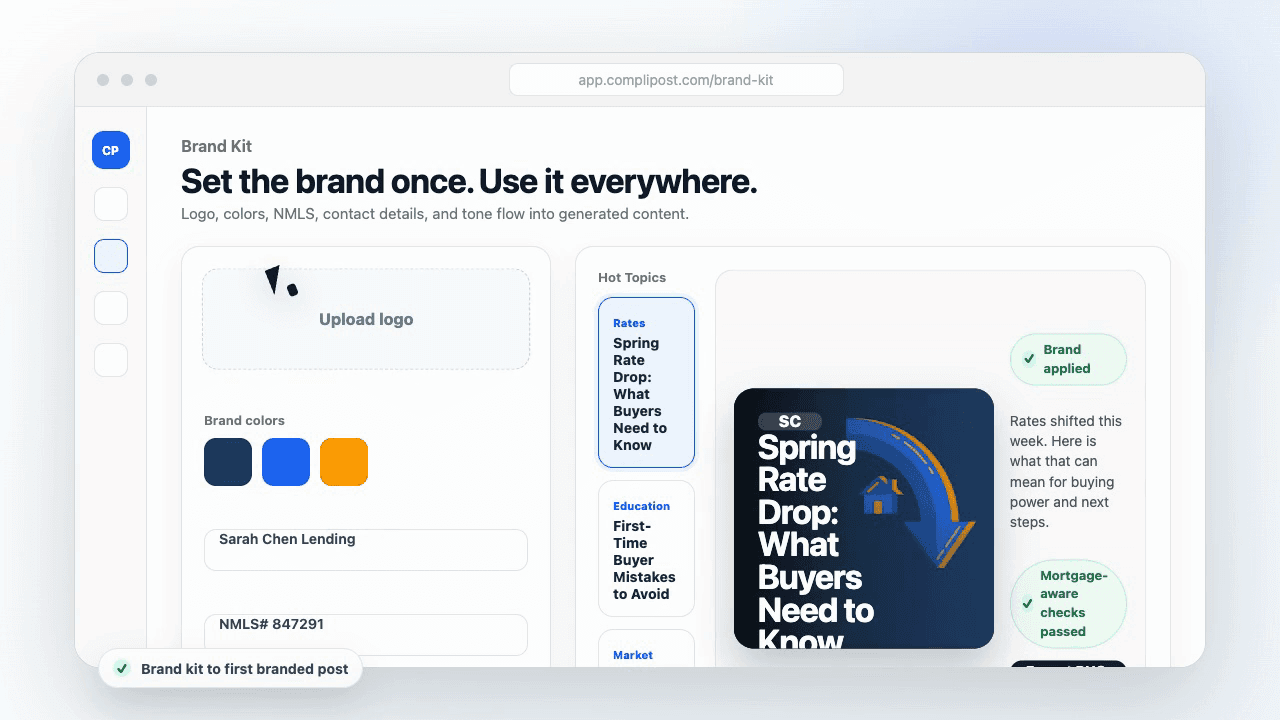
Product workflow
From blank page to export-ready mortgage content
- Start with a borrower topic
- Generate copy and a visual direction
- Review, save, and export the finished asset
These previews reflect the core CompliPost workflow: create, review, save, and export assets for use in your own channels.
Workflow comparison
| Content approach | What happens | Why it matters |
|---|---|---|
| Random posting | One-off ideas created when there is spare time | Inconsistent visibility and weak reuse |
| Template-only posting | Faster design but still requires rewriting and review | Helpful starting point, but not a full system |
| CompliPost workflow | Plan, generate, review, save, and export from one place | Better consistency with mortgage-aware review context |
| Done-for-you service | Someone else creates much of the content | Useful for some teams, but less control and less immediate reuse |
Who this guide helps
This guide is for loan officers working on solo loan officers who need a repeatable mortgage content workflow. The goal is to turn a broad mortgage topic into one borrower question, one useful takeaway, and one asset that can be reviewed before it is shared.
- You need content that sounds like a loan officer, not a generic brand account
- You want examples that can become captions, graphics, GIFs, or PDFs
- You need a clear place to review claims before export
- You want finished work saved for reuse, not lost in a chat thread
A practical workflow for this use case
Start with a narrow scenario, then move through planning, drafting, visual creation, review, and export. For newcomer homebuying preparation timeline, that means the topic should be specific enough that a borrower or referral partner can immediately understand what decision the content helps with.
- Choose the borrower type, loan topic, or platform before generating copy
- Draft the caption and visual together so the asset feels cohesive
- Use the federal baseline review aid to flag claims and disclosure gaps
- Export the finished asset and save the post as a reusable starting point
What makes the content stronger
Strong mortgage content is usually specific, plain-spoken, and calm. It explains tradeoffs without pretending one answer fits every borrower. That is especially important on public social channels, where a short post can be interpreted without the full context of a loan conversation.
- Name the borrower question in the first line
- Explain one decision or tradeoff instead of covering everything
- Use examples without implying approval, savings, or rate outcomes
- End with a soft next step, checklist, or guide rather than pressure
Compliance-aware review notes
CompliPost should be treated as a review aid, not a compliance approval system. The public page, generated draft, graphic, and exported asset should all stay honest about that boundary.
- Review specific payment, APR, rate, savings, and qualification language
- Avoid “best,” “lowest,” “guaranteed,” “free,” and urgency claims unless approved
- Check NMLS, Equal Housing, company, and state-specific requirements
- Use company or legal review for anything outside the federal baseline
How this connects to the rest of CompliPost
A focused guide should leave you with a usable next step. After you understand the topic, you can turn it into a calendar slot, a reviewed social post, a downloadable guide, or a platform-specific version for the channel where your audience already spends time.
- Use the content calendar to turn the idea into a weekly plan
- Use the compliance page when claims or disclosures need a slower pass
- Use lead magnets when the topic deserves a deeper PDF guide
- Use platform pages to adapt the same idea for LinkedIn, Facebook, or Instagram
Recommended next steps
Mortgage social media content
See the cross-platform content workflow for loan officers.
Building U.S. Credit for Newcomers
Detailed strategies for credit building and credit acceleration.
Down Payment and Assistance Programs
Programs and strategies to reduce down payment burden for first-time buyers.
Closing Costs Explained
Breakdown of closing costs and strategies to manage them.
Examples
FAQ
How long should I wait before applying for a mortgage after arriving in the U.S.?+
2–3 years is realistic. Year 1: open bank account, establish credit, build income documentation. Year 2: accumulate down payment savings, strengthen credit score. Year 3: apply. This timeline is not arbitrary—it reflects how lenders assess stability and creditworthiness. Some borrowers qualify faster with high income and good credit; others need longer. Be honest about your timeline.
Can my family abroad send me down payment money?+
Yes. Gift funds from family are allowed. You'll need a gift letter stating funds are a gift (not a loan), wire transfer records showing where funds came from, and the funds must be in your U.S. account for 2+ months before closing (seasoning requirement). Plan timing upfront; don't wire money at the last minute.
Do I need to save for closing costs in addition to down payment?+
Yes. Down payment (10–20% of purchase price) plus closing costs (2–5% of purchase price) total your out-of-pocket spending. Some lenders offer down payment assistance or closing cost credits. Build your savings plan to cover both, or explore programs that reduce closing costs. Don't be surprised by closing costs at the end.
Should I start saving for down payment or building credit first?+
Both simultaneously, but credit first. Secured credit card or authorized user status takes priority (establishes credit within 6 months). While credit builds, start monthly down payment savings. After 12–18 months, you'll have both credit history and down payment progress. Parallel progress is most efficient.
What if I've been in the U.S. less than two years and want to buy now?+
Alternative credit and manual underwriting exist. If you have strong income (W-2s or 1099s for 12+ months), can show rent payment history, have family gifts for down payment, and have a small amount of established U.S. credit, some lenders will consider you. Timeline may be longer, and rates may be higher, but approval is possible. Shop multiple lenders.
Create mortgage content with a calmer workflow
CompliPost helps you plan, generate, review, save, and export useful mortgage content without pretending compliance or social distribution is automatic.
Start free