Global Borrower Series
Serve Borrowers Whose Primary Language Is Not English Effectively
Language barriers create anxiety and slow down mortgages. Professional interpreters, translated documents, and clear communication patterns make the difference between a stressed borrower and a confident one. This guide helps loan officers communicate effectively across language gaps, prevent misunderstandings, and earn trust from borrowers navigating mortgages in a non-native language.
Professional Interpreters vs. Family Members
Always use professional interpreters, never family members. Family members may not understand financial terminology, may have personal interests in the outcome, or may translate poorly. Professional interpreters (certified if possible) are impartial, trained, and accountable. Budget for interpreters; cost is modest compared to closing delays caused by miscommunication.
- Professional interpreters trained in financial/legal terminology
- Certified interpreters (CCHI, RID, state credentials) are preferred
- Avoid using family members: conflict of interest, accuracy issues, terminology gaps
- Interpreter costs: typically $50–$150/hour; budget $300–$600 for typical mortgage process
- Video interpreting available for calls; in-person interpreting for closing documents
Written Materials in Borrower's Language
Provide written materials in the borrower's primary language when available. Many lenders have Spanish, Mandarin, and Vietnamese documents. For other languages, professional translation is worth the cost. Borrowers appreciate written materials; it reduces anxiety and gives them time to process information.
- Core documents translated: application summary, timeline, document checklist, FAQ
- Spanish materials widely available from lenders; request proactively
- For other languages, professional translation costs $500–$1,000 but prevents confusion
- Visual aids (timelines, checklists) work across languages; create these proactively
- Emailed written summaries after phone calls let borrower review and ask questions later
Communication Strategies and Confirmation Protocols
Speak slowly, use simple English (avoid jargon), confirm understanding frequently. After every call, send a written summary: 'We discussed X. You will do Y. I will do Z by [date].' Ask borrower to confirm receipt and understanding. This prevents magical thinking and misalignment.
- Speak slowly and clearly; avoid slang, idioms, and complex financial jargon
- Pause frequently; invite questions: 'Do you understand so far? Any questions?'
- Written summary after every call documenting what was discussed and next steps
- Visual timeline showing milestones: application → underwriting → appraisal → closing
- Confirm understanding: 'Let me recap what we discussed. Here's what I heard: [summary]. Is that correct?'
Document and Process Transparency
Borrowers from different countries may have unfamiliar lending processes. U.S. mortgages involve appraisals, underwriting, title searches—concepts that may not exist in borrower's home country. Explain each step in simple language, why it exists, what to expect. Video walkthroughs of the process build confidence.
- Explain appraisal: lender's inspection to verify property value (not borrower's cost)
- Explain underwriting: lender's review of finances, not a judgment of borrower
- Explain title search: verifying property ownership and lien history
- Explain closing: final signing, funds transfer, recording of deed
- Create video walkthroughs (2–3 minutes) showing each step; post on website
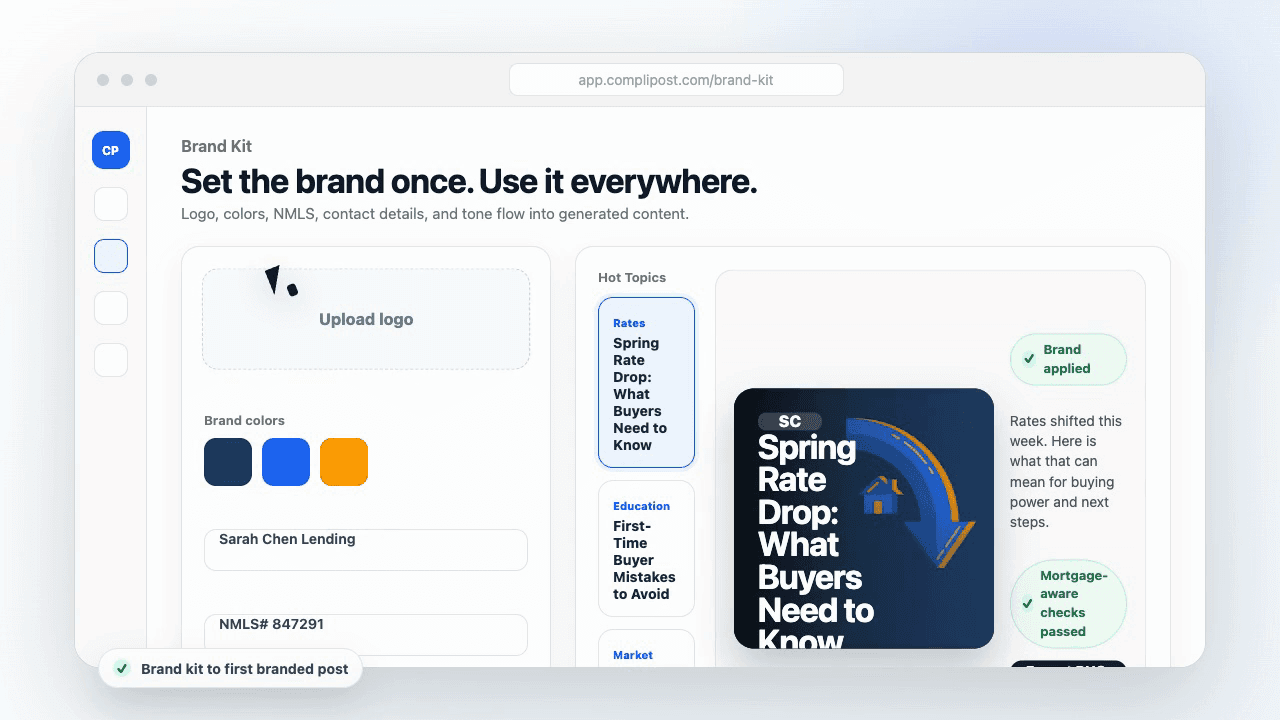
Product workflow
From blank page to export-ready mortgage content
- Start with a borrower topic
- Generate copy and a visual direction
- Review, save, and export the finished asset
These previews reflect the core CompliPost workflow: create, review, save, and export assets for use in your own channels.
Workflow comparison
| Content approach | What happens | Why it matters |
|---|---|---|
| Random posting | One-off ideas created when there is spare time | Inconsistent visibility and weak reuse |
| Template-only posting | Faster design but still requires rewriting and review | Helpful starting point, but not a full system |
| CompliPost workflow | Plan, generate, review, save, and export from one place | Better consistency with mortgage-aware review context |
| Done-for-you service | Someone else creates much of the content | Useful for some teams, but less control and less immediate reuse |
Who this guide helps
This guide is for loan officers working on solo loan officers who need a repeatable mortgage content workflow. The goal is to turn a broad mortgage topic into one borrower question, one useful takeaway, and one asset that can be reviewed before it is shared.
- You need content that sounds like a loan officer, not a generic brand account
- You want examples that can become captions, graphics, GIFs, or PDFs
- You need a clear place to review claims before export
- You want finished work saved for reuse, not lost in a chat thread
A practical workflow for this use case
Start with a narrow scenario, then move through planning, drafting, visual creation, review, and export. For language barriers mortgage accommodations, that means the topic should be specific enough that a borrower or referral partner can immediately understand what decision the content helps with.
- Choose the borrower type, loan topic, or platform before generating copy
- Draft the caption and visual together so the asset feels cohesive
- Use the federal baseline review aid to flag claims and disclosure gaps
- Export the finished asset and save the post as a reusable starting point
What makes the content stronger
Strong mortgage content is usually specific, plain-spoken, and calm. It explains tradeoffs without pretending one answer fits every borrower. That is especially important on public social channels, where a short post can be interpreted without the full context of a loan conversation.
- Name the borrower question in the first line
- Explain one decision or tradeoff instead of covering everything
- Use examples without implying approval, savings, or rate outcomes
- End with a soft next step, checklist, or guide rather than pressure
Compliance-aware review notes
CompliPost should be treated as a review aid, not a compliance approval system. The public page, generated draft, graphic, and exported asset should all stay honest about that boundary.
- Review specific payment, APR, rate, savings, and qualification language
- Avoid “best,” “lowest,” “guaranteed,” “free,” and urgency claims unless approved
- Check NMLS, Equal Housing, company, and state-specific requirements
- Use company or legal review for anything outside the federal baseline
How this connects to the rest of CompliPost
A focused guide should leave you with a usable next step. After you understand the topic, you can turn it into a calendar slot, a reviewed social post, a downloadable guide, or a platform-specific version for the channel where your audience already spends time.
- Use the content calendar to turn the idea into a weekly plan
- Use the compliance page when claims or disclosures need a slower pass
- Use lead magnets when the topic deserves a deeper PDF guide
- Use platform pages to adapt the same idea for LinkedIn, Facebook, or Instagram
Recommended next steps
Mortgage social media content
See the cross-platform content workflow for loan officers.
Cultural Communication Strategies
Broader strategies for cross-cultural communication with global borrowers.
Equal Housing and Fair Lending
Legal requirements for fair lending and equal service across language groups.
Loan Officer Personal Brand
Building trust through clear, inclusive communication.
Examples
FAQ
Is it illegal to use family members as interpreters?+
Not illegal, but not recommended. Lenders prefer independent interpreters to avoid conflict of interest. Some lenders specifically require professional interpreters for mortgage closing. Family members may not understand financial terminology accurately, creating misunderstandings. Invest in professional interpretation; it's cost-effective compared to closing delays.
How much does professional interpretation cost?+
Typically $50–$150/hour. A full mortgage process (application through closing) uses 6–10 hours of interpretation ($300–$1,500 total). This is modest compared to home purchase cost. Phone interpretation is cheaper than in-person; video interpretation is available. Many borrowers pay for interpretation themselves; offer to share cost as goodwill.
Can I provide documents in the borrower's language without professional translation?+
Google Translate is not acceptable for legal/financial documents. Professional translation by certified translator is required. Cost is typically $0.10–$0.30/word. Core documents (summary, timeline, FAQ) might cost $200–$500. It's worth the investment to prevent misunderstanding.
What if borrower wants to bring their own interpreter?+
Allow it if the interpreter is certified/professional. If bringing a family member, gently explain that lenders prefer independent interpreters (conflict of interest). Offer to hire professional interpreter as alternative. Document who interpreted and for what purpose.
How do I confirm a non-English speaker truly understands closing documents?+
Use professional interpreter. Have borrower read documents aloud (or have interpreter read aloud) and ask borrower to explain key terms back to you in their own words. Watch for hesitation or confusion. If unsure, slow down and use simpler language. Better to over-explain than assume understanding.
Create mortgage content with a calmer workflow
CompliPost helps you plan, generate, review, save, and export useful mortgage content without pretending compliance or social distribution is automatic.
Start free