Global Borrower Series
Serve Global Borrowers Legally and Ethically Within Fair Lending Boundaries
Loan officers have legal obligations to serve all borrowers fairly regardless of national origin, immigration status, language, or background. Fair lending law is non-negotiable. This guide clarifies what you can and cannot ask, what constitutes discrimination, and how to maintain compliance while building trust with global borrowers. Integrity is good business.
What You Cannot Ask or Discriminate On
Never ask about immigration status, national origin, or ancestry. Never offer different terms/rates based on visa type, accent, country of origin, or perceived immigration status. Never assume income source, stability, or character based on background. Violation of fair lending law carries penalties: fines, loan buybacks, remediation costs. Integrity matters legally and morally.
- NEVER ask: 'What country are you from?' or 'Where are you really from?'
- NEVER ask: 'What is your immigration status?' or 'Are you legally allowed to work?'
- NEVER offer different programs/rates based on national origin, visa type, or accent
- NEVER assume borrower reliability based on background or accent
- NEVER discriminate on services, communication, or underwriting criteria
What You CAN Ask: Work Authorization and Income Documentation
You CAN ask: 'Do you have work authorization?' (relevant to income documentation). You CAN ask about visa type IF it affects income documentation (H-1B requires employer verification). You CAN ask about visa expiration IF it affects mortgage timeline (visa must be valid at closing). These questions are about lending criteria, not immigration status judgment.
- CAN ask: 'Do you have U.S. work authorization?' (income documentation question)
- CAN ask about visa type IF it affects underwriting (e.g., H-1B employment verification)
- CAN ask about visa expiration IF it affects closing timeline
- CAN ask about income source and documentation method (objective lending criteria)
- Frame questions as process-related, not immigration-related: 'How is your income documented?' not 'Where is your visa from?'
Documentation and Record-Keeping for Compliance
Document everything: what was discussed, why certain documents were requested, underwriting decisions. Written records protect you and borrower. If challenged on fair lending, documentation shows objective criteria applied equally. Never rely on oral agreements; written confirmation prevents disputes.
- Document all conversations: date, topics, documents requested, reasons
- Written explanations for any underwriting decisions or program recommendations
- Keep written summaries sent to borrower (shows clear communication, objective criteria)
- Application notes: why certain documentation was needed (lending criteria, not background judgment)
- All communications: email, text, phone call summaries creating audit trail
Training and Accountability
Train all staff on fair lending principles. Create a culture where fair treatment is expected and enforced. If you discover unfair lending practices (colleague making discriminatory comments, applying different criteria to different borrowers), report it. Silence enables discrimination. Fair lending is everyone's responsibility.
- Annual fair lending training for all loan officers and support staff
- Written fair lending policy reviewed and signed by all team members
- Clear escalation process for reporting suspected discrimination
- Performance metrics reviewed for patterns of unfair treatment across groups
- External fair lending audits recommended annually for larger lenders
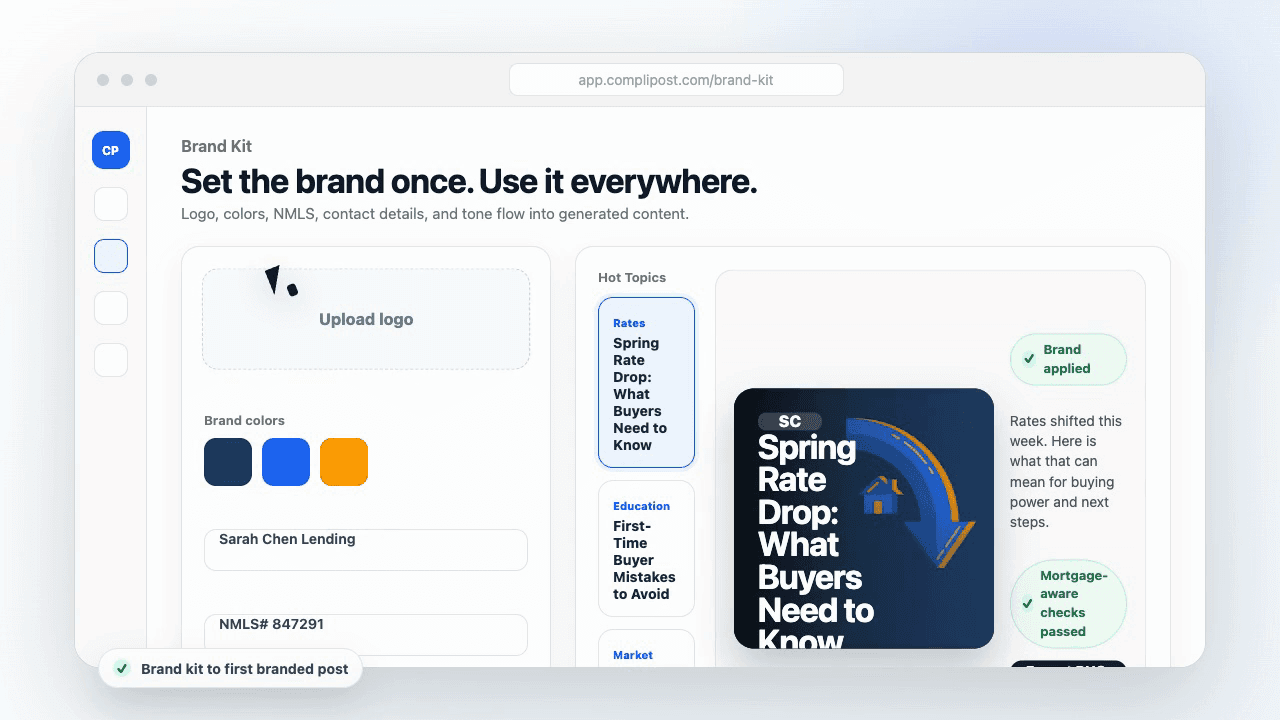
Product workflow
From blank page to export-ready mortgage content
- Start with a borrower topic
- Generate copy and a visual direction
- Review, save, and export the finished asset
These previews reflect the core CompliPost workflow: create, review, save, and export assets for use in your own channels.
Risky copy vs safer review direction
| Draft pattern | Why it needs review | Safer direction |
|---|---|---|
| Guaranteed lowest rate | Guarantee and superlative claim | Compare options carefully with a licensed professional |
| Save $500/month | Unsupported savings claim | Review refinance goals, costs, and break-even timing |
| No-cost loan | Potential fee and disclosure issue | Explain tradeoffs and confirm company-approved language |
| Act now before rates explode | Pressure and urgency language | Use calm market context and invite questions |
Who this guide helps
This guide is for loan officers working on solo loan officers who need a repeatable mortgage content workflow. The goal is to turn a broad mortgage topic into one borrower question, one useful takeaway, and one asset that can be reviewed before it is shared.
- You need content that sounds like a loan officer, not a generic brand account
- You want examples that can become captions, graphics, GIFs, or PDFs
- You need a clear place to review claims before export
- You want finished work saved for reuse, not lost in a chat thread
A practical workflow for this use case
Start with a narrow scenario, then move through planning, drafting, visual creation, review, and export. For fair lending compliance global borrowers, that means the topic should be specific enough that a borrower or referral partner can immediately understand what decision the content helps with.
- Choose the borrower type, loan topic, or platform before generating copy
- Draft the caption and visual together so the asset feels cohesive
- Use the federal baseline review aid to flag claims and disclosure gaps
- Export the finished asset and save the post as a reusable starting point
What makes the content stronger
Strong mortgage content is usually specific, plain-spoken, and calm. It explains tradeoffs without pretending one answer fits every borrower. That is especially important on public social channels, where a short post can be interpreted without the full context of a loan conversation.
- Name the borrower question in the first line
- Explain one decision or tradeoff instead of covering everything
- Use examples without implying approval, savings, or rate outcomes
- End with a soft next step, checklist, or guide rather than pressure
Compliance-aware review notes
CompliPost should be treated as a review aid, not a compliance approval system. The public page, generated draft, graphic, and exported asset should all stay honest about that boundary.
- Review specific payment, APR, rate, savings, and qualification language
- Avoid “best,” “lowest,” “guaranteed,” “free,” and urgency claims unless approved
- Check NMLS, Equal Housing, company, and state-specific requirements
- Use company or legal review for anything outside the federal baseline
How this connects to the rest of CompliPost
A focused guide should leave you with a usable next step. After you understand the topic, you can turn it into a calendar slot, a reviewed social post, a downloadable guide, or a platform-specific version for the channel where your audience already spends time.
- Use the content calendar to turn the idea into a weekly plan
- Use the compliance page when claims or disclosures need a slower pass
- Use lead magnets when the topic deserves a deeper PDF guide
- Use platform pages to adapt the same idea for LinkedIn, Facebook, or Instagram
Recommended next steps
Mortgage marketing compliance
Use a federal baseline review aid before exporting content.
Equal Housing and Fair Lending Compliance
Comprehensive guide to fair lending law and compliance requirements.
Mortgage Disclosures and Truth in Lending
Disclosure requirements and consumer protection compliance.
Cultural Communication Strategies
Ethical communication across language and cultural differences.
Examples
FAQ
Is it discrimination to ask a borrower about their visa status?+
Asking about visa status alone is not discriminatory if the purpose is to understand income documentation method (e.g., H-1B requires employer verification). Discrimination occurs if you use visa status to offer different terms, apply different criteria, or make assumptions about reliability. Intent and application matter. Ask objective lending questions; never ask based on curiosity about origin.
Can I offer different programs based on visa type?+
Yes, IF the program has objective underwriting criteria. For example, offering an 'H-1B specialization program' is fine if H-1B borrowers meet the same credit/income standards as other borrowers. Different program terms (rate, down payment) must be justified by objective factors, not visa type. Avoid programs that feel like separate-but-equal—they invite scrutiny.
What do I do if a colleague makes discriminatory comments about borrowers from different countries?+
Report it to management and/or compliance immediately. Silence enables discrimination. If you feel unsafe reporting internally, contact your regulator or fair lending hotline. Document what was said, when, and who said it. Discrimination is serious; protecting borrowers from it is your legal and moral obligation.
Is it discrimination if I require different documentation from borrowers based on national origin?+
Yes, if documentation requirements differ based on origin alone. BUT—requiring different documentation based on VISA TYPE or INCOME SOURCE is legitimate. Example: H-1B borrowers require employer verification (objective criteria based on visa type). International consultants may require client contracts (objective criteria based on income source). The reason must be lending-related, not origin-based.
How can I serve global borrowers fairly while mitigating lender risk?+
Use objective lending criteria applied equally to all borrowers: credit score, income documentation, down payment, debt-to-income ratio. If borrower doesn't meet criteria, deny based on criteria, not background. Higher risk (thin credit, new to U.S.) may require manual underwriting or co-signer, offered equally to all borrowers in that situation. Fairness and risk management are compatible.
Create mortgage content with a calmer workflow
CompliPost helps you plan, generate, review, save, and export useful mortgage content without pretending compliance or social distribution is automatic.
Start free