Global Borrower Series
Help Borrowers Understand Co-Signers and Co-Borrowers for Stronger Qualification
Some global borrowers qualify stronger with a co-signer or co-borrower (family member or spouse with better credit/income). Understanding the difference matters: a co-signer guarantees the loan but doesn't own the property; a co-borrower is on the title, the deed, and the loan. Help borrowers choose the right strategy for their situation.
Co-Signer vs. Co-Borrower: Key Differences
Co-signer: guarantees the loan, has no ownership stake, doesn't live in the property, is liable if borrower doesn't pay. Co-borrower: is on title and deed, owns the property, lives (typically) in the property, is equally liable. Co-signers are best for borrowers with thin credit; co-borrowers are best for couples or family buying together.
- Co-signer: guarantees loan, no ownership, no title stake, liable for payment if primary defaultsm
- Co-borrower: owns property, on title/deed, typically lives in property, equally liable
- Co-signer's income may count toward qualification; co-borrower's always counts
- Co-signer debt also counts toward primary borrower's debt-to-income ratio
- Lenders document co-signer liability differently than co-borrower ownership
When to Use a Co-Signer: Thin Credit, New to U.S.
Co-signer strategy works well for: borrowers with no U.S. credit history, very low credit scores, thin credit files. The co-signer (often a parent or sibling with strong U.S. credit) guarantees the loan. Lenders use co-signer's credit and income to offset primary borrower's weak credit. Co-signer must live in U.S. with valid SSN or strong credit profile.
- Co-signer works best for borrowers with no U.S. credit or credit score below 620
- Co-signer should have strong credit (700+) and stable income
- Typical co-signers: parents, siblings, spouse with better credit
- Co-signer must be willing to be liable if primary borrower defaults
- Down payment responsibility typically falls to primary borrower, not co-signer
When to Use a Co-Borrower: Couples, Family Buying Together
Co-borrower strategy works for: couples buying together (most common), family members buying investment property together, spouse with strong income/credit strengthening application. Both co-borrowers are on title and equally liable. This is cleaner legally than co-signer arrangement for couples.
- Co-borrower is best for married couples buying primary residence
- Co-borrower is best for family buying investment property together
- Both co-borrowers must meet income/credit standards (lenders use weaker profile)
- Both incomes count toward qualification; both debts count toward debt-to-income
- Ownership is clear and equal; simplifies refinance, sale, or estate planning
Impact on Liability, Ownership, and Future Refinancing
Co-signer has liability but no ownership. If primary borrower defaults, lender pursues co-signer. Co-signer can remove themselves from loan only if primary borrower refinances without them. Co-borrower has ownership and liability; both names are on title. Refinancing requires both to release equity or one to buy out the other.
- Co-signer liability lasts until primary borrower refinances them off
- Co-signer has no inheritance/ownership rights if primary borrower dies
- Co-borrower ownership is clear; both inherit if one dies (dependent on will)
- Refinancing: co-signer can be removed; co-borrower requires both signatures or buyout
- Future sale: co-signer irrelevant; both co-borrowers must agree to sale
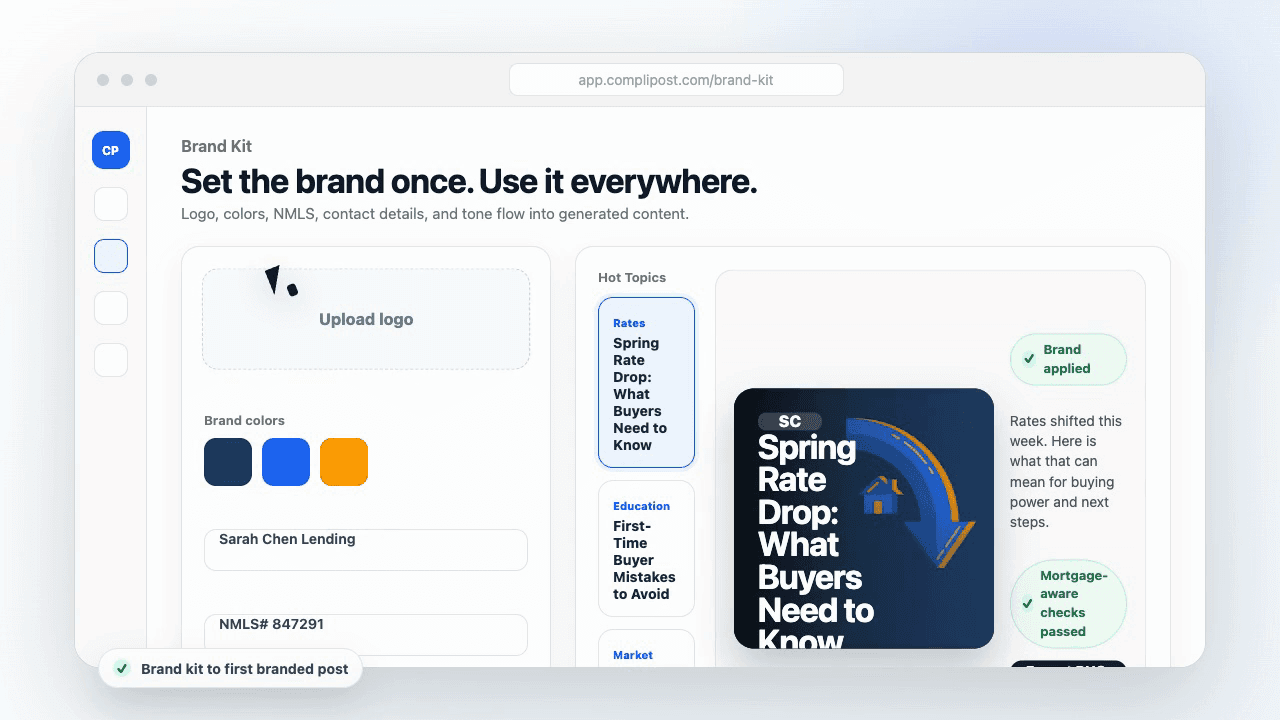
Product workflow
From blank page to export-ready mortgage content
- Start with a borrower topic
- Generate copy and a visual direction
- Review, save, and export the finished asset
These previews reflect the core CompliPost workflow: create, review, save, and export assets for use in your own channels.
Workflow comparison
| Content approach | What happens | Why it matters |
|---|---|---|
| Random posting | One-off ideas created when there is spare time | Inconsistent visibility and weak reuse |
| Template-only posting | Faster design but still requires rewriting and review | Helpful starting point, but not a full system |
| CompliPost workflow | Plan, generate, review, save, and export from one place | Better consistency with mortgage-aware review context |
| Done-for-you service | Someone else creates much of the content | Useful for some teams, but less control and less immediate reuse |
Who this guide helps
This guide is for loan officers working on solo loan officers who need a repeatable mortgage content workflow. The goal is to turn a broad mortgage topic into one borrower question, one useful takeaway, and one asset that can be reviewed before it is shared.
- You need content that sounds like a loan officer, not a generic brand account
- You want examples that can become captions, graphics, GIFs, or PDFs
- You need a clear place to review claims before export
- You want finished work saved for reuse, not lost in a chat thread
A practical workflow for this use case
Start with a narrow scenario, then move through planning, drafting, visual creation, review, and export. For co-signer co-borrower mortgage strategy, that means the topic should be specific enough that a borrower or referral partner can immediately understand what decision the content helps with.
- Choose the borrower type, loan topic, or platform before generating copy
- Draft the caption and visual together so the asset feels cohesive
- Use the federal baseline review aid to flag claims and disclosure gaps
- Export the finished asset and save the post as a reusable starting point
What makes the content stronger
Strong mortgage content is usually specific, plain-spoken, and calm. It explains tradeoffs without pretending one answer fits every borrower. That is especially important on public social channels, where a short post can be interpreted without the full context of a loan conversation.
- Name the borrower question in the first line
- Explain one decision or tradeoff instead of covering everything
- Use examples without implying approval, savings, or rate outcomes
- End with a soft next step, checklist, or guide rather than pressure
Compliance-aware review notes
CompliPost should be treated as a review aid, not a compliance approval system. The public page, generated draft, graphic, and exported asset should all stay honest about that boundary.
- Review specific payment, APR, rate, savings, and qualification language
- Avoid “best,” “lowest,” “guaranteed,” “free,” and urgency claims unless approved
- Check NMLS, Equal Housing, company, and state-specific requirements
- Use company or legal review for anything outside the federal baseline
How this connects to the rest of CompliPost
A focused guide should leave you with a usable next step. After you understand the topic, you can turn it into a calendar slot, a reviewed social post, a downloadable guide, or a platform-specific version for the channel where your audience already spends time.
- Use the content calendar to turn the idea into a weekly plan
- Use the compliance page when claims or disclosures need a slower pass
- Use lead magnets when the topic deserves a deeper PDF guide
- Use platform pages to adapt the same idea for LinkedIn, Facebook, or Instagram
Recommended next steps
Mortgage social media content
See the cross-platform content workflow for loan officers.
Co-Signer and Co-Borrower Mortgage Guide
Comprehensive guide covering legal and financial implications.
Spousal Credit and Income Differences
For couples with different credit profiles considering co-borrower structure.
Family Money and Down Payment
Guide to using family assistance strategically.
Examples
FAQ
If my parent is a co-signer, do they have to pay the mortgage if I can't?+
Yes. A co-signer is legally responsible for the loan. If you can't pay, the lender pursues the co-signer for full payment. Co-signer liability is serious. Make sure your parent understands they're on the hook for the full loan amount if you default. This is why trust matters—co-sign only for family you trust implicitly.
Can my parent co-sign if they live abroad?+
It depends on the lender. Most lenders prefer co-signers with U.S. credit history and presence. A parent abroad with no U.S. credit history may not help much. If your parent is a U.S. citizen or permanent resident with U.S. credit history, they can co-sign even if living abroad. Ask lenders upfront about their co-signer requirements.
Is my spouse my co-borrower or co-signer if we buy together?+
Your spouse is a co-borrower. Both of you are on the title and deed; both own the property. Both are equally liable for the mortgage. Co-borrower is the standard structure for married couples buying primary residences. Co-signer is unusual for spouses—co-borrower is cleaner legally.
Can I remove my co-signer later?+
Only if you refinance without them. When you refinance, the new loan is in your name alone (assuming you qualify). The original co-signer is released from liability. Co-signer cannot be removed from the original loan; you must refinance to release them. Plan ahead if you want co-signer removed eventually.
Does my co-signer's debt count toward my debt-to-income ratio?+
Yes. Lenders add co-signer's debts to your debts when calculating debt-to-income ratio. This can hurt qualification if co-signer carries high debt. If co-signer has existing loans, those payments count against your borrowing power. Consider this when choosing a co-signer—strong credit is important, but low debt is also valuable.
Create mortgage content with a calmer workflow
CompliPost helps you plan, generate, review, save, and export useful mortgage content without pretending compliance or social distribution is automatic.
Start free