Gig Economy Guide
Effective Record Keeping: Streamline Gig Work Documentation for Mortgage Prep
Loan officers, help gig workers navigate the path to mortgage qualification by emphasizing the importance of organized financial records. By teaching them how to maintain accurate documentation of their income, expenses, and tax records, you can aid in reducing delays during the underwriting process. Your guidance can empower gig workers to collect necessary documents like income statements, expense receipts, and tax returns, ensuring they are well-prepared to apply for a mortgage when the time is right. This proactive approach enhances their readiness and confidence in the mortgage application process.
Essential Financial Records for Gig Workers
Gig workers should maintain organized records across three main categories: income documentation, expense documentation, and tax records. Income documentation includes 1099 forms, platform earnings statements, and bank deposits. Expense records should cover all business-related receipts, such as those for fuel, supplies, and insurance. Tax records should include personal tax returns, Schedule C, and business profit and loss statements. Encouraging gig workers to use accounting software like QuickBooks or FreshBooks can help automate this process, making tax preparation and mortgage underwriting more efficient. gig worker record keeping caption angle: name one borrower decision, add one document cue, close.
- Income: 1099 forms, platform earnings, bank deposits
- Expenses: receipts for business-related costs
- Tax records: personal returns, Schedule C, P&L statements
- Organize digital and physical records systematically
- Use accounting software for efficient tracking
Organizing Records for Mortgage Success
Guide gig workers to create a dedicated "Mortgage Documents" folder. This folder should include the last two years of tax returns (1040) with Schedule C, recent bank statements, and a current-year P&L statement. Encourage them to list all income sources with corresponding 1099 forms. By maintaining and updating this folder quarterly, gig workers can ensure they have all necessary documents ready for a smoother underwriting process, reducing potential delays and confusion. gig worker record keeping borrower concern: explain what a lender may verify, why the step matters, and how a reader can prepare. gig.
- Establish a "Mortgage Documents" folder
- Include 2 years of tax returns and Schedule C
- Add recent bank statements and current-year P&L
- List all income sources with 1099 forms
- Update folder quarterly for readiness
Encouraging Proactive Organization
Promote record keeping as a valuable practice that extends beyond mortgage preparation. Organized records not only facilitate easier tax filing but also enhance financial decision-making. Offer gig workers a downloadable checklist or template to help them get started. By sharing stories of how organization reduces underwriting friction, you can motivate gig workers to begin organizing now, ensuring they are prepared when they decide to apply for a mortgage. gig worker record keeping compliance note: avoid exact terms, certainty language, and rushed decisions. gig worker record keeping works better as education when it explains a tradeoff and invites a specific question.
- Frame organization as smart business practice
- Highlight reduced stress and faster underwriting
- Offer checklists and templates for easy use
- Share real-life examples of benefits
- Emphasize improved tax preparation through tracking
Digital Tools for Record Management
Recommending the right digital tools can significantly aid gig workers in managing their records. Accounting software like QuickBooks, FreshBooks, or Wave can simplify the tracking of income and expenses. These tools facilitate the preparation of tax returns and provide clear records that support mortgage applications. Encourage gig workers to choose software that aligns with their business complexity and budget. Consistency in using these tools ensures their financial data remains organized and readily available. gig worker record keeping reuse plan: make one caption, one carousel point, one email follow-up, and one saved template. gig worker record keeping then supports social, partner, and nurture workflows.
- Choose software like QuickBooks, FreshBooks, or Wave
- Ensure compatibility with business needs
- Facilitate tax preparation with organized data
- Maintain consistency in record-keeping tools
- Enhance mortgage application support with clear records
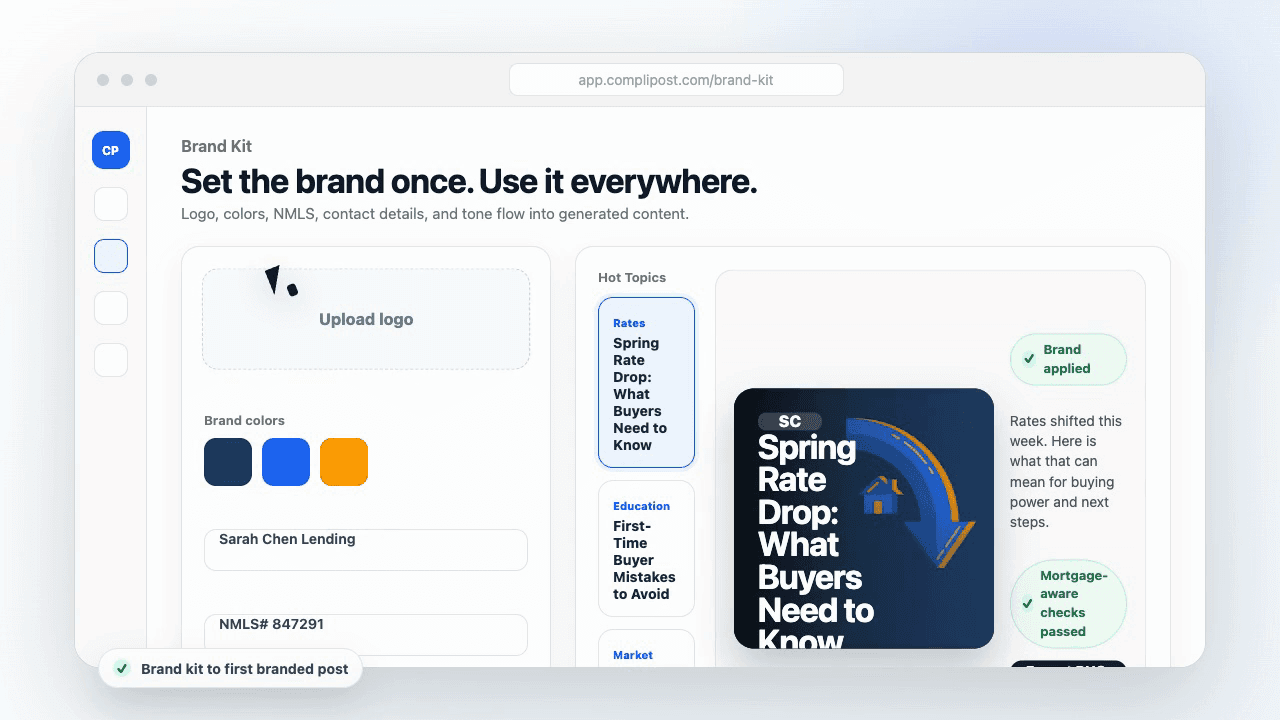
Product workflow
From blank page to export-ready mortgage content
- Start with a borrower topic
- Generate copy and a visual direction
- Review, save, and export the finished asset
These previews reflect the core CompliPost workflow: create, review, save, and export assets for use in your own channels.
Workflow comparison
| Content approach | What happens | Why it matters |
|---|---|---|
| Random posting | One-off ideas created when there is spare time | Inconsistent visibility and weak reuse |
| Template-only posting | Faster design but still requires rewriting and review | Helpful starting point, but not a full system |
| CompliPost workflow | Plan, generate, review, save, and export from one place | Better consistency with mortgage-aware review context |
| Done-for-you service | Someone else creates much of the content | Useful for some teams, but less control and less immediate reuse |
Who this guide helps
This guide is for loan officers working on solo loan officers who need a repeatable mortgage content workflow. The goal is to turn a broad mortgage topic into one borrower question, one useful takeaway, and one asset that can be reviewed before it is shared.
- You need content that sounds like a loan officer, not a generic brand account
- You want examples that can become captions, graphics, GIFs, or PDFs
- You need a clear place to review claims before export
- You want finished work saved for reuse, not lost in a chat thread
A practical workflow for this use case
Start with a narrow scenario, then move through planning, drafting, visual creation, review, and export. For gig worker record keeping, that means the topic should be specific enough that a borrower or referral partner can immediately understand what decision the content helps with.
- Choose the borrower type, loan topic, or platform before generating copy
- Draft the caption and visual together so the asset feels cohesive
- Use the federal baseline review aid to flag claims and disclosure gaps
- Export the finished asset and save the post as a reusable starting point
What makes the content stronger
Strong mortgage content is usually specific, plain-spoken, and calm. It explains tradeoffs without pretending one answer fits every borrower. That is especially important on public social channels, where a short post can be interpreted without the full context of a loan conversation.
- Name the borrower question in the first line
- Explain one decision or tradeoff instead of covering everything
- Use examples without implying approval, savings, or rate outcomes
- End with a soft next step, checklist, or guide rather than pressure
Compliance-aware review notes
CompliPost should be treated as a review aid, not a compliance approval system. The public page, generated draft, graphic, and exported asset should all stay honest about that boundary.
- Review specific payment, APR, rate, savings, and qualification language
- Avoid “best,” “lowest,” “guaranteed,” “free,” and urgency claims unless approved
- Check NMLS, Equal Housing, company, and state-specific requirements
- Use company or legal review for anything outside the federal baseline
How this connects to the rest of CompliPost
A focused guide should leave you with a usable next step. After you understand the topic, you can turn it into a calendar slot, a reviewed social post, a downloadable guide, or a platform-specific version for the channel where your audience already spends time.
- Use the content calendar to turn the idea into a weekly plan
- Use the compliance page when claims or disclosures need a slower pass
- Use lead magnets when the topic deserves a deeper PDF guide
- Use platform pages to adapt the same idea for LinkedIn, Facebook, or Instagram
Recommended next steps
Self-employed borrower hub
Create income-documentation education for self-employed borrowers.
Mortgage content calendar
Plan a weekly rhythm of useful borrower and referral-partner posts.
Documenting 1099 Income for Mortgage Qualification
Learn what documents lenders will request from your organized records.
Calendar generator
Turn one mortgage topic into a practical weekly content plan.
Examples
FAQ
What accounting software should a gig worker use to stay organized?+
Accounting software like QuickBooks, FreshBooks, or Wave is recommended for gig workers. These platforms simplify income and expense tracking, aiding in efficient tax preparation and supporting mortgage applications. Choose based on your business complexity and budget. The practical move is to keep the answer educational, mention that details vary by borrower profile and lender guidelines, and invite the reader to ask for a personal review instead of implying a certain result.
How far back should I keep receipts and expense records?+
Retain business records for 3-7 years, as required by the IRS. Mortgage underwriting typically needs 2 years of tax returns. Keep receipts for all business expenses claimed on the last 2 tax returns, with digital copies accepted. The practical move is to keep the answer educational, mention that details vary by borrower profile and lender guidelines, and invite the reader to ask for a personal review instead of implying a certain result.
Is a year-to-date P&L statement really necessary if I have my tax returns?+
A year-to-date P&L statement is beneficial, especially if applying mid-year. It shows current income and can expedite underwriting by demonstrating income growth, reducing the need for updated documents. The practical move is to keep the answer educational, mention that details vary by borrower profile and lender guidelines, and invite the reader to ask for a personal review instead of implying a certain result.
What if I have multiple income sources from different platforms—how should I organize those?+
Organize income from various platforms using separate sections in accounting software or spreadsheets. Ensure each source is reflected in your Schedule C. This clarity prevents underwriter confusion and aids in mortgage processing. The practical move is to keep the answer educational, mention that details vary by borrower profile and lender guidelines, and invite the reader to ask for a personal review instead of implying a certain result.
Create mortgage content with a calmer workflow
CompliPost helps you plan, generate, review, save, and export useful mortgage content without pretending compliance or social distribution is automatic.
Start free