Self-Employment & Income
Self-Employed Mortgage Guide: FHA vs. Conventional Income Documentation
Self-employed borrowers face additional documentation requirements on both FHA and conventional loans, but the programs differ significantly in how they verify income, calculate qualifying income, and handle business tax write-offs. FHA can be more straightforward, but conventional offers flexibility in income types and averaging methods. Understanding these nuances helps you guide self-employed clients confidently toward the right program and prepare them for what lenders will ask.
Income documentation requirements for self-employed borrowers
Both FHA and conventional require self-employed borrowers to provide 2 years of personal tax returns (1040s) and 2 years of business tax returns (Schedule C for sole proprietors, K-1 for partnerships, corporate returns for S-corps). Most lenders also request profit-and-loss statements (P&Ls) for the current year (since taxes may not be filed yet) and bank statements to verify income deposits. Conventional loans may allow more flexibility in income averaging and may consider business assets as qualifying income under certain circumstances. FHA requires documented income from tax returns and recent income verification but generally takes a more conservative approach to income calculation.
- Both programs require 2 years of personal tax returns (1040s)
- Both require 2 years of business tax returns (Schedule C, K-1, or corporate returns)
- Most lenders request current-year P&Ls and 2-3 months of business bank statements
- FHA takes a more conservative income calculation approach
- Conventional may allow more flexibility in averaging and income type documentation
How business tax deductions affect qualifying income
Self-employed income is typically calculated by taking net profit from tax returns (revenue minus legitimate business expenses). The challenge: if a borrower has significant business deductions—home office, vehicle, equipment depreciation—their net profit appears lower, reducing qualifying income. FHA typically uses the net profit line from Schedule C without adjustment. Conventional lenders may allow add-backs for certain non-cash expenses (depreciation, home office deductions) if they can be clearly documented and justified. This means a self-employed borrower might qualify for a larger loan amount with conventional financing if depreciation or other deductions are material. Plan ahead: discuss business structure and tax strategy with borrowers early.
- Qualifying income = net profit from Schedule C (revenue minus all documented expenses)
- Deductions reduce net profit and therefore reduce qualifying income
- FHA typically uses the Schedule C net profit without adjustment for deductions
- Conventional may allow add-backs for non-cash expenses like depreciation
- Business structure (sole prop vs. S-corp) affects tax deductions and qualifying income
Income stability requirements and payment history
Both FHA and conventional require self-employed borrowers to demonstrate 2+ years in the same business or field. A recent business startup (under 2 years) typically disqualifies self-employed income on both programs unless the borrower recently left W-2 employment and has documented income history in the same field. Lenders examine profit trend: consistent or increasing income is preferable to declining income. FHA may be slightly more flexible on declining income if other factors (credit, down payment, employment history) are strong. Conventional lenders require stronger income stability and typically expect consistent or upward profit trends. If income is volatile or declining, either program becomes tougher to qualify for.
- Both programs require 2+ years self-employment history
- Recent business startups don't qualify unless prior W-2 income in same field
- Income trend matters: consistent or increasing income is strong; declining is risky
- FHA may be slightly more flexible on volatile income if other factors are solid
- Conventional requires stronger income stability and upward/flat trends
Which program for self-employed: FHA or conventional?
FHA works well for self-employed borrowers with steady income, strong credit, and solid down payment because the process is relatively straightforward—submit tax returns and P&Ls, and qualify based on net profit. Conventional is better if you have high business deductions (depreciation, home office) that you want to add back, or if your income is growing and you want flexibility in averaging. Consider also: FHA mortgage insurance is fixed and lasts the life of the loan (or 11+ years depending on down payment); conventional MI can be removed once you reach 20% equity. For a self-employed borrower with modest income, conventional MI removal potential might offer long-term savings. Discuss both pathways and run scenarios.
- FHA: good for steady self-employed income, straightforward documentation
- Conventional: better if deductions are high and you want add-back flexibility
- Conventional MI is removable; FHA MI is often permanent on lower down payments
- FHA requires lower credit scores; conventional may reward stronger credit with better rates
- Run qualifying scenarios for both programs before recommending one
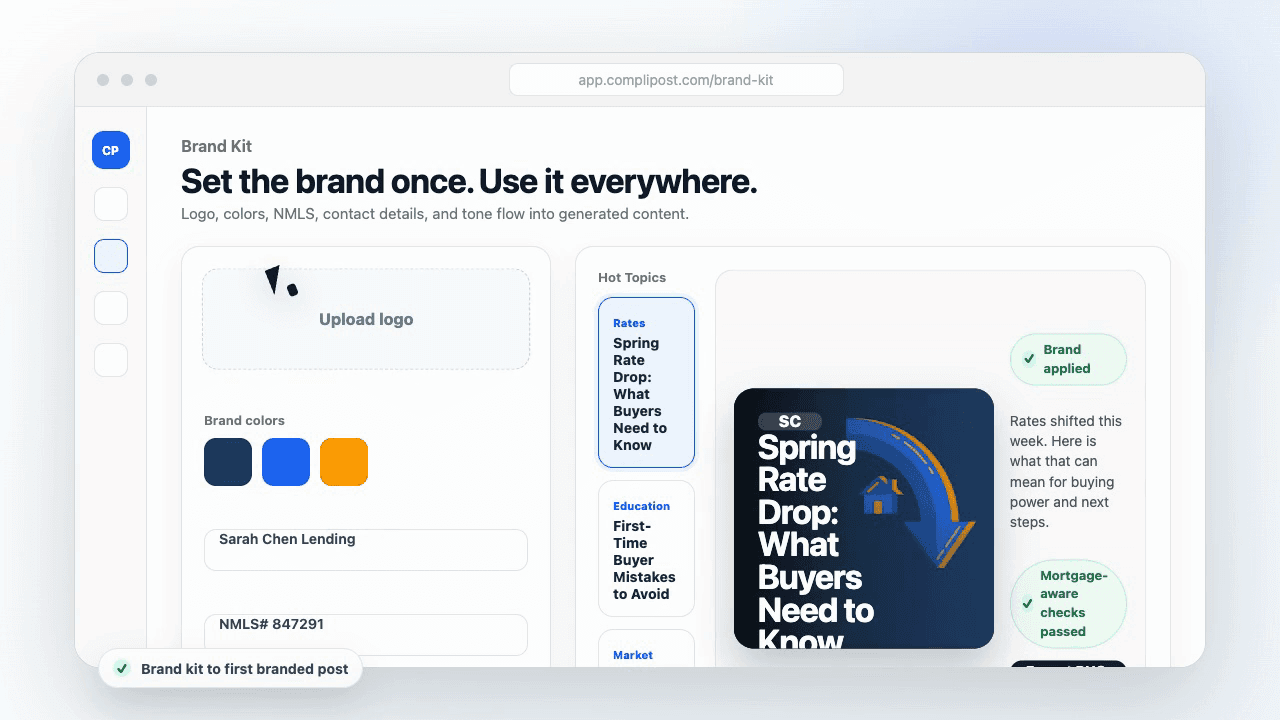
Product workflow
From blank page to export-ready mortgage content
- Start with a borrower topic
- Generate copy and a visual direction
- Review, save, and export the finished asset
These previews reflect the core CompliPost workflow: create, review, save, and export assets for use in your own channels.
Workflow comparison
| Content approach | What happens | Why it matters |
|---|---|---|
| Random posting | One-off ideas created when there is spare time | Inconsistent visibility and weak reuse |
| Template-only posting | Faster design but still requires rewriting and review | Helpful starting point, but not a full system |
| CompliPost workflow | Plan, generate, review, save, and export from one place | Better consistency with mortgage-aware review context |
| Done-for-you service | Someone else creates much of the content | Useful for some teams, but less control and less immediate reuse |
Who this guide helps
This guide is for loan officers working on solo loan officers who need a repeatable mortgage content workflow. The goal is to turn a broad mortgage topic into one borrower question, one useful takeaway, and one asset that can be reviewed before it is shared.
- You need content that sounds like a loan officer, not a generic brand account
- You want examples that can become captions, graphics, GIFs, or PDFs
- You need a clear place to review claims before export
- You want finished work saved for reuse, not lost in a chat thread
A practical workflow for this use case
Start with a narrow scenario, then move through planning, drafting, visual creation, review, and export. For self-employed FHA vs conventional mortgage, that means the topic should be specific enough that a borrower or referral partner can immediately understand what decision the content helps with.
- Choose the borrower type, loan topic, or platform before generating copy
- Draft the caption and visual together so the asset feels cohesive
- Use the federal baseline review aid to flag claims and disclosure gaps
- Export the finished asset and save the post as a reusable starting point
What makes the content stronger
Strong mortgage content is usually specific, plain-spoken, and calm. It explains tradeoffs without pretending one answer fits every borrower. That is especially important on public social channels, where a short post can be interpreted without the full context of a loan conversation.
- Name the borrower question in the first line
- Explain one decision or tradeoff instead of covering everything
- Use examples without implying approval, savings, or rate outcomes
- End with a soft next step, checklist, or guide rather than pressure
Compliance-aware review notes
CompliPost should be treated as a review aid, not a compliance approval system. The public page, generated draft, graphic, and exported asset should all stay honest about that boundary.
- Review specific payment, APR, rate, savings, and qualification language
- Avoid “best,” “lowest,” “guaranteed,” “free,” and urgency claims unless approved
- Check NMLS, Equal Housing, company, and state-specific requirements
- Use company or legal review for anything outside the federal baseline
How this connects to the rest of CompliPost
A focused guide should leave you with a usable next step. After you understand the topic, you can turn it into a calendar slot, a reviewed social post, a downloadable guide, or a platform-specific version for the channel where your audience already spends time.
- Use the content calendar to turn the idea into a weekly plan
- Use the compliance page when claims or disclosures need a slower pass
- Use lead magnets when the topic deserves a deeper PDF guide
- Use platform pages to adapt the same idea for LinkedIn, Facebook, or Instagram
Recommended next steps
FHA loan content hub
Create FHA loan explainers and buyer guidance.
FHA vs. Conventional Explained Simply
Fundamentals of both programs and their eligibility requirements.
FHA vs. Conventional: Debt-to-Income Limits & Income Calculation
How income is weighted and how DTI limits affect self-employed borrowers.
FHA vs. Conventional: Credit Score & Financial Stability Requirements
What scores and financial history each program requires.
Examples
FAQ
Do I need 2 years of self-employment history to qualify for a mortgage?+
Generally yes, for both FHA and conventional. Lenders want to see 2 full years of self-employment income documented via tax returns. However, if you recently transitioned from W-2 employment to self-employment in the same field, you may be able to combine the employment history—for example, 1 year of self-employment plus 1 year of W-2 income in the same role. Startups with less than 2 years of history will not qualify on self-employment income alone and may need to rely on alternative income sources or wait until the 2-year mark.
Can I use projected income or income I haven't made yet?+
No. Lenders will only count documented, historical income from tax returns and recent P&Ls. Projected income, contracts for future work, or bonuses you expect to receive cannot be counted unless they have a documented 2-year history. The exception: if you have a signed, multi-year contract with a large client and have been receiving similar consistent payments, a lender might consider averaging that income, but it still requires documentation. Build your income history first, then apply for mortgage financing.
Will my business deductions hurt my mortgage qualification?+
Yes, they will reduce your qualifying income because lenders base approval on net profit (after deductions). However, this is a one-time impact—you're not penalized twice. Conventional lenders may allow you to add back non-cash deductions like depreciation, which increases your qualifying income. FHA typically uses your Schedule C net profit as-is. The takeaway: if you have significant depreciation or home office deductions, ask a lender about conventional add-back options, which could increase your approval odds or loan amount.
What if my business income declined last year?+
Both FHA and conventional will review the income trend carefully. A one-time dip with a reasonable explanation (market downturn, medical leave, transition period) might be acceptable if current-year income is recovering. Consistent year-over-year decline suggests instability and will reduce your qualifying income—lenders may average the 2 years or use only the most recent year, depending on the trend. If you're recovering from a difficult year, gather documentation showing the reason for the dip and evidence of current recovery. This conversation should happen early so you understand how lenders will view your income.
Do I need to provide business bank statements in addition to tax returns?+
Yes, most lenders will request 2-3 months of recent business bank statements to verify that income deposits are actually reaching your account and to assess cash flow. These statements also help lenders verify that income claimed on tax returns is consistent with deposits shown. Bank statements don't have to match perfectly (invoices may be paid late, expenses may vary by month), but they should generally support the income amounts claimed. Having clean, organized bank records makes underwriting faster and easier.
Create mortgage content with a calmer workflow
CompliPost helps you plan, generate, review, save, and export useful mortgage content without pretending compliance or social distribution is automatic.
Start free