Family buying
Content for setting limits in family buying scenarios
When you post about when to say no to family buying content, the goal is to help loan officers helping families recognize when support may create too much risk or confusion speak clearly and stay inside approved guardrails. This rewrite frames the page for the LO's marketing work: what to teach, what to avoid, and what to turn into captions. The reader should be able to take one section and publish a careful post, then use the examples as a starting point for a carousel, email, or lead magnet. The page gives them concrete anchors like debt exposure, unclear repayment plans, and file documentation gaps, plus a compliance lens around ECOA and UDAAP. It is built for a relative who wants to help but may need permission to pause and review the consequences.
Make debt exposure the first teaching point
Sometimes the helpful answer is pause first is the opening answer for when to say no to family buying content. organize around debt exposure with a relative who wants to help but may need permission to pause and review the consequences, because debt exposure makes this page useful before that reader asks for a quote or verdict. next connect unclear repayment plans to property facts, and close by naming file documentation gaps as the verification point. A when to say no to family buying content page lets the loan officer turn debt exposure into a short email that teaches unclear repayment plans, avoids vague motivation, and gives a relative who wants to help but may need permission to pause and review the consequences a practical reason to keep reading.
Write for a relative who wants to help but may
A family no can still be loving and practical gives when to say no to family buying content its audience filter. map from the copy around loan officers helping families recognize when support may create too much risk or confusion, not around a generic borrower persona. For this subject, show how unclear repayment plans changes the question for a relative who wants to help but may need permission to pause and review the consequences. from there add file documentation gaps as a checkpoint and explain debt exposure in one plain sentence. That mix keeps when to say no to family buying content respectful, specific, and easy for an LO to adapt into a Facebook caption while staying with the mortgage decision at hand.
Turn the topic into post-ready angles
If the role is unclear, slow the mortgage conversation down. For when to say no to family buying content, turn that hook into a sequence: define file documentation gaps, list what to gather for debt exposure, explain how unclear repayment plans changes the answer, and close with boundaries belong in the buying plan too. The talking-point list version should sound like a real post for a relative who wants to help but may need permission to pause and review the consequences. Add one line about ECOA and UDAAP so the CTA stays measured. Reuse family buying when to say no as an email subject, carousel title, or saved caption label when the LO wants a second format.
Keep the compliance guardrail visible
ECOA and UDAAP governs when to say no to family buying content. The review question is this caution: do not decide for the family or discourage protected applicants. In a post for a relative who wants to help but may need permission to pause and review the consequences, say debt exposure is educational, unclear repayment plans is variable, and file documentation gaps needs documentation or file context. Use the CompliPost compliance checklist to check certainty, audience labels, and trigger terms. If a line sounds broader than when to say no to family buying content, narrow it to sometimes the helpful answer is pause first. That keeps the CTA specific and the guidance measurable for family buying when to say no.
Product workflow
From blank page to export-ready mortgage content
- Start with a borrower topic
- Generate copy and a visual direction
- Review, save, and export the finished asset
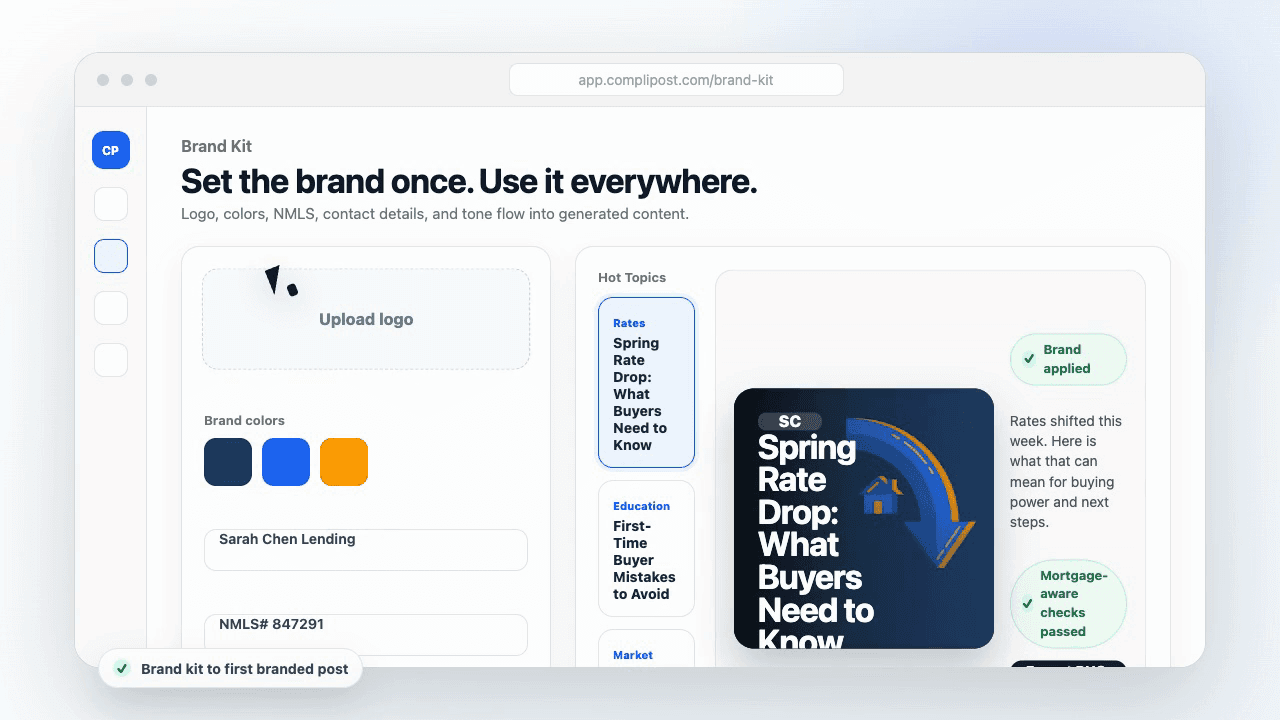
These previews reflect the core CompliPost workflow: create, review, save, and export assets for use in your own channels.
Workflow comparison
| Content approach | What happens | Why it matters |
|---|---|---|
| Random posting | One-off ideas created when there is spare time | Inconsistent visibility and weak reuse |
| Template-only posting | Faster design but still requires rewriting and review | Helpful starting point, but not a full system |
| CompliPost workflow | Plan, generate, review, save, and export from one place | Better consistency with mortgage-aware review context |
| Done-for-you service | Someone else creates much of the content | Useful for some teams, but less control and less immediate reuse |
Who this guide helps
This guide is for loan officers working on solo loan officers who need a repeatable mortgage content workflow. The goal is to turn a broad mortgage topic into one borrower question, one useful takeaway, and one asset that can be reviewed before it is shared.
- You need content that sounds like a loan officer, not a generic brand account
- You want examples that can become captions, graphics, GIFs, or PDFs
- You need a clear place to review claims before export
- You want finished work saved for reuse, not lost in a chat thread
A practical workflow for this use case
Start with a narrow scenario, then move through planning, drafting, visual creation, review, and export. For when to say no family buying content for loan officers, that means the topic should be specific enough that a borrower or referral partner can immediately understand what decision the content helps with.
- Choose the borrower type, loan topic, or platform before generating copy
- Draft the caption and visual together so the asset feels cohesive
- Use the federal baseline review aid to flag claims and disclosure gaps
- Export the finished asset and save the post as a reusable starting point
What makes the content stronger
Strong mortgage content is usually specific, plain-spoken, and calm. It explains tradeoffs without pretending one answer fits every borrower. That is especially important on public social channels, where a short post can be interpreted without the full context of a loan conversation.
- Name the borrower question in the first line
- Explain one decision or tradeoff instead of covering everything
- Use examples without implying approval, savings, or rate outcomes
- End with a soft next step, checklist, or guide rather than pressure
Compliance-aware review notes
CompliPost should be treated as a review aid, not a compliance approval system. The public page, generated draft, graphic, and exported asset should all stay honest about that boundary.
- Review specific payment, APR, rate, savings, and qualification language
- Avoid “best,” “lowest,” “guaranteed,” “free,” and urgency claims unless approved
- Check NMLS, Equal Housing, company, and state-specific requirements
- Use company or legal review for anything outside the federal baseline
How this connects to the rest of CompliPost
A focused guide should leave you with a usable next step. After you understand the topic, you can turn it into a calendar slot, a reviewed social post, a downloadable guide, or a platform-specific version for the channel where your audience already spends time.
- Use the content calendar to turn the idea into a weekly plan
- Use the compliance page when claims or disclosures need a slower pass
- Use lead magnets when the topic deserves a deeper PDF guide
- Use platform pages to adapt the same idea for LinkedIn, Facebook, or Instagram
Recommended next steps
Examples
FAQ
How can LOs post about saying no respectfully?+
A loan officer should connect debt exposure to the reader's next practical decision. Explain what the concept means, why unclear repayment plans may affect the answer, and when file-specific review is needed. That gives useful education without turning a public caption into one-size-fits-all advice.
What warning signs fit a family buying caption?+
A loan officer should connect unclear repayment plans to the reader's next practical decision. Explain what the concept means, why file documentation gaps may affect the answer, and when file-specific review is needed. That gives useful education without turning a public caption into one-size-fits-all advice.
Can LOs discourage someone from co-borrowing?+
A loan officer should connect file documentation gaps to the reader's next practical decision. Explain what the concept means, why debt exposure may affect the answer, and when file-specific review is needed. That gives useful education without turning a public caption into one-size-fits-all advice.
What softer CTA works for this topic?+
A loan officer should connect debt exposure to the reader's next practical decision. Explain what the concept means, why unclear repayment plans may affect the answer, and when file-specific review is needed. That gives useful education without turning a public caption into one-size-fits-all advice.
Create mortgage content with a calmer workflow
CompliPost helps you plan, generate, review, save, and export useful mortgage content without pretending compliance or social distribution is automatic.
Start free