Financing options guide
Navigating Construction, Bridge, and Permanent Loan Options
As a mortgage loan officer, understanding the nuances of construction loans, bridge loans, and permanent mortgages is vital for providing comprehensive guidance to your clients. This detailed guide equips you with the knowledge to differentiate these financing options, allowing you to offer tailored solutions based on specific borrower needs and scenarios. Learn how construction loans can facilitate new builds, bridge loans manage transitions between properties, and permanent mortgages provide long-term solutions. Empower your clients by sharing insights that help them make informed decisions in their home financing journey.
Construction Loans: Building from the Ground Up
Construction loans are designed to finance the building of a new home or significant renovations. These loans provide funds incrementally to cover construction costs as work progresses. Typically, a construction loan is short-term, often spanning 12 to 18 months. During this period, borrowers usually make interest-only payments. Upon completion of the construction, the loan is converted into a permanent mortgage, which covers the long-term financing needs of the borrower. For loan officers, understanding the construction loan process is crucial in guiding clients through the complexities of building a new home, ensuring they are well-prepared for each stage of the process.
Bridge Loans: Facilitating Smooth Transitions
Bridge loans offer a short-term financial solution for clients looking to purchase a new home before selling their current property. These loans are typically structured to last between 6 to 12 months, providing the necessary funds to secure a new home while waiting for the sale of the existing one. The primary advantage of bridge loans is their ability to bridge the gap in timing, allowing clients to avoid the pressure of immediate sales or compromising on purchase opportunities. Loan officers should be prepared to explain the potential risks and benefits of bridge loans, helping clients navigate the transition with confidence and foresight.
Permanent Mortgages: Securing Long-Term Stability
Permanent mortgages are the end-goal financing solution for homeowners, providing long-term stability and predictable payment structures. These loans are used to refinance construction loans or bridge loans, or to finance the purchase of an existing home. Permanent mortgages are characterized by fixed or adjustable interest rates, with terms typically ranging from 15 to 30 years. Loan officers must be adept at matching clients with the right permanent mortgage product, taking into consideration factors such as interest rates, loan terms, and the borrower’s financial situation. By doing so, they can ensure that clients find a sustainable and manageable financing solution.
Key Considerations for Loan Officers
When advising clients on construction loans, bridge loans, or permanent mortgages, it is essential to consider their unique financial circumstances, timelines, and goals. Loan officers should be prepared to discuss the intricacies of each loan type, including qualification criteria, repayment terms, and potential risks. Additionally, staying informed about industry regulations, such as the Truth in Lending Act (TILA), is crucial for maintaining compliance and ensuring transparent communication with clients. By providing thorough and accurate information, loan officers can help clients make informed decisions that align with their homeownership aspirations.
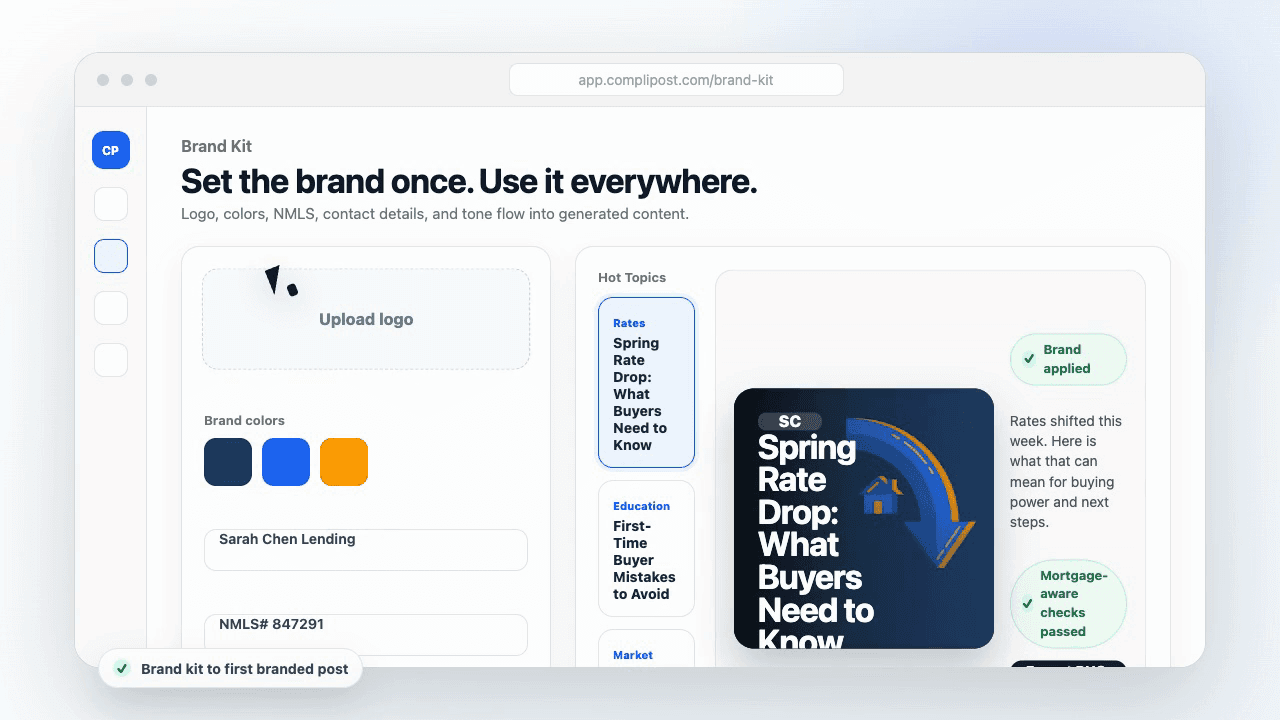
Product workflow
From blank page to export-ready mortgage content
- Start with a borrower topic
- Generate copy and a visual direction
- Review, save, and export the finished asset
These previews reflect the core CompliPost workflow: create, review, save, and export assets for use in your own channels.
Workflow comparison
| Content approach | What happens | Why it matters |
|---|---|---|
| Random posting | One-off ideas created when there is spare time | Inconsistent visibility and weak reuse |
| Template-only posting | Faster design but still requires rewriting and review | Helpful starting point, but not a full system |
| CompliPost workflow | Plan, generate, review, save, and export from one place | Better consistency with mortgage-aware review context |
| Done-for-you service | Someone else creates much of the content | Useful for some teams, but less control and less immediate reuse |
Who this guide helps
This guide is for loan officers working on solo loan officers who need a repeatable mortgage content workflow. The goal is to turn a broad mortgage topic into one borrower question, one useful takeaway, and one asset that can be reviewed before it is shared.
- You need content that sounds like a loan officer, not a generic brand account
- You want examples that can become captions, graphics, GIFs, or PDFs
- You need a clear place to review claims before export
- You want finished work saved for reuse, not lost in a chat thread
A practical workflow for this use case
Start with a narrow scenario, then move through planning, drafting, visual creation, review, and export. For construction loan vs mortgage bridge, that means the topic should be specific enough that a borrower or referral partner can immediately understand what decision the content helps with.
- Choose the borrower type, loan topic, or platform before generating copy
- Draft the caption and visual together so the asset feels cohesive
- Use the federal baseline review aid to flag claims and disclosure gaps
- Export the finished asset and save the post as a reusable starting point
What makes the content stronger
Strong mortgage content is usually specific, plain-spoken, and calm. It explains tradeoffs without pretending one answer fits every borrower. That is especially important on public social channels, where a short post can be interpreted without the full context of a loan conversation.
- Name the borrower question in the first line
- Explain one decision or tradeoff instead of covering everything
- Use examples without implying approval, savings, or rate outcomes
- End with a soft next step, checklist, or guide rather than pressure
Compliance-aware review notes
CompliPost should be treated as a review aid, not a compliance approval system. The public page, generated draft, graphic, and exported asset should all stay honest about that boundary.
- Review specific payment, APR, rate, savings, and qualification language
- Avoid “best,” “lowest,” “guaranteed,” “free,” and urgency claims unless approved
- Check NMLS, Equal Housing, company, and state-specific requirements
- Use company or legal review for anything outside the federal baseline
How this connects to the rest of CompliPost
A focused guide should leave you with a usable next step. After you understand the topic, you can turn it into a calendar slot, a reviewed social post, a downloadable guide, or a platform-specific version for the channel where your audience already spends time.
- Use the content calendar to turn the idea into a weekly plan
- Use the compliance page when claims or disclosures need a slower pass
- Use lead magnets when the topic deserves a deeper PDF guide
- Use platform pages to adapt the same idea for LinkedIn, Facebook, or Instagram
Recommended next steps
Mortgage social media content
See the cross-platform content workflow for loan officers.
Mortgage content calendar
Plan a weekly rhythm of useful borrower and referral-partner posts.
Mortgage marketing compliance
Review mortgage social content for common federal-baseline risk signals.
Investment property guide
Builder strategies.
Examples
FAQ
What is the primary use of a construction loan?+
Construction loans are primarily used to fund the building of a new home or significant renovations. They provide financing in stages as construction progresses, ensuring that the builder receives funds at key milestones. Understanding this process helps loan officers guide clients effectively through their building projects.
How does a bridge loan work?+
A bridge loan offers short-term financing to help clients purchase a new home before selling their current one. It provides funds for the down payment on the new property and is repaid once the existing home is sold. This loan type bridges the financial gap, allowing for a smoother transition between homes.
When should a client opt for a permanent mortgage?+
Clients should consider a permanent mortgage when they need long-term financing for their home purchase or refinance. These loans offer stability with fixed or adjustable rates over extended terms, making them ideal for securing a steady repayment plan post-construction or bridge loan. The practical move is to keep the answer educational, mention that details vary by borrower profile and lender guidelines, and invite the reader to ask for a personal review instead of implying a certain result.
What compliance factors should loan officers consider?+
Loan officers must be aware of compliance factors such as the Truth in Lending Act (TILA), which requires transparent disclosure of credit terms and costs. Ensuring compliance helps maintain trust and protects both the client and the loan officer from potential legal issues. The practical move is to keep the answer educational, mention that details vary by borrower profile and lender guidelines, and invite the reader to ask for a personal review instead of implying a certain result.
Create mortgage content with a calmer workflow
CompliPost helps you plan, generate, review, save, and export useful mortgage content without pretending compliance or social distribution is automatic.
Start free