Specialist marketing
Construction loan officer content that makes complexity your competitive advantage
Construction lending is complicated enough that most loan officers avoid it — which means the ones who master it and explain it clearly own a virtually uncontested niche. Construction loan specialist content works by turning process complexity into trust: every explanation of draw schedules, builder approval, and conversion timelines is something a generalist cannot offer.
Why construction loan specialists who explain the process win the niche
Construction loans confuse borrowers, real estate agents, and even some builders. The two-close vs. one-time-close structure, draw schedules tied to inspection milestones, contingency reserves, and the conversion to a permanent loan at completion — all of it is unfamiliar territory for buyers who have only ever purchased existing homes. A construction loan specialist who consistently explains how the process actually works — in plain language, without burying the detail — becomes the go-to lender for anyone entering the new-build space. Builders refer borrowers to loan officers who make their buyers less anxious. Real estate agents who work new-build communities want a lending partner who can handle the complexity without creating problems. Content that demonstrates that expertise, published consistently, builds those referral relationships before a single phone call.
- One-time-close vs. two-close construction loans: what each means for the buyer's cost and risk
- Draw schedules: how funds are released, who inspects each phase, and what delays can look like
- Builder approval: why lenders approve builders and what it means if the builder isn't approved
- Contingency reserves: what they are and why they exist in construction loan structures
Content angles that are unique to construction lending
Construction loan content has subject matter that simply does not exist in a standard purchase or refinance workflow. Land acquisition and lot loans, the timeline between contract and first draw, managing interest-only construction payments, and the final inspection-to-conversion moment — these are content topics that serve a specific audience and have almost no competition. The closing-to-content repurposing pattern is particularly valuable here: a construction loan closing involves a buyer who navigated months of build milestones, inspections, and timeline uncertainty. That journey — with identifying details removed — becomes a multi-part educational series about what building a home actually looks like from the lending side. That content does not exist anywhere else because no one else lived it the way a construction loan specialist did.
- Land loans vs. construction loans: what's different and why the sequence matters
- Interest-only construction phase: how payments work before the home is finished
- The conversion conversation: what happens at the end of construction and what borrowers should prepare for
- Working with a custom builder vs. a production builder: how the lending process differs
Builder and developer referral content strategy
Construction loan specialists build most of their volume through builder and developer relationships, not direct-to-consumer marketing. Content strategy for this specialist type has two audiences: buyers who are considering building, and the builders and agents who will refer them. Buyer-facing content demystifies the process and reduces the anxiety that causes buyers to hesitate or abandon their build. Builder-facing content — posted on LinkedIn, in local real estate association groups, and in builder forums — demonstrates lender sophistication and reliability. The loan officer who posts about managing buyer expectations through the inspection-and-draw cycle is the one a builder trusts to keep the transaction from falling apart at a milestone.
Compliance notes for construction loan content
Construction loan content has specific compliance exposure points that a federal-baseline review aid is designed to help surface. The most common: overstating timeline certainty ("close in 90 days" as a promise, not an estimate), implying builder approval is routine when it involves underwriting the builder's track record, and presenting interest-only payment examples with specific figures that trigger TILA disclosure obligations. The practical guidance: frame timelines as typical rather than guaranteed, present draw structures as educational rather than contractual, and route any content involving payment figures through your compliance review before export.
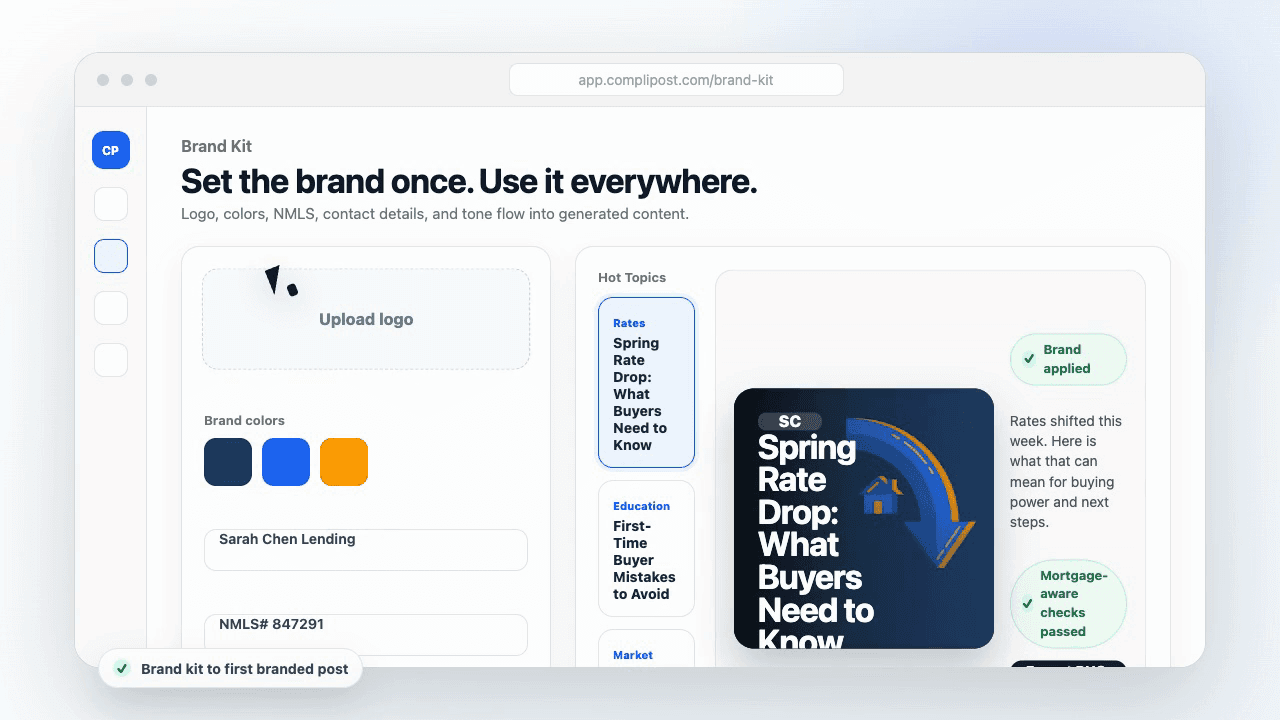
Product workflow
From blank page to export-ready mortgage content
- Start with a borrower topic
- Generate copy and a visual direction
- Review, save, and export the finished asset
These previews reflect the core CompliPost workflow: create, review, save, and export assets for use in your own channels.
Workflow comparison
| Content approach | What happens | Why it matters |
|---|---|---|
| Random posting | One-off ideas created when there is spare time | Inconsistent visibility and weak reuse |
| Template-only posting | Faster design but still requires rewriting and review | Helpful starting point, but not a full system |
| CompliPost workflow | Plan, generate, review, save, and export from one place | Better consistency with mortgage-aware review context |
| Done-for-you service | Someone else creates much of the content | Useful for some teams, but less control and less immediate reuse |
Who this guide helps
This guide is for loan officers working on solo loan officers who need a repeatable mortgage content workflow. The goal is to turn a broad mortgage topic into one borrower question, one useful takeaway, and one asset that can be reviewed before it is shared.
- You need content that sounds like a loan officer, not a generic brand account
- You want examples that can become captions, graphics, GIFs, or PDFs
- You need a clear place to review claims before export
- You want finished work saved for reuse, not lost in a chat thread
A practical workflow for this use case
Start with a narrow scenario, then move through planning, drafting, visual creation, review, and export. For construction loan officer content, that means the topic should be specific enough that a borrower or referral partner can immediately understand what decision the content helps with.
- Choose the borrower type, loan topic, or platform before generating copy
- Draft the caption and visual together so the asset feels cohesive
- Use the federal baseline review aid to flag claims and disclosure gaps
- Export the finished asset and save the post as a reusable starting point
What makes the content stronger
Strong mortgage content is usually specific, plain-spoken, and calm. It explains tradeoffs without pretending one answer fits every borrower. That is especially important on public social channels, where a short post can be interpreted without the full context of a loan conversation.
- Name the borrower question in the first line
- Explain one decision or tradeoff instead of covering everything
- Use examples without implying approval, savings, or rate outcomes
- End with a soft next step, checklist, or guide rather than pressure
Compliance-aware review notes
CompliPost should be treated as a review aid, not a compliance approval system. The public page, generated draft, graphic, and exported asset should all stay honest about that boundary.
- Review specific payment, APR, rate, savings, and qualification language
- Avoid “best,” “lowest,” “guaranteed,” “free,” and urgency claims unless approved
- Check NMLS, Equal Housing, company, and state-specific requirements
- Use company or legal review for anything outside the federal baseline
How this connects to the rest of CompliPost
A focused guide should leave you with a usable next step. After you understand the topic, you can turn it into a calendar slot, a reviewed social post, a downloadable guide, or a platform-specific version for the channel where your audience already spends time.
- Use the content calendar to turn the idea into a weekly plan
- Use the compliance page when claims or disclosures need a slower pass
- Use lead magnets when the topic deserves a deeper PDF guide
- Use platform pages to adapt the same idea for LinkedIn, Facebook, or Instagram
Recommended next steps
Mortgage social media content
See the cross-platform content workflow for loan officers.
New construction loan social media content
Post ideas and angles specific to new-construction loan products.
Renovation loan social media content
Content strategy for loan officers who work with renovation and rehab financing.
Loan officer niche marketing
Why construction lending specialists who own their niche outperform generalists.
Examples
FAQ
What social media content works best for construction loan specialists?+
Process education content that demystifies the construction loan timeline. Draw schedules, builder approval, one-time-close vs. two-close structure, and the conversion from construction to permanent financing are all topics with almost no good plain-language content online. A construction loan specialist who explains these consistently becomes the trusted resource for buyers, agents, and builders navigating new construction.
How is construction loan specialist content different from new-construction loan content?+
New-construction loan content is about the financing product — what terms look like, what the loan covers, how it works. Construction loan specialist content is about the loan officer's positioning and expertise — demonstrating deep process knowledge, building builder referral relationships through content, and creating the reputation that makes buyers and builders want to work with this specific lender.
What platforms work best for construction loan officer content?+
LinkedIn for builder, developer, and real estate agent referral relationships. Instagram for buyer-facing process education, especially carousel formats that walk through the construction timeline step by step. Facebook Groups for local builder and real estate professional communities. The construction niche is small enough that consistent presence in the right professional networks — not broad reach — generates the most referral quality.
What compliance risks should construction loan officers watch in their content?+
Timeline and payment certainty are the main risks — presenting typical timelines as guarantees, and using specific payment examples that trigger TILA trigger-term requirements. CompliPost's federal-baseline review aid is designed to flag these risk signals in construction loan content before export. Your compliance team and company policy govern final approval.
Does CompliPost help with construction loan specialist content creation?+
Yes. CompliPost helps construction loan specialists create, save, and export branded content across the education angles that define this niche — process explainers, draw schedule graphics, builder-partner posts, and buyer reassurance content. The federal-baseline review aid surfaces risk signals before export. You post from your preferred platform.
Create mortgage content with a calmer workflow
CompliPost helps you plan, generate, review, save, and export useful mortgage content without pretending compliance or social distribution is automatic.
Start free